



Outlook • March 16, 2026
Long-Term Rates at the Farm Gate Likely to Stay Elevated


Report Snapshot
Situation
Inflation expectations, a higher neutral monetary policy rate, and an elevated term premium are keeping long-term Treasury yields — a good benchmark for long-term rates at the farm gate — from declining meaningfully.
Outlook
U.S. interest rates in 2026 are likely to be defined by a steepening of the yield curve as gradual easing in short-term policy rates is met with persistently elevated long-term yields.
Finding
A resilient labor market, higher inflation expectations, and sustained fiscal deficits are limiting how far long-term borrowing costs can fall even if the Federal Reserve moves to lower short-term policy rates.
Impact
A gradual easing in short-term rates implies modest savings on short-term and variable-rate loans for farmers. However, the long-term rate outlook favors discipline over leverage. In a higher-for-longer rate environment, balance sheet strength, liquidity and targeted investment are likely to outperform aggressive, debt-driven growth strategies at the farm level.
The most likely path for U.S. interest rates in 2026 is a slow, deliberate easing of short-term rates, while long-term rates remain relatively sticky and resistant to a sharp decline.
Although inflation has eased considerably since its 2022 peak, it has proven stubborn at around 3%, reflecting the continued convergence of wage growth and prices. At the same time, real economic activity remains resilient. Policy uncertainty — from tariffs to fiscal deficits — adds another layer of complexity, keeping term premiums elevated for longer-dated securities. (Term premiums are the extra compensation investors demand for holding long-dated bonds rather than rolling over short-term securities.)
As the Federal Reserve slowly lowers interest rates, the difference between short- and long-term rates is increasing. For producers, falling short-term rates may lower the cost of seasonal operating loans for inputs like seed and fertilizer, but persistently high long-term rates keep borrowing costs elevated for assets like land and equipment. This dynamic can also impact refinancing opportunities and can also weigh on farmland values and expansion plans.
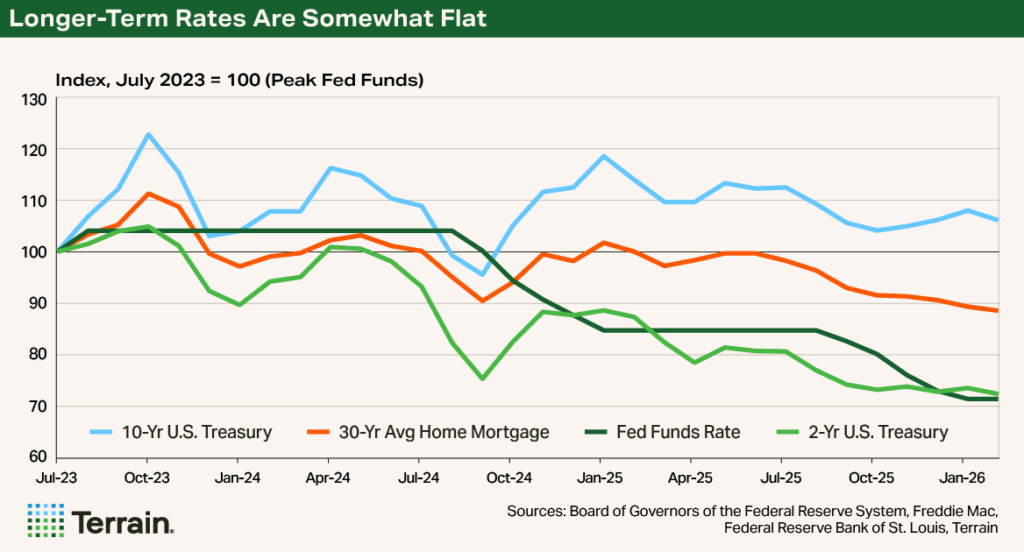
Short-Term Rates Likely to Fall Slightly
Since reaching a recent high of 5.5% in July 2023, the Federal Reserve has cut its short-term policy rate by 1.75 percentage points to a new range of 3.5% to 3.75%; however, over the same period the 10-year U.S. Treasury has increased about 0.2%. So far, the Fed has justified cuts to the short-term policy rate due to a slight softening in the labor market and a desire to slow inflation toward the central bank’s stated goal of 2%.
The labor market weakened slightly throughout 2025, reaching a high in the unemployment rate of 4.5% in November. Since November, there have been signs of stabilization in unemployment claims and modest job growth. As a result, the unemployment rate declined slightly to start 2026. At this point, it is best to think of the labor market as rate neutral: neither arguing for aggressive cuts nor changing the pace of gradual cuts.
Inflation has remained stickier. For example, the Personal Consumption Expenditures (PCE) Index has accelerated since mid-2025 after a prolonged period of declines. The Consumer Price Index (CPI) has been more favorable, indicating modest declines over the past 12 months, though still above the Fed’s 2% goal. The stickiness of inflation also argues for a cautious easing of short-term policy rates.
Therefore, the most likely scenario is a gradual, slow easing of the short-term policy rate to about 3% by the end of 2026, which would be near the average rate from 1990 through 2019. For farmers, this implies modest savings on short-term and variable-rate loans.
Long-Term Rates Likely to Remain Sticky
Ten-year Treasury yields, a good benchmark for long-term rates at the farm gate, remain elevated because the current macroeconomic backdrop does not justify a return to the ultra low-rate environment that followed the 2008 financial crisis. From January 2008 through 2019, the 10-year Treasury averaged just 2.58%, or about 1.6% lower than current rates. I believe that the macroeconomic backdrop will prevent the 10-year Treasury from declining to these low rates for three reasons:
- Continued income growth
- Higher expectations for future inflation and rate levels
- U.S. government debt measures
First, a labor market that continues to generate income growth suggests people still have the ability and willingness to spend. When demand is firm, inflation — particularly in labor-intensive service sectors — tends to prove sticky. That dynamic increases the likelihood that inflation settles above pre-pandemic norms, even if it continues to cool gradually. Long-term yields adjust to that risk by embedding a higher expected average inflation rate over the next decade.
Second, long-term rates also reflect the financial market’s assessment of the economy’s long-run “neutral” policy rate. A resilient labor market implies that neutral may be structurally higher than it was in the 2010s. If the economy can sustain solid employment without tipping into recession, investors infer that the Fed does not need to return its policy rates anywhere near zero. That repricing lifts borrowing costs across the economy and keeps long-term financing rates elevated for longer.
Third, as the federal government becomes more indebted, it must issue increasing amounts of Treasury securities, expanding the supply of government debt that markets must absorb. The growing U.S. federal debt burden is therefore becoming increasingly relevant for long-term interest rates and, by extension, for U.S. agriculture.
Total federal debt now exceeds $38.6 trillion, and the federal government is currently running an annual deficit of roughly $1.8 trillion, or about 6% of GDP. According to the Congressional Budget Office, annual deficits are projected to rise above $3.1 trillion by 2036.
Put simply, in 2026 the federal government is spending about $106 for every $100 the economy produces. Historically, financial markets have been more comfortable when deficits are closer to 3% of GDP — a level generally viewed as consistent with stabilizing the debt burden relative to the size of the economy. One stated objective of the administration’s “3-3-3 plan” is to move in that direction by reducing the deficit to 3% of GDP while targeting 3% real GDP growth and increasing domestic oil production by 3 million barrels per day.
The challenge with running deficits near 6% of GDP during a period of steady growth is that the Treasury must continuously issue large volumes of bonds to fund the gap. Greater supply typically requires higher yields to attract buyers. Moreover, U.S. debt is increasingly being absorbed by private domestic investors, who demand higher returns, pushing domestic ownership to levels not seen in more than 20 years. This helps explain why the 10-year Treasury yield has remained elevated despite moderating inflation. Higher long-term yields ripple through the economy, influencing mortgage rates, corporate borrowing costs and equity valuations.
Until deficits move materially closer to 3% of GDP, upward pressure on long-term interest rates is likely to remain a structural feature of the macroeconomic backdrop.
Reducing the deficit from roughly 6% of GDP to 3% would require closing a budget gap of about $1.2 trillion per year, on average, over the next decade at current baseline GDP levels. That adjustment could come through spending restraint, higher revenues or faster economic growth. But growth alone would need to accelerate meaningfully and remain well above trend to close the gap without fiscal changes. Through 2030, nominal GDP would need to average around 19% growth for the deficit-to-GDP ratio to fall to 3%.
In short, until deficits move materially closer to 3% of GDP, upward pressure on long-term interest rates is likely to remain a structural feature of the macroeconomic backdrop.
Even if the Fed moves to ease policy, heavy Treasury issuance can keep longer-term yields elevated.
For the Fed, this environment presents a policy complication — particularly as new leadership is expected sometime in 2026 following congressional approval. Even if the Fed moves to ease policy, heavy Treasury issuance can keep longer-term yields elevated, effectively doing some of the tightening for the Fed and limiting how accommodative monetary policy can ultimately become.
How Much Do These Factors Impact Long-Term Rates?
My analysis of the 10-year Treasury yield, using quarterly data dating back to 1992, reinforces the view that movements with long-term rates are driven more by expectations and risk premiums than by macroeconomic data alone. Inflation expectations remain a dominant driver, while the two-year Treasury yield — capturing market expectations for the future path of monetary policy — continues to exert a powerful influence on long-term rates.
At the same time, shifts in the term premium play a central role. They reflect uncertainty around inflation, growth and future policy as well as changes in risk appetite and bond supply.
Notably, year-over-year S&P 500 returns also emerge as a statistically meaningful factor over this long sample. Strong equity returns tend to coincide with higher long-term Treasury yields, consistent with periods of robust risk appetite, stronger growth expectations, and reduced demand for safe-haven assets. Conversely, weaker equity performance is often associated with lower long-term yields as investors rotate toward Treasuries.
For 2025, the model produced an implied 10-year Treasury yield of 4.22%, closely matching the actual average yield of 4.29%.
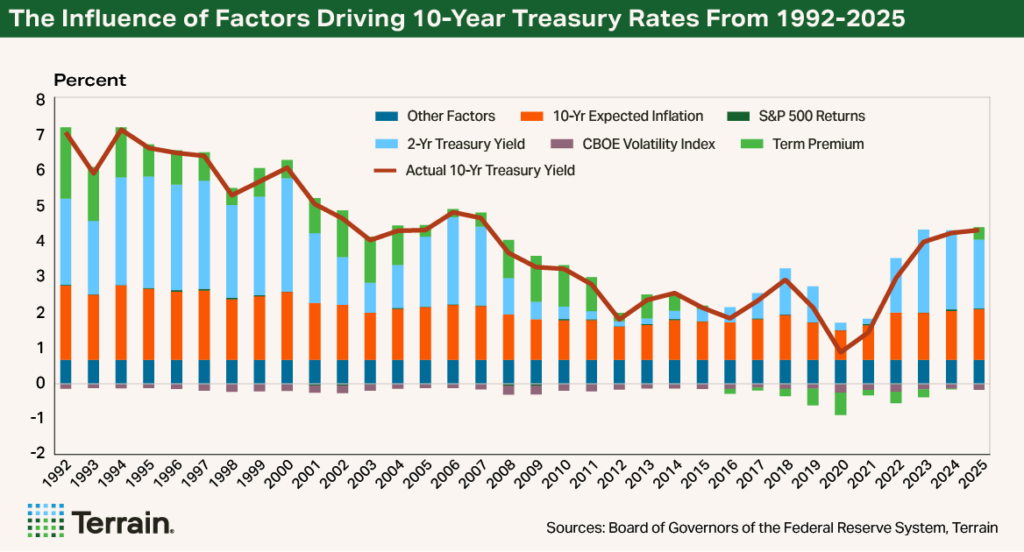
Importantly, rising government deficits can feed directly into the term premium channel by increasing Treasury issuance and the amount of long-dated debt that private investors must absorb. Even if deficits do not directly lift inflation expectations, sustained fiscal expansion can push long-term yields higher by increasing the compensation investors require to hold government bonds — particularly when balance sheet capacity or foreign demand is constrained.
Risk sentiment also matters. Periods of elevated market volatility tend to pull yields lower through safe-haven demand — that is, more investors looking for safe, less risky investments.
Unless there is a structural change in the macroeconomic backdrop, long-term rates are likely to remain elevated despite U.S. monetary policy action.
Taken together, these dynamics suggest that long-term yields are driven less by realized economic data and more by the interaction of expectations, heavy Treasury issuance, and how markets price risk. It is important to understand that this analysis is not designed to isolate single-variable causality, but rather to provide a framework for understanding how expectations, financial conditions, and risk pricing interact to shape long-term interest rates.
In short, the current factors weighing on long-term Treasury rates are significant drivers. Therefore, unless there is a structural change in the macroeconomic backdrop, long-term rates are likely to remain elevated despite U.S. monetary policy action.
This environment argues for U.S. farmers to undertake disciplined balance sheet management rather than aggressive expansion.
Implications at the Farm Gate
This environment argues for U.S. farmers to undertake disciplined balance sheet management rather than aggressive expansion. Disciplined balance sheet management can look like:
1. Prioritizing liquidity and working capital. Higher interest expense increases the importance of cash flow discipline, making it prudent to stress-test budgets using conservative price assumptions.
2. Where feasible, locking in fixed rates on term debt to help reduce exposure to further rate volatility. For producers who have been on the sidelines considering refinancing, 2026 may provide an opportunity to engage lenders and evaluate available options.
3. Making only selective capital expenditures focused on improving efficiency, reducing per-unit costs, or enhancing yield stability. In a higher-rate environment, projects must clear a higher return threshold to justify additional debt.
Risk management also takes on added importance. Forward contracting, hedging strategies and crop insurance can help protect margins in an environment where both input costs and financing costs are less forgiving.
At the same time, resilient consumer demand supported by a firm labor market continues to underpin food consumption. The goal, therefore, is not retrenchment but disciplined positioning. In the current environment, balance sheet strength, cost control and margin protection are likely to outperform highly leveraged growth strategies.



Terrain content is an exclusive offering of AgCountry Farm Credit Services,
American AgCredit, Farm Credit Services of America and Frontier Farm Credit.