Outlook • September 10, 2026
Pre-Harvest Outlook: Fewer Bushels, Brighter Demand



Report Snapshot
Situation
The Pro Farmer Crop Tour supported evidence that corn yields will fall below trend in 2026. Across much of the corn belt, variability, weather stress and lower ear counts limited yield potential. Soybeans remain more uncertain, with late-season weather still capable of determining whether yields finish below trend or challenge records.
Outlook
As harvest approaches, market attention is shifting from production potential toward demand. For corn, a smaller crop paired with resilient exports and domestic use could keep prices well supported. Beyond the U.S. harvest, South American production prospects for corn and soybeans will likely become the primary focus.
Corn and soybeans are nearing the finish line, and the Pro Farmer Crop Tour in mid-August reinforced what we and markets have predicted: There is likely less corn production than previously assumed, but there is potential yet for soybean production.
Tour Highlights
The tour (which Bree scouted for a second year in a row), provided a detailed look at the current state of the corn and soybean crop across select parts of seven major Midwestern states.
Though disease issues were not as prevalent this year, persistent drought in the western corn belt will likely prevent Nebraska and South Dakota from repeating 2025’s record corn yields. And excessive moisture in the eastern corn belt could prompt the USDA to reduce its state yield forecasts in future supply reports for corn and/or soybeans in Illinois and Indiana. Weather for the remainder of the growing season will ultimately determine final corn and soybean yields.
The tour estimated the national average corn yield at 173.2 bu./ac., with production at 15.344 billion bushels (BBU) — about 670 million bushels (MBU) below the USDA’s August World Agricultural Supply Demand Estimates (WASDE).
While we disagree with the magnitude of the national yield estimate, the tour confirmed what the USDA already suggested in its August forecast: below-trend yields for corn.
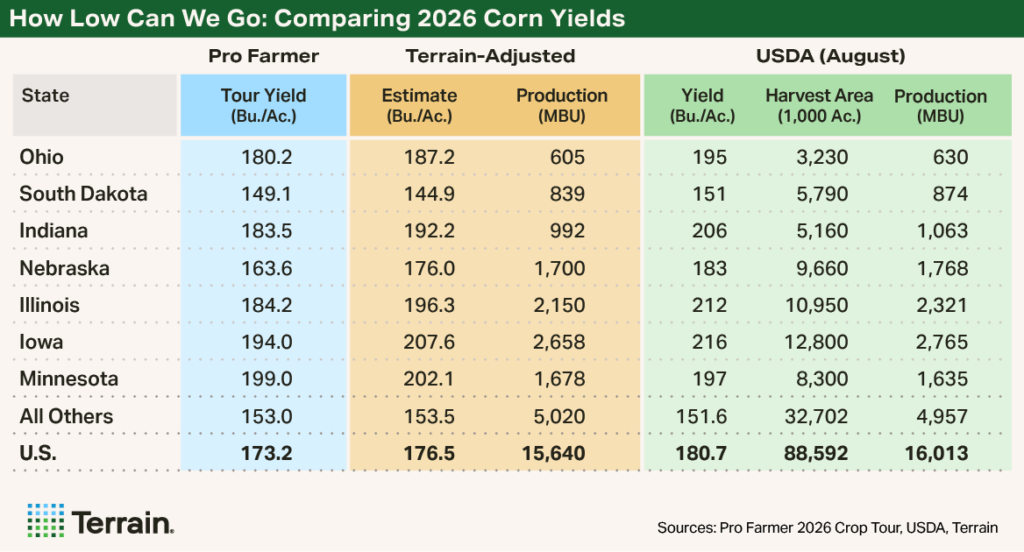
Terrain’s analysis of Crop Tour estimates compared with the USDA’s official final yields over the past 10 years suggests an average yield closer to 176.5 bu./ac. If realized, this would imply production at about 15.64 BBU, just 375 MBU shy of the USDA forecast in August.
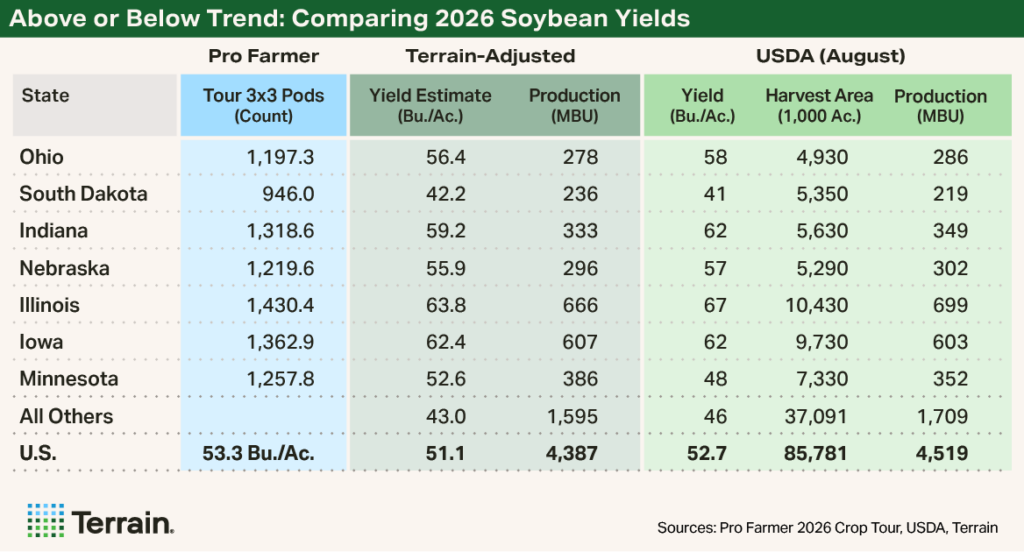
For soybeans, the tour estimated the national average yield at 53.3 bu./ac., with total U.S. production at 4.572 BBU (53 MBU above the USDA). Terrain’s analysis of the Crop Tour data suggests a U.S. average yield of approximately 51.1 bu./ac., or about 4.386 MBU (133 MBU less than the USDA forecast in August).
Despite the USDA’s report in August for higher planted and harvested corn acres, the market outlook for corn has shifted from large supply and another year of strong consumption to one that is focused on balancing consumption against a smaller supply number. Higher prices are left to do that work.
For soybeans, the USDA revised both planted and harvested acres higher in August. When combined with the prospects for yields on either side of trend, supply estimates remain in an adequate position so far.
Pricing the Yield Debate
Corn
- If the Pro Farmer yields were realized, and export demand remains strong in the new crop year, stocks-to-use would continue to tighten. If stocks-to-use were to hit 8%, Terrain forecasts average corn prices of $6/bu.
- Even with a higher yield potential at 176.5 bu./ac., prices are still supported in the mid-$5/bu. range.
- If yield is closer to 180 bu./ac., Terrain forecasts average farm prices in the lower-$5/bu. range.
- Currently markets appear to be pricing in a yield in the range of 179-182 bu./ac. ahead of the USDA’s September WASDE report. Keep in mind, December corn futures are up over $1/bu. since the most recent low in early June.
Soybeans
- Record yields of 53.3 bu./ac. estimated by Pro Farmer correspond to average farm prices between $11/bu. and $11.50/bu. at current forecast demand levels.
- Yields closer to Terrain’s forecast at 51.1 bu./ac. correspond to higher average farm prices around $12.25/bu.
- Current market prices appear more in line with an average yield between 51 bu./ac. and 52 bu./ac., as new-crop futures are in the $13/bu. range.
- Keep in mind, new-crop futures for the November contract are up nearly $2.50/bu. since the start of the year, so paying close attention to trade relations with China is critical as geopolitical risk remains.
Corn Yield: Story Between the Rows
For corn, the dominant theme from scouts on the tour was variability. A cool spring slowed emergence, a wet June limited development, and a hot, dry July created pollination stress. The crop looks respectable but lacks trend-line yield potential. Fields often looked exceptional from the road, but in-field inspections repeatedly found lower-than-expected ear counts, pollination problems, tip back, shorter grain length and uneven stands.
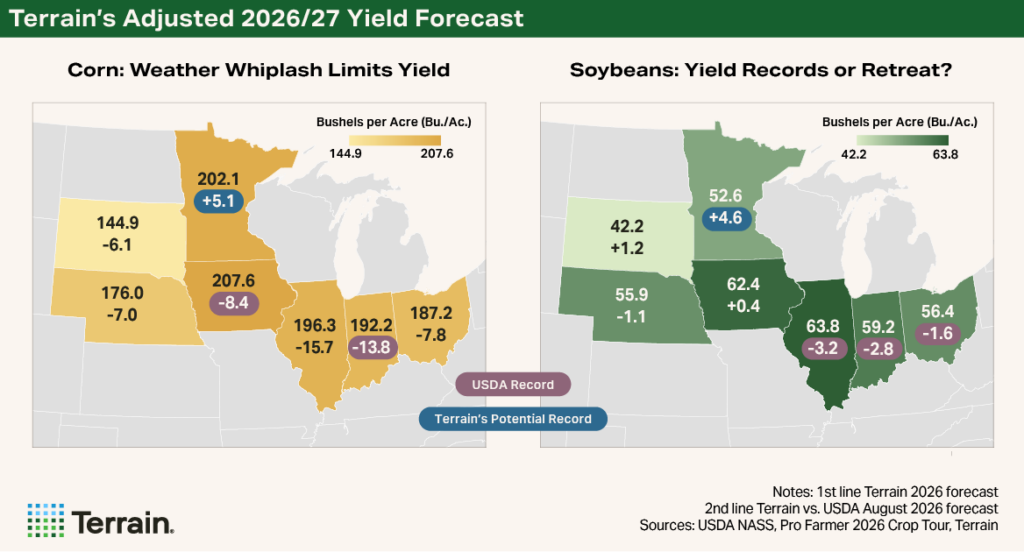
While the USDA’s August forecast estimated record yields in Iowa and Indiana, excessive moisture led to nitrogen loss, hurting yield potential in the eastern corn belt. The opposite was true for the western corn belt — heat and drought reduced yield potential. Minnesota was the only state Pro Farmer estimated with higher yield potential than the USDA’s August forecast.
Soybean Yield: Promise Still in the Pod
For soybeans, the jury is still out on final yields. For 2025, the USDA reported record yields in the west (Iowa, Minnesota and Nebraska), with the reverse forecast for the east in 2026. Illinois, Indiana and Ohio are expected to have record yields according to the USDA, but Pro Farmer estimated declines across the region due to the similar set of issues impacting corn yields. Pro Farmer estimates South Dakota, Minnesota and Iowa to have better potential than the USDA’s August forecast, with Nebraska the lone exception due to the lack of moisture in July.
Several global wild cards are in play again this year, leaving the door open for strong corn exports in the new crop year.
The World May Need More U.S. Corn
Both the USDA and Pro Farmer Crop Tour estimating reduced supply for corn raises an important question: Will consumption decline in the new crop year as a result of the lower supplies and higher prices?
As the prior Terrain outlooks noted, corn demand shows no signs of slowing. Corn exports for the 2025/26 marketing year were regularly revised higher as they continued to exceed the USDA’s expectations. Several global wild cards are in play again this year, leaving the door open for strong corn exports in the new crop year:
- The European Union’s smallest corn crop in over two decades.
- The Russia-Ukraine conflict, which continues to reduce both countries’ ability to export corn and/or wheat.
- Logistics constraints on the Strait of Hormuz, which reduce global fertilizer and crude oil supplies and have the potential to reduce foreign exportable supplies.
- Growing concerns about a super El Niño reducing Brazil and China production.
The U.S.-China meeting at the end of September will be an important event to watch, as the outcome could influence price direction. The market continues to await additional agricultural purchases to meet the $17 billion in non-soybean sales that the White House said China has agreed to, which has the potential to include corn, wheat and sorghum.
For soybeans, record domestic crush continues to be a bright spot for demand.
Soybeans Caught Between Crush and China
For soybeans, record domestic crush continues to be a bright spot for demand, with additional capacity coming on line in the new crop year. The EPA recently announced additional small refiner exemptions, paired with a statement to propose a reallocation for the portion of exemptions that exceeded the prior forecast level by the end of October. Finalizing these reallocations will be important to sustain soybean oil prices and crush margins at current levels.
Finalizing the stated reallocation will be key to achieving the USDA’s forecast of domestic crush rising 5% year over year (YOY) to 2.78 BBU (accounting for over 60% of consumption) in 2026/27. Additionally, global crush is also forecast to be record large, with global ending stocks tightening as we head into the new crop year.
However, risk to both the upside and downside is much higher for soybeans, as the USDA has forecast record global imports in 2026/27, with China accounting for 95% of the increase YOY.
As with corn, pay close attention to trade relations with China (and its domestic soybean demand indicators such as domestic pork sector profitability, state reserve auctions and purchase activity). China's imports of U.S. soybeans will ultimately determine if the USDA’s forecast is achievable, if the U.S. is able to regain lost export market share, and whether soybean prices will be higher through harvest and beyond in 2026/27.
What These Estimates Mean for Farmers
The Pro Farmer Crop Tour provides greater evidence that corn trend-line yields will likely not be achieved as we head into harvest. However, record yield potential is still in play for soybeans. Weather here at the end of the growing season will have the ultimate say.
We forecast price gains to more than offset lower yields, on average, even with elevated diesel costs at harvest.
The USDA will update the new-crop balance sheet in the September WASDE report after its own in-field measurements. Watch the markets when that report is published September 11.
If yields are lower, seasonal harvest pressure may be shorter-lived, with basis opportunities in regions with tighter supplies, particularly in the western corn belt. Average operating margins for many corn and soybean growers would likely be better than what was expected just a few months ago, as we forecast price gains to more than offset lower yields, on average, even with elevated diesel costs at harvest. The quarterly Grain Stocks report on September 30 will also influence new-crop beginning supplies and future price direction.
Prices after harvest will depend on the balance of the South American crop, domestic consumption and exports amid ongoing geopolitical events.
Terrain content is an exclusive offering of AgCountry Farm Credit Services, American AgCredit,
Capital Farm Credit, Farm Credit Services of America and Frontier Farm Credit.