



Outlook • March 17, 2026
U.S. Soybeans Have an Opportunity at Home
Article Originally Published in the X edition of South Dakota Soybean Leader magazine


Report Snapshot
Situation
The U.S. soybean market is facing export headwinds from China and Brazil. On the positive side, the USDA forecasts stronger domestic demand for 2025/26.
Finding
In the past few years, several new crush plants have been built to support rising demand for domestic biofuel, specifically renewable diesel, with soybean oil as a preferred feedstock. South and North Dakota have both had new capacity come on line, which should improve basis for farmers within the radius of these new crush plants.
Impact
Paying attention to domestic biofuel policy headlines, as well as quickly rewarding price rallies tied to positive China trade, will serve growers in this environment.
The U.S. soybean market is facing export headwinds tied to Brazil’s expanding acreage and China’s slowing economy. The good news is that the USDA forecasts stronger domestic demand for 2025/26, with only 40% of demand tied to exports but 60% tied to domestic crush.
Paying attention to domestic biofuel policy headlines, as well as quickly rewarding price rallies tied to positive China trade, will serve growers in this environment.
Stay Cautious as the Export Environment Slows
Ten years ago, Brazil and the U.S. were nearly tied in the domestic production and export of soybeans. Since then, U.S. production and exports have remained flat while Brazil has continued to expand, largely driven by China’s super-cycle of demand, expanding population and economic growth. However, this cycle has now peaked, with China’s fundamentals no longer key supports. This means the U.S. needs to be prepared for structural lower demand from China in the long term while Brazil continues on its course of record-breaking supplies.
In late February, the USDA released its first estimate of the new-crop 2026/27 supply and demand estimates, projecting soybean planted acres to increase nearly 5% year on year (YOY) to 85 million acres, versus 81.2 million planted acres in 2025. At the same time that production is expected to rise, new-crop demand is also forecast to increase.
The USDA estimates exports will increase 8% YOY to 1.7 billion bushels. Given Brazil’s abundant supplies and reduced demand from China, I am skeptical that this export growth will be achieved.
Regardless of fundamentals, geopolitical events are driving the U.S. export market when it comes to Chinese soybean purchases. Farmers should be prepared to reward any price rallies tied to speculation of increased Chinese purchases, as they might be short-lived.
Biofuels = Better Basis
In the past few years, several new crush plants have been built to support rising demand for domestic biofuel, specifically renewable diesel, with soybean oil as a preferred feedstock.
South and North Dakota have both had new capacity come on line, which is great for minimizing volatility and the sole dependence on soybean exports via the Pacific Northwest. This should improve basis for farmers within the radius of these new crush plants.
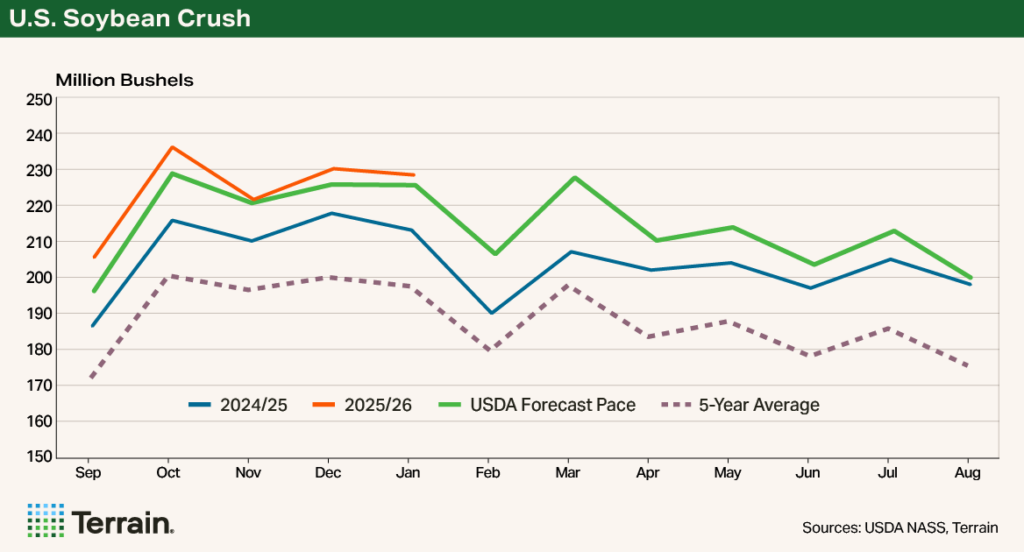
For the 2025/26 marketing year, the USDA has forecast record crush demand at 2.57 billion bushels, or approximately 85% of 2025/26 crush capacity. The USDA made the goalpost even higher in 2026/27, with 3% growth expected at 2.66 billion bushels of soybeans for crush.
While the old-crop actual crush pace continues to exceed last year’s, the pace has slowed from December to January. This raises doubt about the U.S. crush industry’s ability to achieve the USDA’s lofty forecast for the old- and new-crop marketing years. During the same time, soyoil stocks have also climbed, indicating questionable demand for the feedstock in biofuel use.
For the crush industry to meet the USDA’s forecast and provide local farmers favorable basis, domestic biofuel clarity is needed.
Key Biofuel Policy Updates
In a big win for domestic feedstocks, the One Big Beautiful Bill Act this past summer indicated that the $1-per-gallon 45Z clean fuel tax credit will apply only to North American feedstocks, which began in 2026. The act also removed the indirect land use penalty that increased the carbon intensity (CI) of soyoil and other row crops used as a feedstock (in favor of imported waste feedstocks like tallow from Brazil and used cooking oil from China).
Additionally, for farmers implementing climate-smart agricultural practices, these were unbundled, allowing more acres to qualify. However, more work is needed from the USDA on what carbon emission assumptions will be utilized so farmers interested in producing low-CI grain can participate.
The main factor is that this tax credit goes to the biofuel producer and the sharing of the tax credit with the farmer is not mandatory. I encourage proactive dialogue with local processors and biofuel producers on how the tax credit might be shared prior to adopting new climate-smart practices.
At the same time, the Environmental Protection Agency (EPA) is expected to finalize the renewable volume obligations (RVO) for 2026 and 2027 sometime in March, which could be positive or negative for prices.
Important issues include whether the EPA limits renewable identification number (RIN) credits to 50%, favoring domestic biofuel feedstocks like soyoil, which will receive 100% RIN credits; and the practice for small refinery exemptions. In the past, any exemptions reduced the overall RVO and, therefore, feedstock demand. Conversely, if the EPA requires the biofuel industry to offset these exemptions, this will increase feedstock demand to adequately meet the RVO mandates.
Stay Informed of News, Alert to Rallies
In my discussions with Farm Credit soybean farmers, I emphasize the importance of paying attention to biofuel policy news, as well as quickly rewarding price rallies tied to positive China trade. These rallies might be short-lived given the expected increase in planted acres for the new-crop year.

Terrain content is an exclusive offering of AgCountry Farm Credit Services,
American AgCredit, Farm Credit Services of America and Frontier Farm Credit.