



Quarterly Outlook • April 8, 2026
Why Sorghum Acres May Surprise


Report Snapshot
Finding
The risk of an oversupply of sorghum is understated. Unless we see China accelerate purchases in the second quarter of 2026, the risk of an oversupply will continue to rise at home and abroad.
Outlook
Expanding acreage and global competition will keep U.S. sorghum prices under pressure in 2026/27, absent stronger Chinese demand.
Impact
Farmers must stay disciplined on risk management in the coming months.
The March 31 USDA Prospective Plantings report shows farmers intend to plant 6.12 million acres of sorghum, an 8% decline from 2025.
Intentions, Inputs and Inflection Points
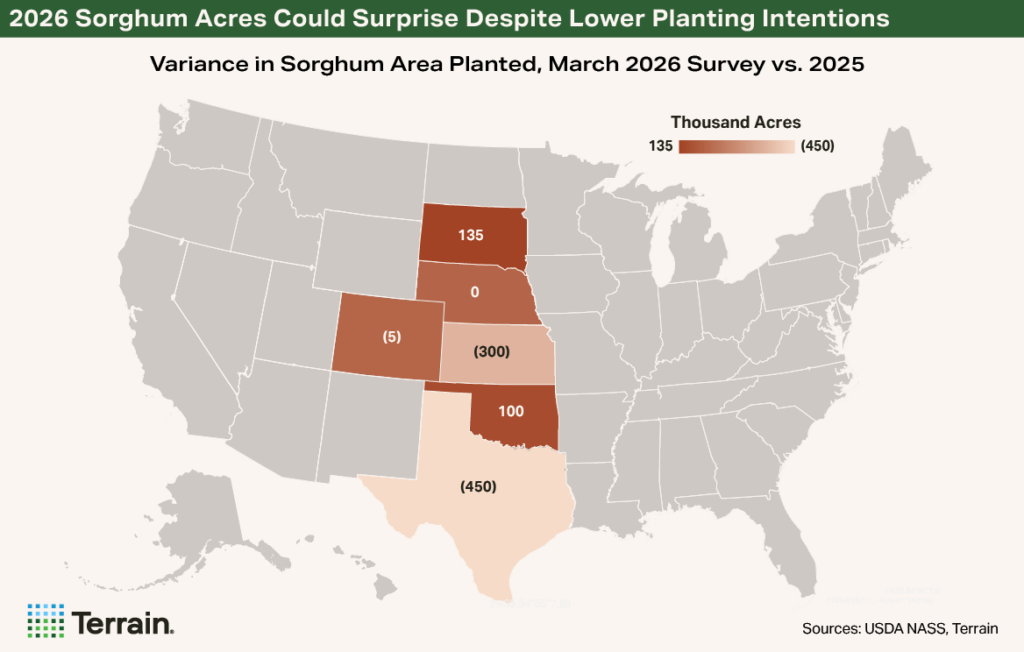
In Terrain’s first look at the 2026/27 balance sheet for sorghum, we originally expected a slight year-over-year (YOY) reduction in area planted. The March 31 USDA Prospective Plantings report shows farmers intend to plant 6.12 million acres of sorghum, an 8% decline from 2025’s 6.64 million acres, with Texas and Kansas having the largest YOY reduction.
Though most survey responses were collected prior to the escalation of the conflict in the Middle East, and no one knows how long the conflict will last, farmers who did not previously secure their input needs could still pivot their planted acres from corn to other crops that are less fertilizer-intensive, such as sorghum.
The persistent dryness in the Western Corn Belt and Southern Plains could increase planted area further, since sorghum is less water-intensive.
These two variables could cause supplies to increase even further from the current March 31 planting intentions. If old-crop export sales do not accelerate, I expect ending stocks to rise another 25 million bushels (MBU), which will pressure prices lower and widen basis.
Global Acres, Global Pressure
The U.S. is the top sorghum producer, accounting for 17% of global production, per the USDA. Other countries are expanding production and exports, pressuring U.S. market share.
- Australia: Ranking 10th in global production, the country is seeking alternative crops to plant in place of wheat as we look to 2026/27. Historically, 85% of the country’s total sorghum supply has been exported.
- Argentina: Ranking ninth globally, Argentina has increased sorghum production in the past several years, with nearly half of its supply exported historically.
- Brazil: Ranking third, Brazil accounts for 8% of global production and in the past eight years has been increasing harvested area.
Any increase in other countries’ planted area will pressure the U.S. market share as the world’s largest exporter of sorghum.
According to the USDA, Brazil sorghum production costs are 20% to 30% lower than for second-crop corn. Brazil uses most of its sorghum domestically for feed, but it has surplus area available to continue expanding sorghum acreage. If domestic consumption does not keep pace with production growth, expect Brazil’s exports to increase. China approved Brazil as a sorghum exporter in September after a 10-year hiatus, further signaling strong ties between the two countries, as we have seen with soybeans.
Any increase in other countries’ planted area will pressure the U.S. market share as the world’s largest exporter of sorghum.
The single largest variable that will influence U.S. sorghum prices in the next several months will be export sales activity from China.
Sorghum’s Fate Rests With China
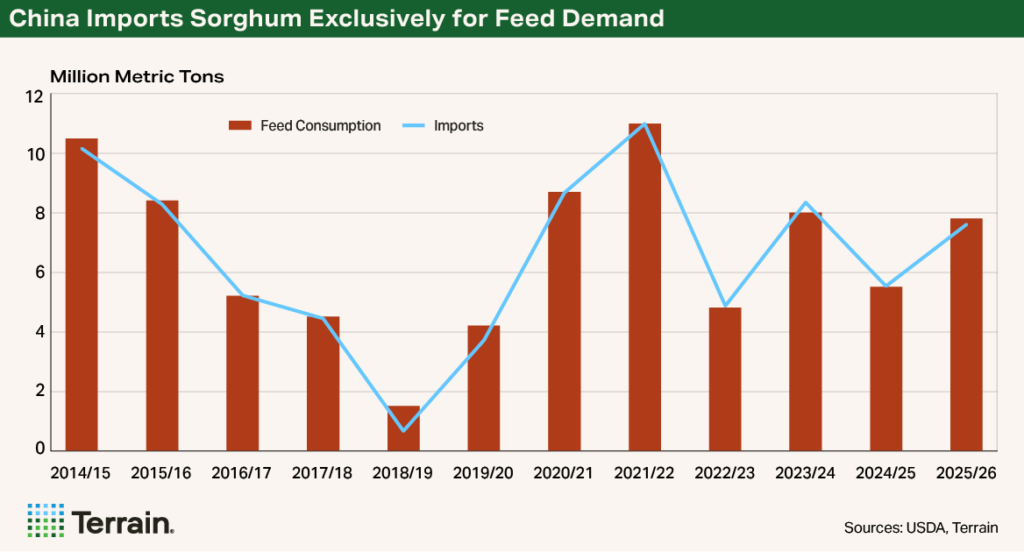
On the demand side, the single largest variable that will influence U.S. sorghum prices in the next several months will be export sales activity from China. In the past 10 years, China’s export demand has accounted for over 50% of U.S. sorghum production.
China relies almost exclusively on domestic sorghum for industrial consumption, including for its baijiu alcoholic beverage (which continues to see declining demand). And it relies almost exclusively on imports for its domestic animal feed needs. The USDA estimates China’s demand for feed across all grains will increase in 2026/27, driven by increased poultry consumption.
There is speculation that China’s domestic corn supplies are not as robust as previously forecast due to persistent rainfall in Northern China. The USDA estimates China’s corn supply could be downgraded by 20-30 million metric tons (MMT). According to the National Bureau of Statistics, China’s domestic corn prices have been increasing in 2026. However, China proactively discourages corn imports with its tariff rate quota (TRQ) system.
While corn is the dominant feed ingredient in China, there is no TRQ for other feed ingredient substitutes such as sorghum and dried distillers grains with solubles (DDGS). This presents an opportunity for increased imports of these commodities to backfill any gaps in China’s domestic corn supply.
Recent trade talks suggest China is considering additional U.S. agricultural purchases, which may lead to incremental sorghum purchases. China resumed buying U.S. sorghum in November and has doubled its purchases from a year ago. However, China still maintains a 10% tariff and continues to diversify its global grain feed suppliers, increasing purchases of corn from Argentina and DDGS and sorghum from Brazil.
Sorghum Surge Fueling Record Ethanol Use
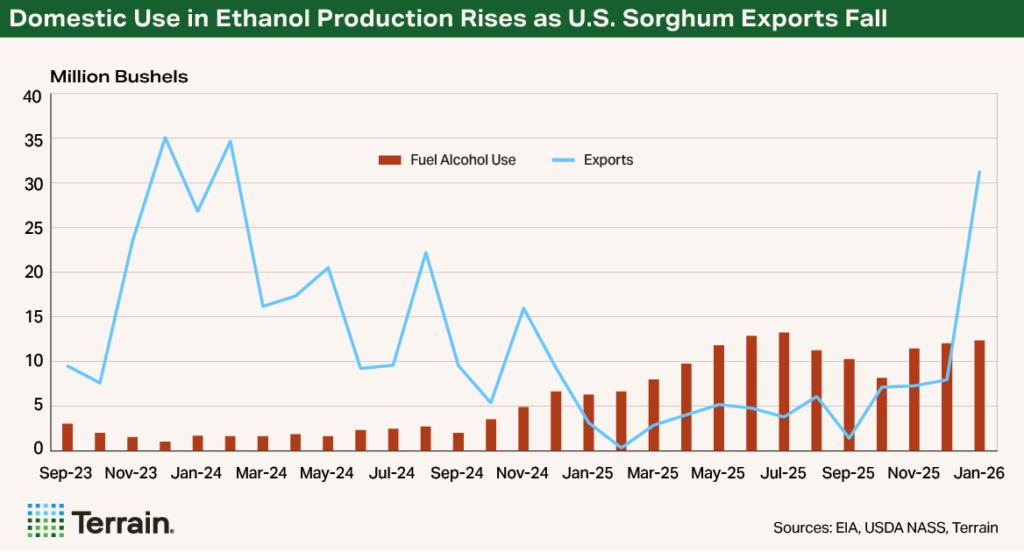
In the past decade, 20% of sorghum use has gone to industrial use, primarily for ethanol. When U.S. exports decline, so do sorghum prices, displacing corn in domestic ethanol production and feed.
A near record amount of sorghum is being used for ethanol production, but the surge is more due to the price effect caused by a lack of exports than rising incremental demand. As of March 1, the USDA’s quarterly Grain Stocks report revealed 172 MBU of grain sorghum was stored thus far in 2026, up 15% from the prior year — confirming the supply swell.
The Energy Information Administration forecasts a slight increase in ethanol production in 2026 to 1.09 million barrels per day, and the USDA forecasts the highest amount of sorghum used for industrial consumption in the past decade. However, it will not be enough to account for reduced exports to China. Although China resumed purchases of U.S. sorghum, supplies have ballooned because of the hiatus since spring 2025.
Therefore, I expect sorghum ending stocks to continue to grow for both old and new crop, pressuring prices through fall.
If planted acres exceed March intentions, supply pressure would be compounded by elevated ending stocks.
Watching Acres, Waiting on China
Looking ahead, unless China’s purchase pace accelerates in second-quarter 2026, the USDA’s current old-crop sorghum export forecast remains a tad too rosy. I forecast old-crop exports to finish closer to 200 MBU, with the additional 25 MBU increasing ending stocks. If planted acres exceed March intentions, supply pressure would be compounded by elevated ending stocks. Combined with the likely prospects of increasing domestic and international sorghum production, U.S. exports could be further pressured as we look to new-crop 2026/27.
Farmers need to stay disciplined on risk management and pay close attention to any trade headlines tied to China increasing sorghum purchases, as this could lead to narrower basis and higher local cash prices. Otherwise, I expect the season-average farm price to hover between $3.50/bu. and $3.70/bu.


Terrain content is an exclusive offering of AgCountry Farm Credit Services,
American AgCredit, Farm Credit Services of America and Frontier Farm Credit.