Market Movers • May 18, 2026
Climbing the Continuous Wall of Worry
Article Originally Published in the May Issue of the National Cattlemen Magazine

Report Snapshot
Situation
The cattle market’s rally has prevailed despite facing a slew of challenges in recent years affecting supplies, exports and prices. Now, the Iran war poses a new challenge.
Finding
The war will likely cause another volatility speed bump on this historic rally. How long that volatility will last depends on how long the effect lasts for consumers’ gas budgets.
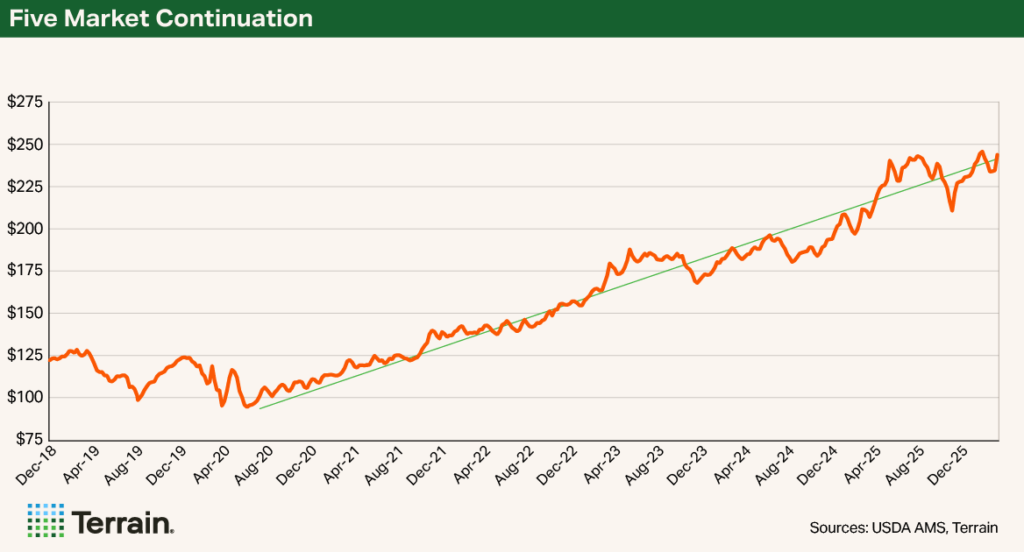
Since basing at the COVID-19 low, the cattle market has done nothing but climb a continuous, but healthy, Wall of Worry. The current trend of the market has been in place for just under six years and rallied just short of $150/hundredweight (cwt), driven by ever-tightening cattle supplies and, more importantly, a robust surge in demand as consumer diets have become more protein-driven. Meanwhile, the market has faced a slew of challenges affecting supplies, exports and prices.
We are now facing another great challenge with the Iran war, which will likely cause another volatility speed bump on this historic rally. How long that volatility will last depends on how long the effect lasts for consumers’ gas budgets. But recent history suggests that the rally will prevail.

The Challenges This Rally Has Already Faced
So, what is a Wall of Worry? It’s a bull market that has plenty of challenges weighing against it — and therefore buyers willing to take the risk of buying what others want to sell.
In no particular order, the challenges that this rally has already faced include:
- The effect of cattle on feed extra days and delayed marketings, creating additional tonnage as a defense for contracting fed cattle supplies.
- A challenging export situation over the last year and a half, partly due to escalating prices but mostly due to cutoff exports to China as a result of expired export inspection approvals by China.
- White House intervention to increase beef imports by raising Argentine import quotas.
- Continuous increases in retail beef prices that were feared to drive away consumer demand.
- The closure of the Mexican border to cattle imports because of the spread of New World screwworm south of the border. The additional contracting supplies as a result of the closure not only drove up cattle and beef prices further but also forced a regional imbalance in supplies.
- Changes in packing capacity, including the January closure of the Tyson beef plant in Lexington, Nebraska; reduced capacity at Tyson’s Amarillo, Texas, plant to a single shift; and the March labor strike at the JBS plant in Greeley, Colorado.
The Strongest Test of All
On February 28, the U.S. and Israel launched military action against Iran. In a retaliatory action, Iran closed the Strait of Hormuz and has consistently threatened to place mines in the strait. Twenty to twenty-five percent of the world’s seaborn oil trade and 20% of liquefied natural gas go through the strait. Crude oil prices have surged to over $100 a barrel, while U.S. domestic gasoline prices have climbed above $4 a gallon and diesel prices have topped $5 a gallon as of the beginning of April.
While the spike in energy prices is not expected to last very long, the war continues to escalate with more Middle East countries getting involved.
There is no question that this additional strain on consumers’ disposable income will ultimately impact consumer spending. At this time, there is just too much uncertainty regarding the war’s duration and the reopening of the Strait of Hormuz to determine if the war will be the event to put an end to the current rally in cattle and beef prices.
The current rally in cattle and beef prices has had a multitude of challenges. Given the obstacles this market has already encountered, will war-driven energy prices be able to stop the rally, just as the market faces the tightest supply and peak seasonal demand? No doubt there will be more to follow.
Terrain content is an exclusive offering of AgCountry Farm Credit Services, American AgCredit,
Capital Farm Credit, Farm Credit Services of America and Frontier Farm Credit.