



Quarterly Outlook • March 20, 2026
Cracking the New Economics of Walnut Production




Report Snapshot
Situation
After a record low in 2022, walnut prices have mostly hovered above traditional break-even levels. Establishment and production costs, however, have also risen dramatically, squeezing current margins.
Outlook
With walnut profitability dropping in recent years, farmers considering replanting must know their numbers and their niche more than ever.
In November, the Walnut Board released its 2025 acreage report. While acreage removal was lower than in 2024, walnut removals continue at a steady pace. With many older walnut orchards in the Central Valley being removed, some growers could be asking themselves whether it makes sense to replant.
Like the almond market, the walnut market has experienced a few difficult years. The grower price was the lowest ever recorded in nominal terms in 2022. Since then, it was on an upward trajectory until the 2025 crop surprised the market by being the second largest on record.
Beyond short-term obstacles, the walnut market faces unique structural issues. Older walnut varieties are no longer seen as desirable relative to the Chandler and Howard varieties. This has become clearer as the global market has become more competitive. China and Chile have increased production and taken export share from the U.S. in the global market.
The combination of price pressures and higher costs leads us to our topic of the day: margin and breakeven.
Additionally, walnut producers have not been immune from the most common concern among California farmers: the ever-increasing cost of production. The current bout of input inflation has only made this worse.
The combination of price pressures and higher costs leads us to our topic of the day: margin and breakeven. Specifically, it raises two familiar questions:
- How has the break-even year to get a positive return in orchard establishment changed?
- What is the break-even price point for existing orchards?
Getting to Breakeven
Let’s start with the break-even year for producers considering planting a new orchard. The assumptions are:
- Yearly operating costs cited in the UC Davis cost study for northern San Joaquin Valley in 2017 and inflation adjusted for 2026.
- A price of $1.20 per inshell pound for both years.
- 100 acres of contiguous land with 60 acres planted to walnuts.
- Yields of 600 inshell pounds in fourth leaf; 1,200 inshell pounds in fifth leaf; 2,400 inshell pounds in sixth leaf; 5,000 inshell pounds in seventh leaf; and 6,000 onward.
- A 30-year mortgage rate of 4% in 2017 and 7% in 2026.
Given that it takes longer for a walnut orchard than an almond orchard to ramp up yields, the breakeven of the farmer’s investment in this scenario is not until eighth and ninth leaf, depending on whether the farmer has a mortgage. The equivalent years for almonds were sixth and seventh leaf.1
Then there are differences in 2017 compared with 2026. Adjusting the 2017 costs for inflation to get an approximation of operating costs in 2026 pushes the break-even year to 13th leaf or 17th leaf, depending on whether the farmer has a mortgage. Like the case of other permanent plantings, this no doubt explains the sharp drop in new plantings in recent years.
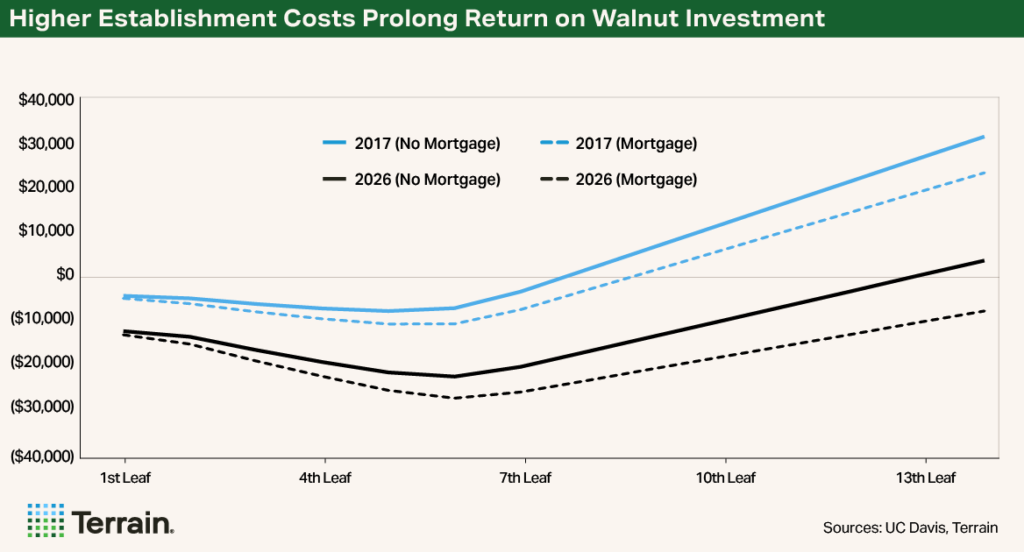
Once an orchard is established and in full production, the break-even price becomes more relevant than break-even year. Assuming a yield of 6,000 pounds, we can back into break-even price for different years. With operating costs at about $3,808 per acre in 2026, it takes 63 cents per inshell pound to break even, versus 38 cents per inshell pound in 2017.
Knowing your numbers and comparative advantage can be a powerful tool when making decisions in the field.
Know Your Numbers, Know Your Niche
The point of this analysis is not to give an exact estimate of breakevens. Growers will have different cost structures if they’re in the northern, southern, eastern or western part of the Central Valley. Even within the same county, there can be considerable differences in cost and yield.
The analysis is meant to provide an approximation of breakevens and help inform the decisions farmers are faced with everyday. Knowing your numbers and comparative advantage can be a powerful tool when making decisions in the field.
These tips, however, ring even truer for walnuts than for almonds. Given the sensitivity of quality, variety, crackout, yield and global production levels, knowing whether walnut production makes sense for you is hardly a straightforward question. As profitability is more challenging than ever, running the numbers with your Farm Credit lender is a good place to start.
Endnote
1 Note that the analysis is an undiscounted breakeven for simplicity.
Terrain content is an exclusive offering of AgCountry Farm Credit Services,
American AgCredit, Farm Credit Services of America and Frontier Farm Credit.