



Outlook • March 10, 2026
Economy Continues to Press Wine Market
Winescape Spring 2026 | Market Happenings




Report Snapshot
Situation
Wine sales softened across the board in 2025, and prices stagnated as a result of consumer price sensitivity and heightened competition among producers trying to move excess inventory. Although the wine market slump continues, bright spots include premium and luxury wines, non-alcoholic and ready-to-drink wines, and white and sparkling wines.
Outlook
I’m not expecting a material change in the trajectory of U.S. wine sales in the near term, though I see the most potential for progress in the second half of the year. There should be less excess supply burdening the grape market when the 2026 harvest begins than there was in 2025.
Impact
For wineries that are fairly certain about their grape needs, it may be prudent to act sooner rather than later.
Sales Trends by Channel and Price Segment
Change vs Year AgoTrend Retail: Value
 Retail: Premium
 Retail: Super-Premium
 Retail: Luxury
 Direct-to-Consumer
 Export
Wine Market Update:
A Familiar Story for Wine Sales, With Nuances
The post-pandemic slump in wine sales shows no signs yet of abating. U.S. wine sales fell across all channels and price tiers in 2025, and the pace of the decline hastened relative to 2024. There were no signs of improvement in the crucial OND (October, November, December) season. Trade tensions also slammed wine exports in 2025.
There are some nuances to the story, and while there are only a few bright spots, some corners of the market appear to be less dim than others.
Three-Tier Sales Softened in 2025
Based on my analysis of NIQ data, off-premise retail sales fell 5% in value and 6% in volume in 2025, a modest deterioration from 2024. Following a rough start to the year, the second quarter saw some improvement, but the positive momentum couldn’t be maintained in the second half. The fourth-quarter results were a bit weaker than for the full year.
Depletions continued to track below retail sales in 2025 due to retail inventory reductions. They fell 6% in value and 9% in volume, according to SipSource data. On-premise sales held up slightly better than off-premise sales. The 2025 results were slightly worse than 2024’s, and the fourth-quarter numbers were the weakest of the year.
The depletions data also indicate that wine continued to lose shelf space and menu listings in 2025. Points of distribution (POD) dropped by 5% while the number of wine-buying accounts declined just 1%.
Price taking continues to be challenging. Off-premise wine prices were flat again in 2025, according to Consumer Price Index (CPI) data, and have risen just 1% since 2022 — versus a 9% increase in all goods. The stagnation in prices is due to both consumer price sensitivity and heightened competition among producers trying to move excess inventory.
The wine market remains conspicuously bifurcated at the $15 mark.
While the three-tier market may not see many bright spots or fresh trends in 2025, consumer preferences continue to evolve, with some important nuances to note:
Premium and Luxury Wine Sales Continue to Hold Their Ground
The wine market remains conspicuously bifurcated at the $15 mark. NIQ data indicate that off-premise sales of bottles priced $15 and over slipped by just a percentage point in volume in 2025, though the higher end saw some discounting. Conversely, sales of lower-priced brands dropped 7%. SipSource statistics paint a similar picture.
Non-Alcoholic Wines and Ready-to-Drinks Are Growing
The only wine categories that experienced outright growth in 2025 were ready-to-drinks (RTDs) and non-alcoholic wines. Sales of wine-based RTDs surged 30% to $1.2 billion according to NIQ, largely due to the success of BeatBox. Meanwhile, non-alcoholic wine sales swelled 22%, though they still represent just a fraction of wine sales.
White and Sparkling Wines Are Still Outperforming
White and sparkling wine sales held up better than red wine sales again in 2025. The outperformance for white varietals continues to be attributable mostly to solid Sauvignon Blanc sales, as Chardonnay sales fell at a slightly faster clip than the market overall. An uptick in Champagne and Prosecco sales boosted the sparkling wine category.
The 500ml container was the sweet spot.
Alternative Packaging Is Gaining Traction
Depletions of wine packaged in glass, boxes and cans fell 9% in volume in 2025, according to SipSource figures, while other packaging types recorded an increase of 4%. The outperformance was driven by the Tetra Pak/carton and “other” categories. Sales of smaller formats (<750ml) slipped just 1%, versus an 8% decline for 750s and an 11% drop for larger formats. The 500ml container was the sweet spot.
Tariffs Haven’t Helped U.S. Producers
Despite the imposition of tariffs of 15% or more on almost all foreign wines in April 2025, domestic wines continued to gradually cede market share to imports. Foreign wines also lost fewer PODs than domestic wines in 2025. Some market participants stockpiled imported wines in advance of tariffs and some have not fully passed the tariff on to consumers, so domestic producers haven’t yet gained much of a price advantage.
Direct-to-Consumer Sales Slump Deepens
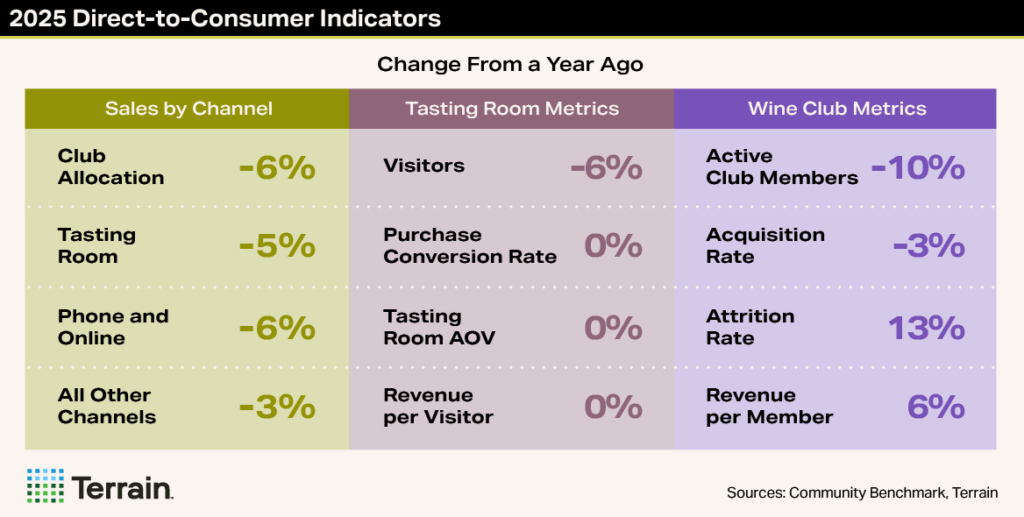
Direct-to-consumer (DtC) sales fell again in 2025, though the data are sending mixed signals regarding the magnitude and trajectory of the decline.
Total DtC revenue for Community Benchmark’s nearly 500 participants fell 6% in 2025, a pronounced deterioration from 2024’s 3% drop. Revenue declined 9% in the crucial fourth quarter. Figures from Enolytics (a data analytics platform) indicate that revenues fell 3% in value and 4% in volume, with no deterioration in Q4 2025.
DtC “shipment” revenues fell 6% in 2025, according to estimates from Sovos/ShipCompliant and Wine Business Analytics, while shipment volume plunged 15%. This compares with a 10% loss in volume and 5% loss in dollars in 2024. An 11% increase in the average bottle price accounted for the narrower loss in value versus volume.
Each data source produces its estimates based on a different subset of wineries, which explains the variation.
Revenues fell across DtC sales channels in 2025. The most troubling development was an erosion in club allocation sales.
Community Benchmark’s metrics allow additional insights to be drawn into the nature of the DtC slump:
Club Shipment Revenues Deteriorated
Revenues fell across DtC sales channels in 2025. The most troubling development was an erosion in club allocation sales, which account for nearly half of total revenue. They dropped 6% in 2025, a marked downturn relative to a 1% gain in 2024. However, this was almost wholly attributable to a steep decline in allocation sales by Napa wineries. Total club revenue (including purchases outside of the allocation) fell by 5%.
Wine Clubs Are Shrinking
Flagging wine club revenue was precipitated by a 10% drop in the number of active club members. This trend was broader, as all regions reported declines. The drop in club members was due to a rise in membership cancellations, as the attrition rate rose by 13% while the acquisition rate slipped just 3%. On a positive note, the revenue impact of fewer members was partly offset by a 6% increase in revenue per member.
Tasting Room Visitation Slump Shows No Signs of Abating
Tasting room visitor counts dropped 6% in 2025 and visitation was down across the West Coast. However, this represented a marginal improvement relative to a 7% drop in 2024. There was also no growth in revenue per visitor, as both the purchase conversion rate and average order value were flat in 2025, though some regions performed better on these metrics than others.
A final point to note is that there has been no shift from red to white wines in the DtC channel. Red varietals composed nearly 80% of shipment revenue and two-thirds of volume in 2025 and red wine sales held up better than white wine sales in 2025, owing mostly to a strong performance by Cabernet Sauvignon. In addition, Chardonnay continues to be the clear-cut leader in the white category.
Trade Tensions Took a Hefty Toll on Exports
U.S. wine exports peaked in 2016 and have declined steadily since due to declining global wine consumption and heightened competition. Trade tensions further reduced demand for American wine abroad in 2025 and the slump deepened as exports tumbled 18% in volume and 34% in value.
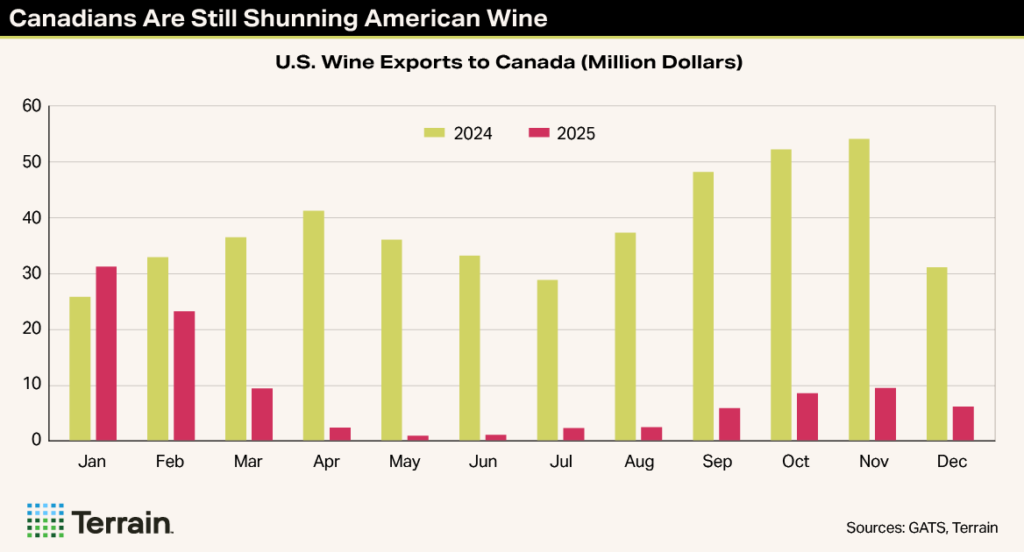
The deterioration was mainly attributable to Canadian provincial bans on American alcohol. Wine exports to Canada, the most important buyer of U.S. wine, dropped 77% in value, which represents a loss of more than $350 million to U.S. producers. U.S. wine exports to China also plummeted 73%, though they form a much smaller share of the total.
Excluding Canada and China, U.S. wine exports were essentially flat and there were a few bright spots. For example, sales to Japan, the third most important market for American wine, rose by 10%.
There is no end in sight to the export slump. Export revenues fell 43% year over year (YOY) in the fourth quarter.
Several small Canadian provinces have, however, lifted their American alcohol bans, though this hasn’t made much of a difference yet. U.S. Wine exports to Canada were still down by 83% YOY in the fourth quarter, compared with declines of 96% in the second quarter and 93% in the third.
What’s Up With Wine Consumption?
The deepening slump in wine consumption is likely attributable partly to a tenuous economic backdrop.
The deepening slump in wine consumption is likely attributable partly to a tenuous economic backdrop. Consumer sentiment plunged amid an environment of seismic policy shifts, heightened economic uncertainty, questions around affordability, and political unrest. And less affluent consumers are still feeling pressured by inflation. This likely depressed wine sales in 2025, particularly in the lower price tiers.
However, U.S. wine consumption has now declined for four consecutive years and has fallen by around 15% since 2019. There are no signs that the slump is coming to an end. This suggests that longer-lasting structural factors are the main cause.
The slump has been concentrated at the lower end of the market, as premium and luxury off-premise sales volumes are still well ahead of their pre-pandemic level.
For one, Americans are drinking less alcohol in general. This trend is likely to persist for some time, as I detailed in the Fall 2025 issue of “Winescape.” In addition, wine’s market share has eroded due to rising competition within the alcoholic beverage sector as well as demographic and generational shifts. These headwinds aren’t likely to dissipate soon.
The slump has been concentrated at the lower end of the market, as premium and luxury off-premise sales volumes are still well ahead of their pre-pandemic level despite the drop in recent years. These segments are less exposed to competition from RTDs, and consumers who are moderating their alcohol consumption may be gravitating toward higher-quality bottles when they drink.
Affluent consumers have also seen their wealth boosted by a surging U.S. stock market and general appreciation of hard assets. The S&P 500 returned 18% to shareholders in 2025 and has returned a stunning 200% since 2018. This has almost certainly propped up premium and luxury wine sales.
The DtC channel is facing the same economic and structural headwinds, yet DtC case sales, which are predominantly premium and luxury offerings, are declining at a faster rate and are now below their pre-pandemic level.
While some idiosyncratic factors are involved (that is, the surge in Americans traveling abroad and a decline in foreign visitors), I believe the primary reason for the deepening DtC slump is rising costs in a time of heightened consumer price sensitivity. Clicking the cancel button on a wine club membership is an easy way to free up funds for other uses.
Based on shipment data from Sovos/ShipCompliant and Wine Business Analytics, average bottle prices rose 11% in 2025 and are now 40% higher than in 2019. This compares with a 26% increase in the CPI and a 6% rise in off-premise wine prices.
The shipment data only represent a slice of the broader DtC market, and average prices could be rising due to a change in the mix of bottles sold as opposed to organic price increases. Even so, I don’t believe the shipment figures are too far from the mark.
Tasting room fees and wine country travel costs have also risen sharply in the 2020s. Thus, the DtC experience has become more exclusive and may be out of reach for less affluent consumers and young adults, which narrows the potential audience.
Wine sales should firm a bit once the economic backdrop steadies. The wine industry has the potential to stabilize its market share over the medium term.
Wine Market Outlook:
Most Potential for Progress Later in the Year
To the extent that the shaky economic backdrop has played a role in the wine consumption slump, I don’t see much potential for improvement in the near term. Still, there are some economic tailwinds and could be some progress in the second half of the year. The premium and luxury segments, outside of DtC, should continue to outperform.
Wine sales should firm a bit once the economic backdrop steadies. The wine industry has the potential to stabilize its market share over the medium term. Nonetheless, it’s difficult to see a path to outright growth unless alcohol consumption rebounds.
The Economic Outlook Remains Murky
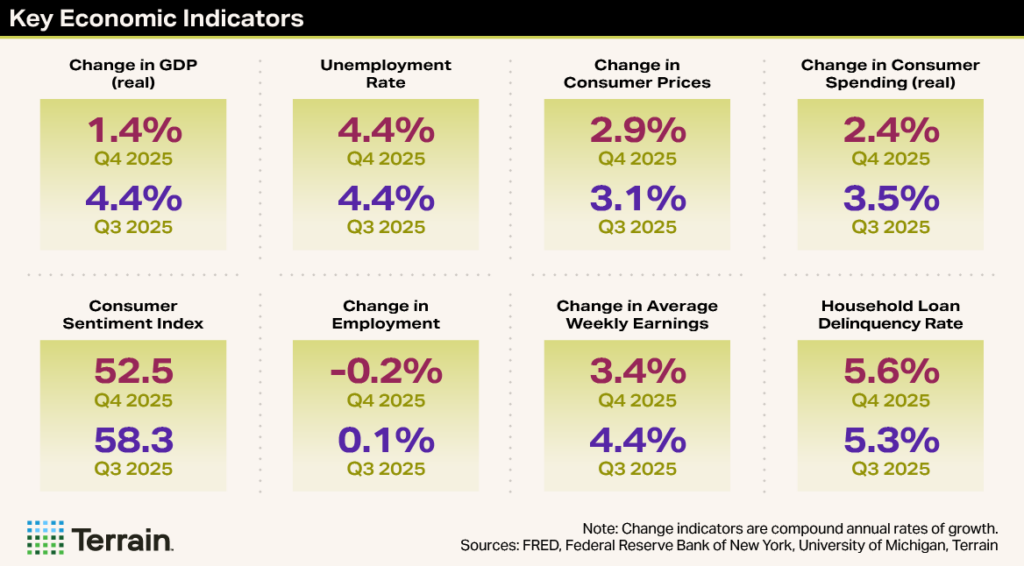
2025 was a tumultuous year for the U.S. economy. Real GDP seesawed wildly and finished the year on a weak note with an increase of just 1.4% in the fourth quarter, though this was mainly due to the government shutdown. For the full year, economic growth came in at 2.2%, down slightly from a 2.4% gain in 2024.
Inflation proved to be sticky and remains above the Federal Reserve’s 2% target by all measures.
The labor market slowly softened through the year. Employment growth stalled and unemployment rose to 4.5% in November, its highest level since October 2021. On a positive note, job growth accelerated in January, and the unemployment rate improved to 4.3%, a healthy reading by historical standards.
Consumer spending remained reasonably resilient despite a plunge in consumer sentiment, which hit its second-lowest level on record in November. Personal consumption expenditures rose 2.7%, a modest drop relative to a 2.9% gain in 2024. Spending was buoyed by continued modest gains in real wages and the surging stock market.
The chaotic economic and political backdrops do not look to be stabilizing. But, despite the turmoil, the economy seems to be on relatively firm footing in early 2026, though there are many question marks.
Most importantly, the Supreme Court’s ruling that the Trump administration lacks the authority to impose tariffs under the International Emergency Economic Powers Act (IEEPA) adds considerable uncertainty to the outlook. It also remains to be seen how changes at the Federal Reserve will impact monetary policy. The upcoming midterm elections and the potential for an escalation in geopolitical conflicts are also wild cards.
The uncertainty is likely to continue to dampen economic activity in the near term but there are several, positive tailwinds as well.
The AI capital investment boom should continue to boost economic growth. And fiscal stimulus from the One Big Beautiful Bill Act is now beginning to show up in the form of larger tax refunds and lower withholding. Additional stimulus measures could potentially be rolled out, as the ruling Republican Party will be keen to prop up the economy in an election year.
Consumers also appear to be in reasonably good financial health, particularly older households and those at the higher end of the income distribution whose wealth has been boosted by the surging stock market and strong asset appreciation. There are no signs of severe financial distress, as credit card and auto loan delinquencies have stabilized, though student loans have seen a surge in late payments since defaults began to be reported again in late 2025. Finally, the new leadership at the Federal Reserve Board is likely to favor interest rate cuts in 2026, though it is impossible to say when or by what magnitude.
While the economic environment remains uncertain, the Terrain team’s base-case scenario is that the economy won’t look much different than it did in 2025.
Economic growth is likely to be moderate and choppy, though there could be some acceleration in the second half of the year, and inflation will remain sticky. Employment growth is liable to remain soft, though unemployment should remain in check, as immigration policy has stalled labor force growth. And consumers will likely continue to spend, though tentatively, as sentiment is apt to remain depressed.
Wine Sales Likely to Remain Under Pressure for Some Time
I’m not expecting a material change in the trajectory of U.S. wine sales in the near term. The economic backdrop isn’t likely to boost demand, and skittish consumers will continue to push back against price increases. Turmoil in the distribution sector also has the potential to disrupt the path to market and hurt wine sales in 2026.
The premium and luxury segments are poised to outperform again in 2026.
I do see more potential for progress in the second half of the year. An acceleration in economic growth or stabilization in the political-economic environment could boost demand for wine.
The premium and luxury segments are poised to outperform again in 2026. They are partially sheltered from the structural headwinds, and affluent consumers are better positioned than their lower-income counterparts. The benefits of the One Big Beautiful Bill Act are skewed toward upper-middle and higher-income households. Although, a stock market correction could derail this dynamic.
Domestic producers could potentially gain some U.S. market share in 2026 if tariffs remain in place, as more of the price tag is likely to be passed on to consumers with time.
The tariff situation remains fluid to say the least. It’s too early to understand the implications of the end to the IEEPA tariffs, under which most imported wines have been taxed since last April. The Trump administration has already instituted a global tariff of 10% to replace them and has signaled it will raise it to 15% soon, the same rate that most foreign wines have been paying, though these tariffs will time out after 150 days unless congressional approval is received. Even so, the administration has other tools at its disposal, though they may be more difficult to implement. The most likely scenario is a continuous evolution of tariff policy throughout the year.
The potential for progress on the export front also seems limited unless trade tensions ease, and I don’t see any good reasons to expect this. A thaw in political relations with Canada represents an upside scenario for exports, but Canadian consumers will be slow to return to American wine even if this occurs. Therefore, recovering the ground lost in 2025 will likely take considerable time.
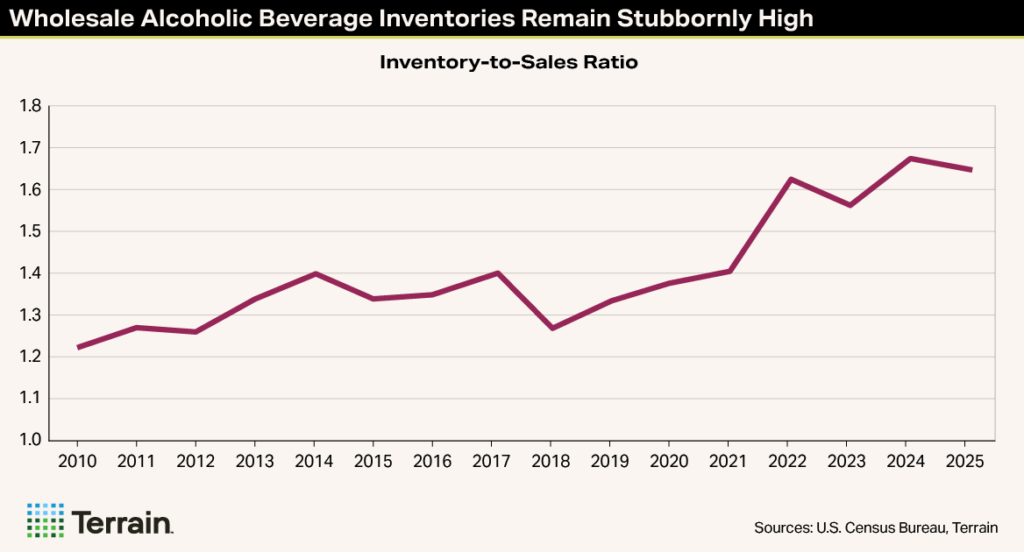
Finally, wholesale inventories remain stubbornly high, so winery shipments are likely to lag retail sales as distributors work through the excess. Distributor consolidation and SKU rationalization in both the retail and wholesale tiers will also make it even more challenging for small and midsize wineries to move their wares through the three-tier channel in 2026.
All things considered, 2026 is almost certain to be another challenging year for the wine industry.
When the economic backdrop finally settles, and uncertainty and inflation fade, consumers will feel more secure and less hesitant to spend on discretionary items, and wine sales will firm up.
Competitive pressures will eventually ease as the wine inventory glut recedes and the industry right-sizes.
I also firmly believe that wine has a compelling story to tell, and if the industry can reframe its narrative with the younger generations, its market share will eventually stabilize. Nonetheless, it is difficult to see a path to outright growth unless alcohol consumption rebounds.
That said, many wineries are still thriving today, and enterprising producers will continue to have opportunities. Competitive pressures will eventually ease as the wine inventory glut recedes and the industry right-sizes, paving the way to a more profitable operating environment for the winners.
There is no one-size-fits-all solution in the wine industry, but all producers can benefit in a competitive market environment by improving their operational efficiency and honing the value proposition they provide to the consumer. It is also more important than ever to be laser focused. This means understanding your competitive advantage and target market and playing to them.
Grape Market Outlook:
Have We Hit Bottom Yet?
We will only know in hindsight whether the grape market has hit bottom yet, and the timing will vary across market segments. That said, I believe the broader market is closing in on a bottom and there should be less excess supply in 2026 than there was in 2025.
Activity Hasn’t Picked Up
The California grape market has been eerily quiet in early 2026 as the diminutive 2025 crush has failed to stimulate future grape sales. Much of the activity that is occurring for the 2026 harvest involves buyers attempting to renegotiate contracts already in place. The dearth of new transactions makes it difficult to know where pricing stands.
We don’t know yet how small the 2025 crush was, as the release date for the “preliminary” version of the California Grape Crush Report has been pushed out to March 13. The Trending Topic section of this edition of “Winescape” will also be delayed until the report comes out, as it will draw implications from the 2025 crush for the 2026 grape market.
The lack of contracting activity and information on the 2025 crush puts growers with uncontracted fruit in a bind. They must soon decide whether to fully farm, mothball or tear out vines before the 2026 growing season progresses much further.
The hesitancy from wineries to contract with growers is due to a number of factors. Uncertainty in the future trajectory of wine sales makes it more difficult for wineries to gauge how much fruit they will need. Many wineries may be waiting until the last possible moment to commit to contracts in the hope that the picture will become clearer. Some are also struggling with cash flow issues and are narrowly focusing on short-term issues today (like selling the wine already on hand) rather than looking ahead to the future.
Plenty of attractively priced bulk wine is also still available, though the bulk wine market has been more active than the grape market due to private-label demand. According to figures from Ciatti, the quantity of bulk wine actively listed for sale is in line with this time last year. Thus, buying bulk wine in lieu of grapes at some point may seem like a more appealing option to some potential grape buyers.
I expect grape sales to pick up progressively as the 2026 harvest approaches, and at least as much fruit will end up being crushed in 2026 as was crushed in 2025.
There is an important caveat. Ciatti also indicates that a higher-than-normal share of the bulk inventory is made up of older vintages. Approximately 40% of red varietals are from 2023 or prior vintages while 50% of the whites are from 2024 or older vintages. Thus, inventory from recent vintages, where demand is focused today, looks to be more balanced.
Demand Should Improve, Though It’s Hard to Say by How Much
I expect grape sales to pick up progressively as the 2026 harvest approaches, and at least as much fruit will end up being crushed in 2026 as was crushed in 2025. There are several reasons for my optimism.
First, even if wine sales continue to decline, winery inventories should be less excessive heading into the 2026 harvest due to the small crushes in 2024 and 2025, as I explained in detail in the Winter edition of “Winescape.”
The magnitude of the inventory reduction will depend on how much was crushed in 2025 as well as the trajectory of wine sales, which look to be trending toward my low-end assumption. Nonetheless, I still expect inventory to be less excessive, and many wineries who’ve been sitting on the fence will eventually need to buy grapes for the 2026 crush, or they risk not having enough wine to sell down the road.
Moreover, anecdotal evidence suggests that some large grape buyers are considering signing grape contracts at some point to ensure sufficient acreage remains in the ground and avoid a future shortage.
I estimate that approximately 3 million tons of fruit would be required to replace the volume of California wine I assume will be sold in 2026. However, given that less well-capitalized wineries are likely to be very conservative, and that inventories are almost certain to still be above target, the amount of fruit utilized will be substantially short of this figure. Even so, I believe at least 2.4 million tons will be harvested in 2026, which is also my estimate of the 2025 crush.
It’s difficult to say when the grape market will pick up. A smaller than anticipated 2025 crush figure or a material improvement in wine sales over the next several months (which I’m not expecting) could accelerate the timetable for action.
The Supply Side of the Equation Is Equally Uncertain
Progress continues to be made on the supply side as a substantial number of vineyards have been retired over the last several years, particularly in California’s interior region. But given the rapid pace of change and dearth of data, it’s difficult to estimate California’s grape production capacity now, let alone what it will be at harvest time.
According to the California Association of Winegrape Growers, 38,000 acres of wine grapes were pulled between the 2024 and 2025 harvests, though this was partially offset by new bearing acreage coming on line. Allied Grape Growers projects a slight increase in removal activity and a decrease in additions prior to the 2026 harvest. Nonetheless, even under more aggressive assumptions, there should be enough capacity to produce at least 3 million tons assuming normal yields and that all vineyards are farmed.
It’s still too early to form an outlook for yields in 2026, though no major issues are apparent with the crop so far and water resources look adequate. Rainfall has been near or above average in most growing regions, though a drier-than-normal spring is predicted. And, following mid-February storms, California snowpack levels, which have been a concern, don’t look alarmingly low, particularly in the southern and central Sierras.
The biggest wild card is how aggressively the current acreage will be farmed. The number of vineyards that won’t be farmed, or farmed only minimally, in 2026 will surely be substantial due to the plethora of vineyards that are out of contract and the cash flow issues growers are facing. But it’s impossible to estimate with any precision at this point.
Many growers have delayed pruning, but in most cases, they won’t have to make a final decision until late March or early April. The longer buyers wait to pull the trigger, the less fruit that will end up being grown. Moreover, some growers with contracts may cut corners because grape prices are too low to cover farming costs or generate a profit, which could reduce their yield.
We may well be at or approaching the bottom of the current market cycle.
Where Does This Leave the Grape Market?
In the end, I expect enough fruit to be grown in 2026 to satisfy demand, so long as mother nature cooperates, and pricing is apt to remain subdued. But there will almost certainly be less fruit available at harvest time in 2026 than there was in 2025, and the market should become more balanced as harvest nears. While unlikely, a grape shortage is not out of the realm of possibility.
Thus, we may well be at or approaching the bottom of the current market cycle. But as we all know, the grape market is highly fragmented, so the state of the market is certain to vary widely across appellations, varieties and quality tiers.
Given the fragmented nature of the grape market, I can only offer general advice here.
For growers capable of producing quality grapes at a commensurate cost, it may be wise to hold out a bit longer to take in any additional information that becomes available before deciding whether to farm or mothball. I also advise against simply abandoning vineyards, as this can create severe headaches for both you and your neighbors down the road.
For wineries that are fairly certain about their grape needs, it may be prudent to act sooner rather than later, as the choice set will progressively narrow as harvest nears.

Terrain content is an exclusive offering of AgCountry Farm Credit Services,
American AgCredit, Farm Credit Services of America and Frontier Farm Credit.