



Quarterly Outlook • March 20, 2026
Milk Prices Improve, but Volatility Ramps Up

Report Snapshot
Situation
2026 began with a global oversupply of milk, and volatility is likely to ramp up as supply continues to grow heading into the spring flush.
Outlook
Milk prices should be more favorable than previously expected. For the second quarter of 2026, I expect Class III milk prices to average $17/cwt and Class IV to average $19.50/cwt.
Impact
Risk should continue to be taken off the table through the year whenever prices present favorable opportunities.
The milk price outlook for 2026 has improved from the beginning of the year. But volatility is likely to ramp up as supply continues to grow heading into the spring flush and components and global commodity markets rebalance in response to strong protein demand.
As spring flush approaches, strong milk supply growth persists.
The entry into 2026 was defined by a global oversupply of milk. U.S. production had been growing dramatically for the last three quarters of 2025. For the full year, milk production was up 2.8% versus 2024, and up nearly 4% in the second half of 2025 versus the second half of 2024. Europe was also up 4% in the second half.
As spring flush approaches, strong milk supply growth persists. January milk production was up 3.4% from a year earlier, with a herd 189,000 head larger. There have been reports of milk being dumped in California because of capacity constraints.
The recent price strength has not been due to a shortage of milk.
Prices Pivot as Whey Strengthens
In the previous Quarterly Outlook, my expectation was that prices were not headed for a long-term slump but at least a few months of pressure. However, markets took a sharp turn higher, sooner than expected. Markets seemed optimistic that Class III and Class IV milk prices could be supported through the rest of 2026, but disjointed product price movements suggest a more volatile road ahead.
The initial move higher was driven by an ongoing steady climb in whey markets, then a sudden lift in nonfat dry milk. Cheese and butter remained low compared with last year. By the beginning of March, however, some cracks started to appear, raising questions about the durability of this move higher.
Exports played a critical role in clearing markets in 2025.
Whey has benefited from the much-discussed boom in protein demand. Nonfat dry milk has been an additional beneficiary of the trend but in a less direct way. Strong protein demand is pulling more solids into high-protein yogurts, ultra-filtered milks and milk protein concentrate, leaving less surplus skim to be dried into nonfat dry milk.
The Value of Exports
Exports played a critical role in clearing markets in 2025. With production growing faster than domestic demand can be expected to keep up, export growth becomes increasingly important. Dairy exports grew by around 3.8% year over year in 2025 on a total solids basis, falling just below the record set in 2022. Dairy exports in 2025 were valued at $9.51 billion.
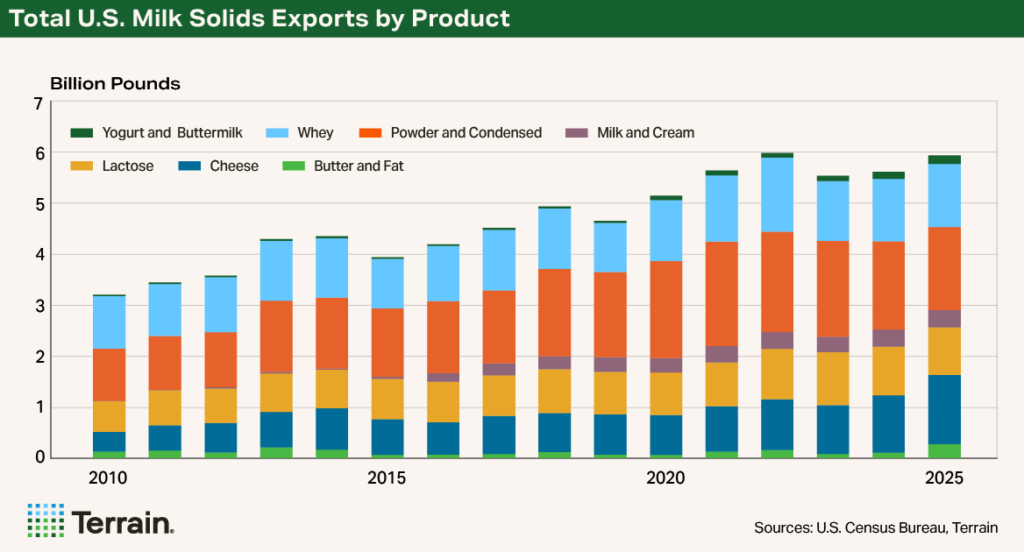
The United States-Mexico-Canada Agreement will be up for joint review in July. More than 40% of dairy export value came from our North American neighbors, with $2.58 billion from Mexico and $1.31 billion from Canada. Dairy trade has found itself in the spotlight of past negotiations between the countries. Any moves to gain leverage leading up to this year’s negotiations could be an additional source of volatility in dairy markets.
For the second quarter of 2026, I expect Class III milk prices to average $17/cwt and Class IV to average $19.50/cwt.
Higher Near-Term Milk Prices, and Volatility
Milk prices should be more favorable than previously expected. However, volatility will likely be high due to temporary shortages and surpluses in individual product markets, as well as spillover from global market movements.
For the second quarter of 2026, I expect Class III milk prices to average $17/cwt and Class IV to average $19.50/cwt. My most recent second-half 2026 outlook features a $16.75/cwt Class III milk price average and a dramatically improved Class IV forecast of $19.20/cwt. Looking ahead to 2027’s first half, I forecast $16.60/cwt for Class III and $17.80/cwt for Class IV.
The jump in prices in Q1 presented opportunities to manage risk through Dairy Revenue Protection or other hedging tools. Risk should continue to be taken off the table through the year whenever prices present favorable opportunities.


Terrain content is an exclusive offering of AgCountry Farm Credit Services,
American AgCredit, Farm Credit Services of America and Frontier Farm Credit.