



Quarterly Outlook • March 20, 2026
Processing Tomatoes Enter Contractionary Phase of Cycle




Report Snapshot
Situation
In January, the USDA released its intended contracted tonnage of 9.8 million tons, the lowest figure since 2001.
Finding
The U.S. processing tomato industry is early in a contractionary phase, with inventory levels still increasing and prices looking for a stabilization point before they can start to recover.
The last few years have been a wild ride in California’s processing tomato industry. Whereas the COVID-19 pandemic hurt many agricultural markets by choking off supply chains, it was a boon for tomato paste.
The surge in demand for canned goods and takeout spiked the need for tomato paste at a time when prices and inventory were low. Eventually, as prices rose, additional supply was created which, in turn, has brought prices back down to earth.
What Inventory Levels Tell Us
California farmers don’t always apply the traditional commodity cycle framework to their markets. Many of the state’s crops are permanent plantings, where new orchards and vineyards take years to come into production and are costly to remove. Because supply adjusts so slowly, cycles tend to play out over long horizons, limiting the usefulness of the traditional framework as structural factors dominate market outcomes.
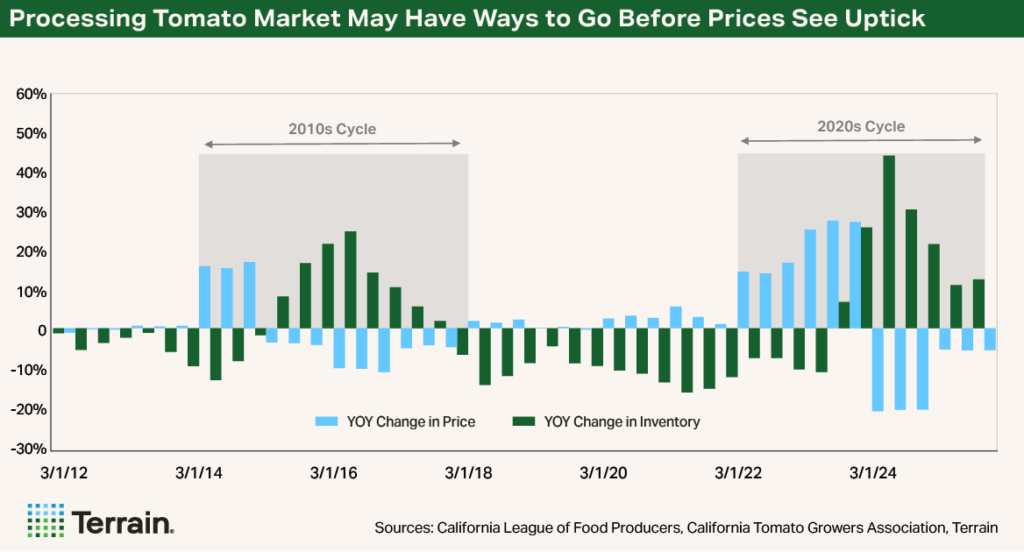
While inventory levels are not as high in absolute terms as they were in 2017, they continue to increase.
With an annual crop like processing tomatoes, however, the framework is far more relevant. The last comparable cycle occurred in the 2010s when drought conditions in California, combined with low global production and record U.S. exports, resulted in a sharp uptick in pricing. Eventually, inventory outpaced demand, bringing prices down with it, a painful memory for those of us who grew tomatoes that year. It was not until inventories declined for several years that prices began to recover.
Using that period as a guide, I believe we are early in another contractionary phase of the current cycle. While inventory levels are not as high in absolute terms as they were in 2017, they continue to increase. Historically, prices only rise once inventories begin to decline, suggesting that the market may still have some distance to travel before prices stabilize or recover.
Even with a 2026 price that is unlikely to be as high as it was last year, higher yields could save the day.
Outlook
Given that we’re still in the contractionary phase of the cycle, with inventories increasing and processors pulling back on acreage, it’s unlikely that prices see a meaningful uptick soon. This is a challenge, since back-of-the-envelope math reveals how tight margins are. Assuming 55 tons per acre and a rough cost of $5,500 per acre, $100 per ton is now an approximate breakeven in the tomato market.
On a more positive note, however, fewer contracted acres means growers who are contracted to grow processing tomatoes in 2026 will do so on their more productive acres. In 2025, this phenomenon resulted in the highest yields on record. Even with a 2026 price that is unlikely to be as high as it was last year, higher yields could save the day.

Terrain content is an exclusive offering of AgCountry Farm Credit Services,
American AgCredit, Farm Credit Services of America and Frontier Farm Credit.