



Outlook • March 10, 2026
Specialty Crop Farmers May Miss on ASCF Payments




Report Snapshot
Situation
In early December 2025, the USDA announced a $1 billion bridge assistance program for specialty crop farmers.
Finding
Economic losses will exceed what is provided in funding, and many farmers are unprepared to take advantage of the program.
The Assistance for Specialty Crop Farmers (ASCF) Program is now being rolled out to distribute the $1 billion allocated for specialty crops.
Late last year, the USDA announced a total of $12 billion in Farmer Bridge Assistance (FBA) program payments to address “market disruptions, elevated input costs, persistent inflation, and market losses from foreign competitors engaging in unfair trade practices that impede exports.” The payments are authorized through the Commodity Credit Corporation Charter Act and administered through the Farm Service Agency (FSA).
Of the $12 billion total, $11 billion was allocated to row crops and $1 billion to specialty crops. Payments to row crop producers began in late February and were based on aggregate economic losses in 2025, subject to available funding. The Assistance for Specialty Crop Farmers (ASCF) Program is now being rolled out to distribute the $1 billion allocated for specialty crops.
The specialty crop economy will benefit from additional assistance. While it is difficult to generalize the health of the specialty crop sector across the nearly 100 eligible crops, prices for many specialty crops have remained depressed due initially to pandemic disruptions and ongoing knock-on effects. More recently, tariff announcements have heightened market uncertainty as global trade patterns continue to shift. Compounding these pressures, production costs — already among the highest in the country for California growers — have risen sharply.
Crunching the Numbers: Big Losses
We derived a rough estimate of aggregate specialty crop losses by piecing together data from the USDA, UC Davis, Cornell University, Oregon State University, Washington State University, the University of Hawaii, and several grower organizations. When cost data were unavailable for a specific year, Crop Sector Producer Price Index data were used to adjust estimates forward in time.
Notable crops that are likely to benefit from this program given recent losses are almonds, walnuts, apples and grapes.
There are two conclusions from our analysis.
1. The total economic loss far exceeds the $1 billion in available assistance by a large margin.
According to our estimates, losses could be as high as $10 billion to $30 billion depending on whether estimates are based on FSA or NASS (National Agricultural Statistics Service) acreage. The prorating factor, or the share of calculated economic losses that is paid, is around 10% for specialty crops using FSA acreage. Notable crops that are likely to benefit from this program given recent losses are almonds, walnuts, apples and grapes. The USDA, however, will make its own estimates of the economic loss experienced by eligible crops and the subsequent payment rates, which could differ from ours.
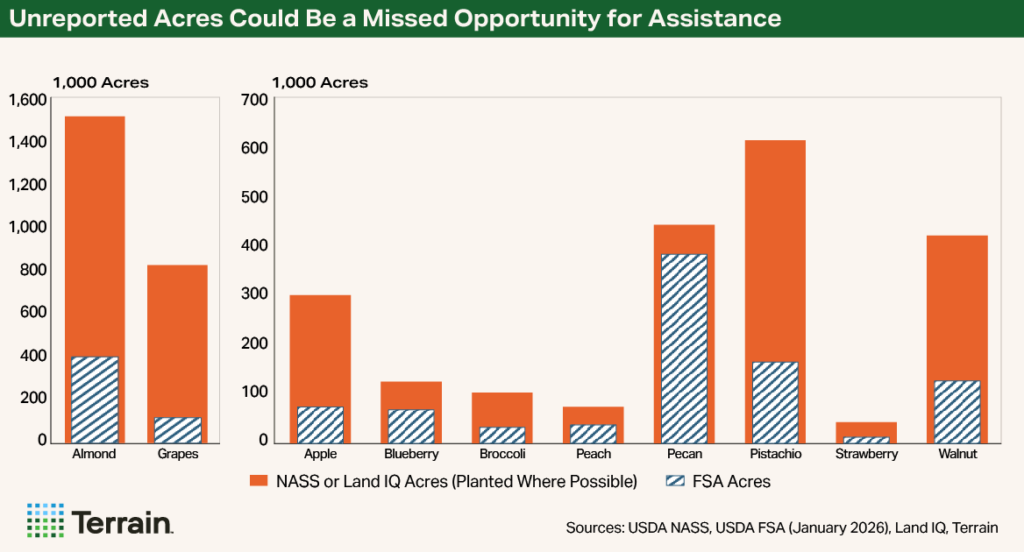
2. A significant gap appears to exist between the total acres of many specialty crops (as estimated by either NASS or Land IQ) and the number of those acres that have been reported to the FSA as of January.
Since payments are likely to be made only on acres reported to the FSA, this underreporting could have a significant impact on some farms. Those who report acres by the March 13 deadline have the possibility to receive larger payments if not all acreage is reported. This also suggests that many specialty crop farmers could miss out on federal assistance after experiencing economic losses.
Payment rates are expected to be announced by the USDA in late March.
What Producers Can Do: Report Your Acres!
Producers planning to participate must report acreage (or verify its accuracy) to their local FSA office by 2 p.m. Pacific time/3 p.m. Mountain time on March 13.
Payment rates are expected to be announced by the USDA in late March, after acreage reporting and economic loss estimates are finalized to ensure total spending remains within the $1 billion allocation.
Once rates are released, producers should watch for guidance on final application procedures and the program sign-up deadline.


Terrain content is an exclusive offering of AgCountry Farm Credit Services,
American AgCredit, Farm Credit Services of America and Frontier Farm Credit.