



Outlook • March 31, 2026
2025 Grape Crush Not as Small as Expected
Winescape Spring 2026 | Trending Topic




Report Snapshot
Situation
The 2025 California grape crush came in at 2.62 million tons, the smallest since 1999. This represented an 8% drop from 2024 (the smallest harvest since 2004). Still, it was much larger than market analysts were expecting.
Outlook
The larger-than-expected crop will result in less improvement in the wine inventory glut than hoped for, and grape demand isn’t likely to see any improvement in 2026.
Impact
Wineries and growers should be sure to review the final version of the Grape Crush Report when it arrives April 30. While I don’t expect to see any material changes, some movement in the numbers is possible, particularly for specific district-variety pairings.
The 2025 California grape harvest was the smallest in more than a quarter-century, but it was still much larger than market analysts were expecting. Thus, the reduction in wine inventory will be less than was hoped for, and grape demand is likely to remain weak this year.
However, the crush wasn’t uniformly small. Demand for white grapes held up better than that for red grapes, and the 2025 Sauvignon Blanc harvest was a record. Moreover, the North Coast has seen essentially no reduction in total grape output over the past two years.
The California Department of Food and Agriculture’s Grape Crush Report shows prices were down again in 2025, though the prices are backward-looking and not indicative of where the market stands today. Grape prices have lagged inflation in almost all districts over the past decade and are down in absolute terms in three. Napa is the exception.
The 2025 California grape crush came in at 2.62 million tons, the smallest since 1999.
The 2025 Crush Was the Slightest of the 21st Century
According to the preliminary Grape Crush Report, the 2025 California grape crush came in at 2.62 million tons, the smallest since 1999. This represented an 8% drop from 2024 (the smallest harvest since 2004) and was 23% below the prior five-year average.
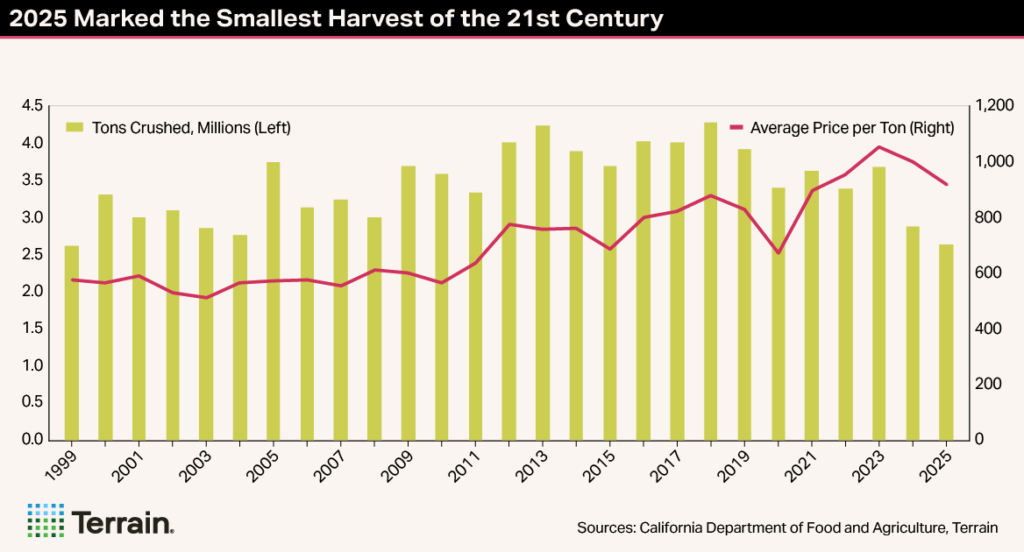
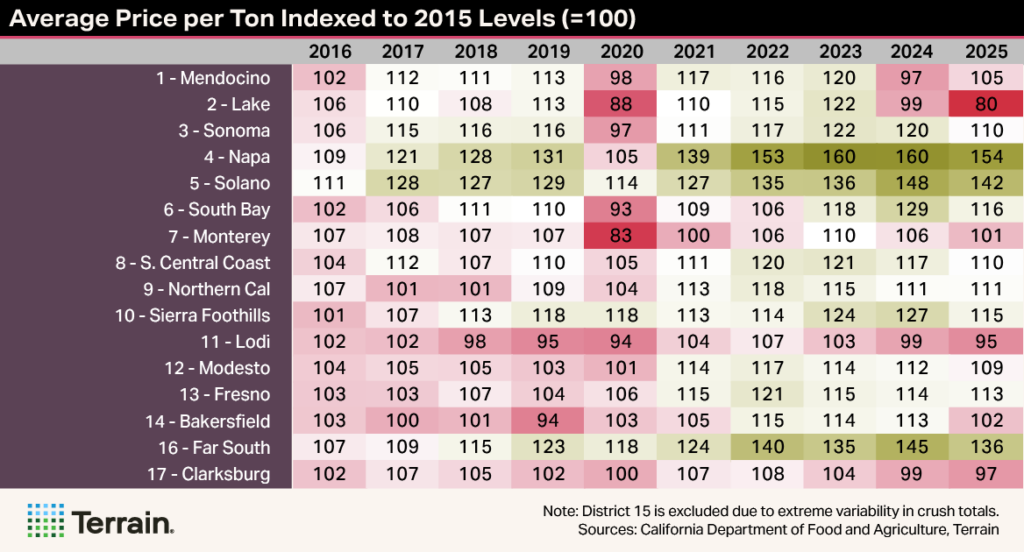
The crush was down year over year (YOY) and below the trailing five-year average in both the Coast and Interior regions. However, two districts, Napa and Mendocino, saw crushes that were slightly above the five-year average.
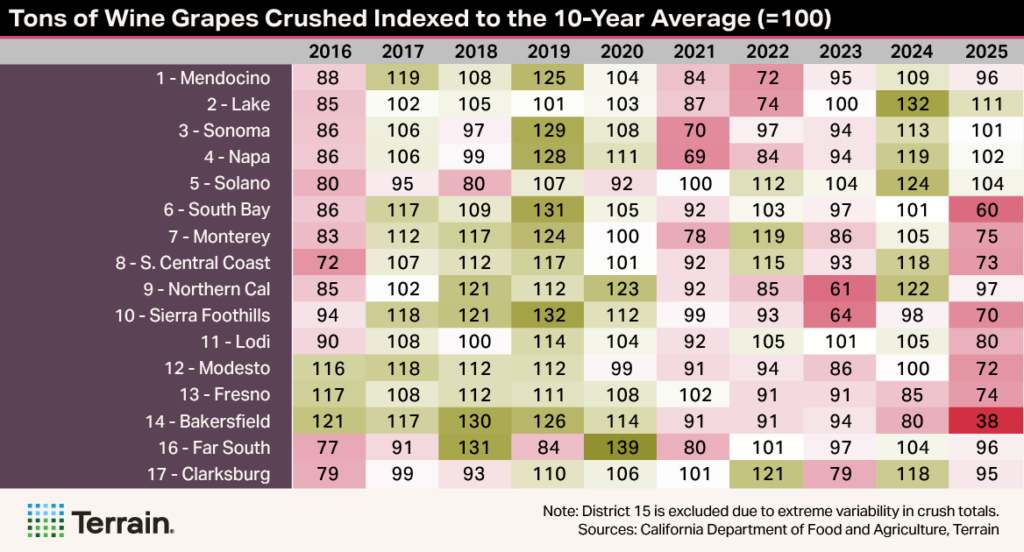
Growers who were fortunate enough to have sold their fruit in 2025 received lower prices.
The smaller crop was due in part to vineyard removals and adverse weather conditions in some areas. More importantly, a substantial quantity of fruit — perhaps 20% of the crop — was left on the vine because there was no buyer.
Growers who were fortunate enough to have sold their fruit in 2025 received lower prices. The overall weighted average price per ton declined by 4% to $987, and the average price for sales between unrelated parties fell by 8%. Unrelated-party prices fell in 16 of 17 districts.
Crush Takeaway: Less Demand for Grapes in 2026
The biggest surprise in the 2025 Grape Crush Report wasn’t how small the crush was, but rather how large it was relative to expectations.
Market observers were generally expecting the crush to be in the range of 2 million to 2.4 million tons. The larger tally suggests that yields — while still below average in some regions— were somewhat more generous than initially thought, and perhaps more unsold fruit was crushed by growers than initially projected.
I’m expecting only a modest drawdown in California winery inventory of around 20 million cases (a ballpark estimate) between midyear 2025 and midyear 2026.
The larger-than-expected crush coupled with deteriorating California wine sales means wine inventory likely won’t see as much of a reduction as I had previously expected.
After incorporating the actual crush total and an updated projection for California wine shipments into my inventory model, I’m expecting only a modest drawdown in California winery inventory of around 20 million cases (a ballpark estimate) between midyear 2025 and midyear 2026. If the crush had come in at 2 million tons, the drawdown would have been 65 million cases.
I believe a supply of approximately 14 months would represent a balanced inventory position.
Because wine sales are still deteriorating, I’m not expecting any improvement in the inventory-to-sales ratio under my base-case scenario. Based on my projection that around 200 million cases of California wine will be sold between July 2025 and June 2026, I expect there to be about 18 months’ supply at the end of June 2026 — the same as where we were heading into the 2025 harvest.
I believe a supply of approximately 14 months would represent a balanced inventory position. So, unless there is a turnaround in wine sales, or a substantial quantity of inventory is transitioned to non-wine uses, we are likely to still be very long on inventory heading into the 2026 harvest, and wineries will likely continue to be very conservative with their grape purchases as they work through carryover inventory.
Thus, demand for grapes isn’t likely to improve in 2026. Approximately 2.9 million to 3 million tons of grapes would be required to replenish the wine sold in 2025. But because of the inventory glut and declining wine sales, far fewer grapes will be needed. There is a possibility that the amount of fruit sold in 2026 will be lower than in 2025. Thus, growers with unsold fruit shouldn’t count too heavily on a buyer materializing before harvest time.
The 2025 Crush Report indicates that more white grapes were crushed in California than red for the first time since 1996.
Beyond the Headline Numbers
Demand for White Grapes Was More Resilient in 2025
The 2025 Crush Report indicates that more white grapes were crushed in California than red for the first time since 1996, though the margin was slim at 10,000 tons. White varieties represented just 44% of the crush as recently as 2022.
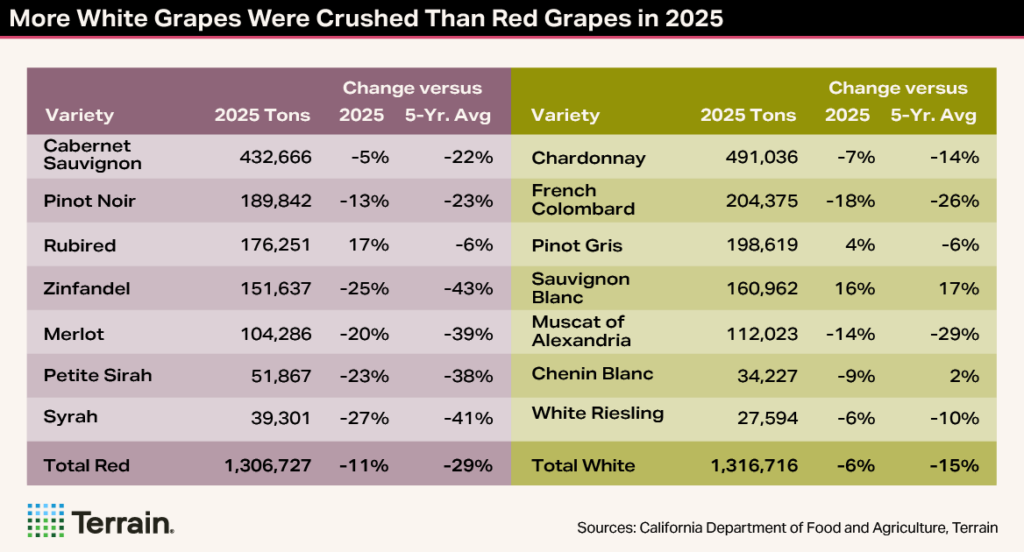
This doesn’t imply that demand for white grapes has been strong; the white grape crush was down 6% YOY and 15% below the five-year average. A large quantity of white grapes went unpicked in 2025, and prices fell in 12 of 17 districts in 2025, implying there was more supply than demand.
The greater resilience of demand for white grape varieties mirrors stronger consumer demand for white wines. White wine sales have been declining but at a slower rate than red wine sales. I expect this trend to continue.
Nonetheless, I advise caution in replanting to white grapes without a contract in hand. This is particularly true for Sauvignon Blanc, which has seen heavy plantings in recent years.
At 161,000 tons, the Sauvignon Blanc harvest reached an all-time high in 2025. It was up 16% YOY and 17% above the five-year average. The crush was particularly heavy in the North Coast (32% above the five-year average), though it was also above average in the Central Coast and Northern Interior. However, Sauvignon Blanc prices fell in all major districts that produce this variety in 2025.
While demand for Sauvignon Blanc grapes has held up better, the surge in planting increasingly looks to be overdone. Although consumers have been gravitating toward Sauvignon Blanc, and it has been the top performer in the retail wine market in recent years, sales volume was flat in 2025, according to NIQ data.
Moreover, bulk Sauvignon Blanc inventory has surged over the past year and now stands at an all-time high, according to Turrentine Brokerage. More Sauvignon Blanc plantings will begin to bear in the next several years, so the excess is likely to grow going forward.
The North Coast Hasn’t Seen as Much Adjustment in Grape Supply
Most California regions have seen steep declines in grape output over the past two years. The Southern Interior crushed 31% fewer grapes per year in 2024 and 2025 than it did between 2019 and 2023. Central Coast output is down 28%, and the Northern Interior crush fell by 22%.
Conversely, the North Coast hasn’t yet seen any reduction in its grape harvest. While its 2025 crush was down slightly compared with 2024, it wasn’t exactly small. And over the past two years, the North Coast crush has averaged 478,000 tons, slightly above the 472,000 tons per year that were crushed in the prior five years.
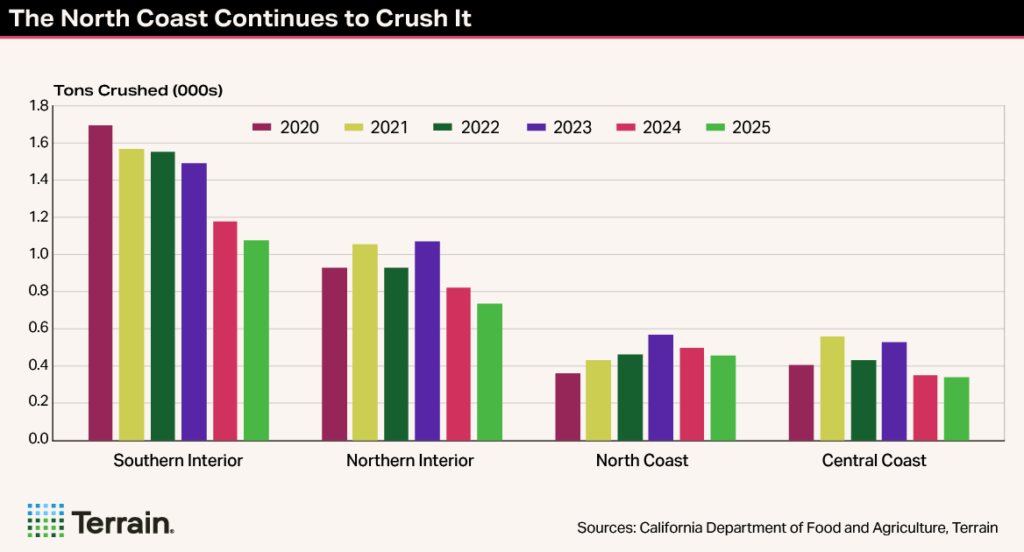
Resilient North Coast grape output is partly attributable to generous yields in recent years. Additionally, fewer vineyards have been removed compared with the Interior and Central Coast. Grape demand has also been stronger, as the North Coast remains California’s premier wine-growing region, and premium and luxury wine sales volumes have been declining at a slower rate than sales of lower-priced bottles.
Nonetheless, North Coast grape prices have been falling, and a substantial amount of fruit was left on the vine in 2025. Thus, supply is clearly outstripping demand in the North Coast as it is in other regions.
The North Coast should remain favorably positioned vis-à-vis wine sales trends over the medium term.
The consequence of resilient North Coast grape output is that there will be plenty of North Coast wine available from the 2024 and 2025 vintages. Thus, inventory is likely to remain excessive. Indeed, Turrentine Brokerage indicates that North Coast bulk wine availability has surged over the past several years and now looks to be at an all-time high.
The North Coast should remain favorably positioned vis-à-vis wine sales trends over the medium term. But more vines will likely need to be removed to bring the grape market back into balance, unless premium and luxury wine sales volumes begin to grow again in absolute terms.
Grape Prices Look Increasingly Unsustainable
Grape Crush Report prices are always a lagging indicator of current market prices, and this is particularly true during market transitions. Most of the prices captured in the 2025 report reflect the economics of deals signed in past years because few new grape contracts were signed in 2025 and spot market activity was depressed.
It’s difficult to see where grape prices stand today due to the dearth of sales activity since the 2025 harvest concluded. Even so, there is clearly downward pressure on prices, as there are many more sellers than buyers.
Despite these caveats, Crush Report prices are still useful for examining historical trends.
The past decade has not been kind to California wine grape growers. Grape prices increased slowly, but steadily, in most districts from 2015 until 2022 or 2023. But the decline in prices in recent years has wiped out much or all of the gains in many districts.
Napa grape prices are still up by 54% over the past 10 years, and the Napa grape price premium has widened.
Grape prices have failed to keep up with inflation over the past decade (general prices rose 37% between 2015 and 2025) in 15 of 17 districts, let alone farming costs, which are thought to have risen at nearly twice the rate of general price inflation. Prices are now below where they were 10 years ago in absolute terms in three districts (Lake, Lodi, Clarksburg). Obviously, this is not a sustainable situation. Vineyards will continue to be removed until supply is reduced by enough to generate prices that provide a reasonable return for growers.
Napa is the only major district to buck this trend. Despite a modest decline over the past two years, Napa grape prices are still up by 54% over the past 10 years, and the Napa grape price premium has widened. Napa grapes now command a 152% premium over Sonoma grapes, up from 79% 10 years ago. They now trade for 3.9 times the price of District 8 grapes (San Luis Obispo and Santa Barbara counties), up from 2.8 times a decade ago.
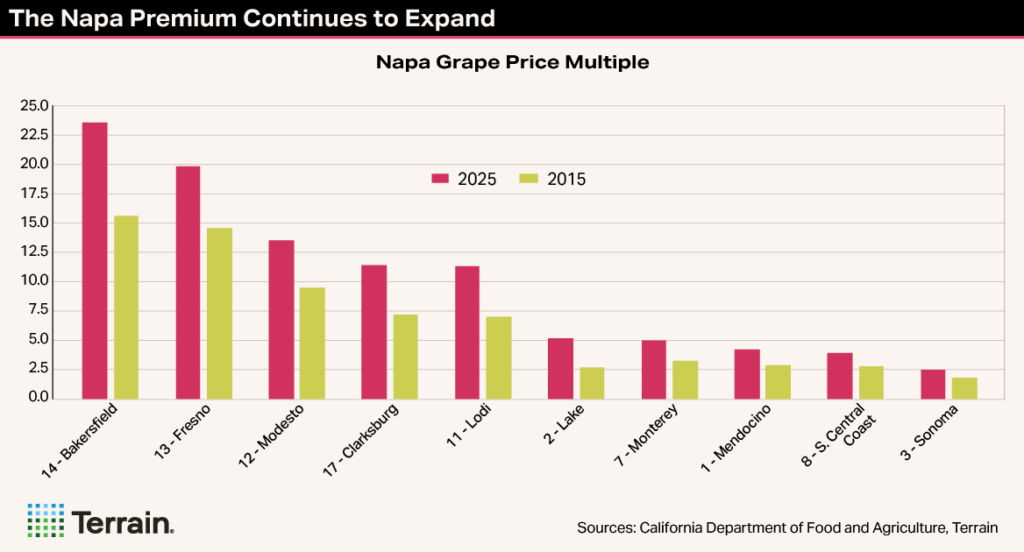
The fact that Napa grapes command a premium isn’t problematic given that it is still the premier wine region in the U.S. and one of the most coveted in the world. Whether or not the size of the premium will continue to hold is more questionable and will ultimately depend on the trajectory of Napa bottle prices.
Napa bottle prices have been softening in the three-tier channel due to discounting to move excess inventory. Given the sizable Napa crushes in recent years, Napa wines will continue to be in ample supply, which should continue to constrain bottle prices. On the other hand, direct-to-consumer bottle prices look to still be rising, though this has come at the price of lost volume.
May the Odds Be Ever in Your Favor
There wasn’t much good news in the 2025 Grape Crush Report for grape growers. The larger-than-expected crop will result in less improvement in the wine inventory glut than hoped for, and grape demand isn’t likely to see any improvement in 2026.
Grape prices will ultimately be determined by the intersection between supply and demand. Substantial progress has been made on the supply side, and there will almost certainly be fewer grapes grown this year due to vineyard removals and mothballing. However, without knowing how much acreage will be farmed in 2026, or where yields will land, I can’t predict yet where prices will be when harvest arrives.
Wineries that know they will need more grapes in 2026 should act sooner rather than later.
Growers who choose to farm without contracts will be rolling the dice. As always, the balance between supply and demand will vary across regions and varieties, and some market segments will offer higher odds than others.
Wineries that know they will need more grapes in 2026 should act sooner rather than later, as the choice set will narrow progressively as harvest approaches.
Wineries and growers should be sure to review the final version of the Grape Crush Report when it arrives April 30. While I don’t expect to see any material changes, some movement in the numbers is possible.


Terrain content is an exclusive offering of AgCountry Farm Credit Services,
American AgCredit, Farm Credit Services of America and Frontier Farm Credit.