Quarterly Outlook • June 23, 2026
A Modest Improvement on the Wine Sales Front

Report Snapshot
Situation
The pace of decline in wine sales has moderated slightly after disappointing results in 2025. However, wine inventory levels are stubbornly high and exports are down. In the grape market, sales continue to be slow, though there are buyers actively sizing up their options.
Outlook
Given high inflation and record-low consumer sentiment, I’m not expecting the pace of decline in wine sales to improve through the remainder of the year.
Finding
Buyers who are fairly certain they’ll need more fruit this year may want to act sooner rather than later. There will be fewer options at harvest time than there were last year.
Wine Market Update
There hasn’t been a great deal of change in the complexion of the U.S. wine market in early 2026, though the data generally suggest that the pace of the decline in wine sales is moderating a bit following disappointing results in 2025.
Based on my analysis of NIQ data, off-premise retail sales fell 3% in value and 4% in volume during the first four months of the year compared with the same period in 2025. However, the year-ago comparison was weak, and progress tailed off in April.
Distributor depletions continue to decline at a faster rate. They fell 5% in value and 9% in volume year over year (YOY) during the same period, according to SipSource data.
The three-tier decline continues to be uneven: Premium and luxury wine sales are still holding up better than value-priced bottles.
Direct-to-consumer (DtC) sales have seen more substantial improvement, though the channel continues to see losses in visitor and club member counts. DtC revenues for Community Benchmark participants increased 1% YOY for the first four months of 2026, compared with a modest decline for full-year 2025.
DtC shipments continued to drop in early 2026, according to figures from Sovos ShipCompliant and WineBusiness Analytics, though at a slower rate than in 2025. They were down 2% in value and 13% in volume YOY from January through April.
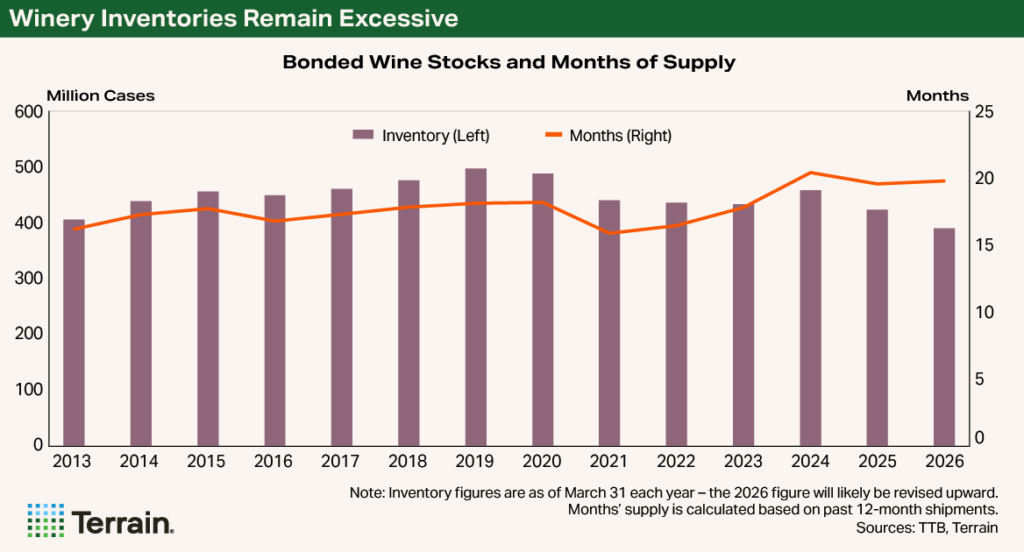
Wine inventory levels remain stubbornly high.
U.S. wine exports plunged 20% in value YTD through April and 16% in volume versus the same period a year ago. This represents a slower rate of decline compared with the last three quarters of 2025, though this was mainly attributable to a weaker comparison, as Canadian provincial bans on American alcohol went into effect during Q1 2025.
Wine inventory levels remain stubbornly high. The most recent TTB data indicate that U.S. wineries are still holding a 20-month supply of bonded wine (both bulk and bottled). A 15- or 16-month supply would be more desirable.
Wine Market Outlook
The economy has performed reasonably well in early 2026. The Terrain team expects it to continue to grow in the months ahead at a rate slightly below trend. Unemployment remains low by historical standards, and we expect it to remain steady going forward. Nonetheless, consumer sentiment has taken a turn for the worse (it hit its lowest level ever in May) amid a climate of rising prices and heightened political and economic uncertainty.
We expect above-target inflation to persist for some time even if the Iran war concludes soon, as it will take time for impacted supply chains to normalize. Moreover, price increases are now beginning to outstrip wage gains, which will squeeze household budgets, particularly for those in the lower half of the income distribution. Thus, consumers are apt to be cautious with their spending on discretionary items, including wine, for some time.
Given this backdrop, I’m not expecting the pace of decline in wine sales to improve through the remainder of the year. The premium and luxury segments should continue to hold up better than the lower end, though there is also likely to be downward pressure on wine prices as wineries prioritize moving excess inventory.
Lastly, wine exports are likely to remain deeply depressed in the near term. There are no signs yet that additional Canadian provinces intend to lift their bans on American alcohol.
Grape Market Update
Grape sales continue to be slow, though there are buyers actively sizing up their options. On the supply side, uncontracted grapes remain abundant and vineyards continue to be uprooted at a steady pace. In addition, abandoned or only minimally farmed vineyards are readily apparent across California.
There will almost certainly be less excess fruit available this year than last.
California weather conditions have been volatile in early 2026, and shatter and mildew are apparent in some areas. The summer is forecast to be warmer than normal throughout California, with equal chances of above- or below-average precipitation, consistent with the brewing El Niño cycle. Warmer temperatures could accelerate vineyard development, which is already generally running two to four weeks ahead of schedule.
Given the lack of improvement in wine sales, still-excessive wine inventory, and an abundance of bulk wine available for sale, grape buyers are in no hurry to commit to fruit. It’s difficult to say what the spot market will look like come harvest time. Demand is likely to remain fragile, but there will almost certainly be less excess fruit available this year than last. Still, I expect there will be plenty of fruit to go around unless yields come in low.
Sellers should give any offers received due consideration, as there may not be another one coming.
Buyers who are fairly certain they’ll need more fruit this year may want to act sooner rather than later. There will be fewer options at harvest time than there were last year.
Terrain content is an exclusive offering of AgCountry Farm Credit Services, American AgCredit,
Capital Farm Credit, Farm Credit Services of America and Frontier Farm Credit.