Outlook • May 7, 2026
A Time for Reflection on the Almond Market


Report Snapshot
Situation
Following an exceptionally strong decade, the almond industry saw a convergence of challenges in the early 2020s. As the industry now moves toward greater stability, this is a natural moment to take stock of its strengths, weaknesses, opportunities and threats.
Finding
While recent stress highlighted real vulnerabilities, including export dependence and groundwater limits, it did not erase the structural strengths that supported decades of growth.
Impact
While many risks cannot be identified before their impacts are felt, proactively hedging against known risks helps support long-term economic sustainability. Additionally, growers and handlers evaluating these dynamics or exploring specific opportunities should talk with their Farm Credit lender as they navigate what comes next for their operation.
Periods of transition invite reflection. The almond industry is emerging from a period of below break-even pricing to one where prices are at or just above breakeven. While current economics remain much weaker than the conditions that defined the 2010s, today’s environment is meaningfully more stable than in 2022 or 2023. After several years of widespread orchard removals, some growers are now even considering whether replanting makes sense.
As the industry moves from a pronounced supply-demand imbalance toward greater stability, this is a natural moment to take stock of what drove past success, where constraints have emerged, and how present conditions may shape what lies ahead.
Using the SWOT Framework
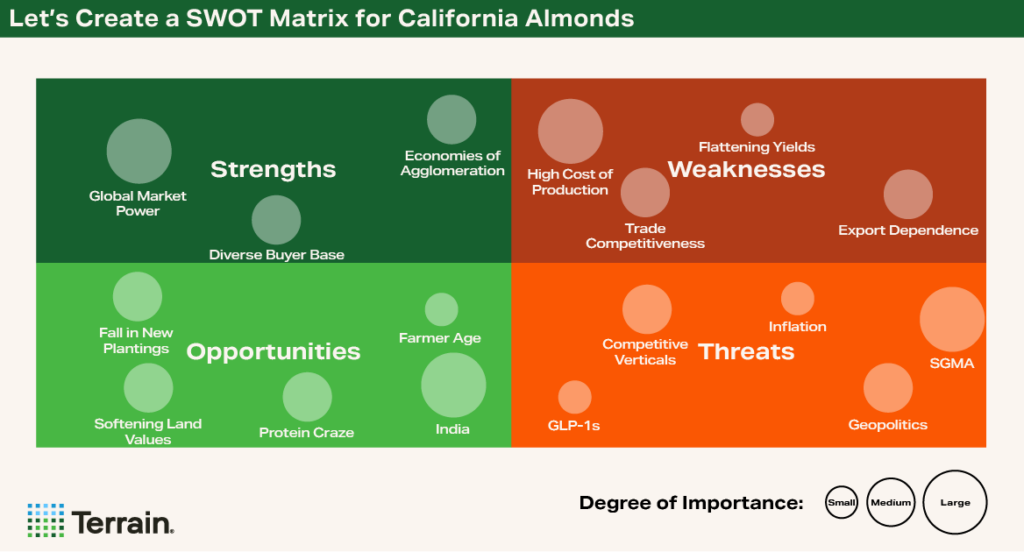
A SWOT (strengths, weaknesses, opportunities, threats) framework provides a useful lens for organizing that discussion, focusing on the key forces that have influenced how the industry arrived here and where it may be headed.
- Strengths reinforce the advantages the California industry has over global competitors — and what we should not lose sight of. Changes to the industry should not diminish these strengths.
- The last decade’s shocks to the supply chain highlighted the weaknesses — areas that can be improved to reduce or mitigate risk.
- Opportunities highlight that there are areas still for growth and not just stabilization, while threats examine new, developing risks. These new, brewing risks can be either mitigated or turned into opportunities.
Strengths
Despite recent challenges, it is important not to lose sight of the remarkable success that transformed California almonds from a niche crop into the state’s second largest agricultural commodity by value. USDA data show that from 1990 to 2024, almond production expanded at a compound annual rate of roughly 4.3%, supported by the Central Valley’s ideal climate for almond production.
Growth was further supported by powerful demand tailwinds as global incomes rose and diets shifted toward convenient, healthy foods. Almonds fit neatly into modern consumption patterns and became increasingly embedded in value-added products such as butter, flour, oil and dairy alternatives. That innovation has resulted in almonds appearing in nearly every aisle of the grocery store.
California remains the world’s dominant supplier, allowing the industry to capture the benefits of scale, innovation and expanding demand.
As demand expanded, the industry also built a diversified buyer base. Export growth outpaced production growth, with shipments rising at an estimated 5.6% annually. Measured by the Herfindahl–Hirschman Index (HHI), almond demand is less concentrated than total agricultural exports, helping mitigate country-specific risk when geopolitics or weakness in a particular country interrupt trade flows.
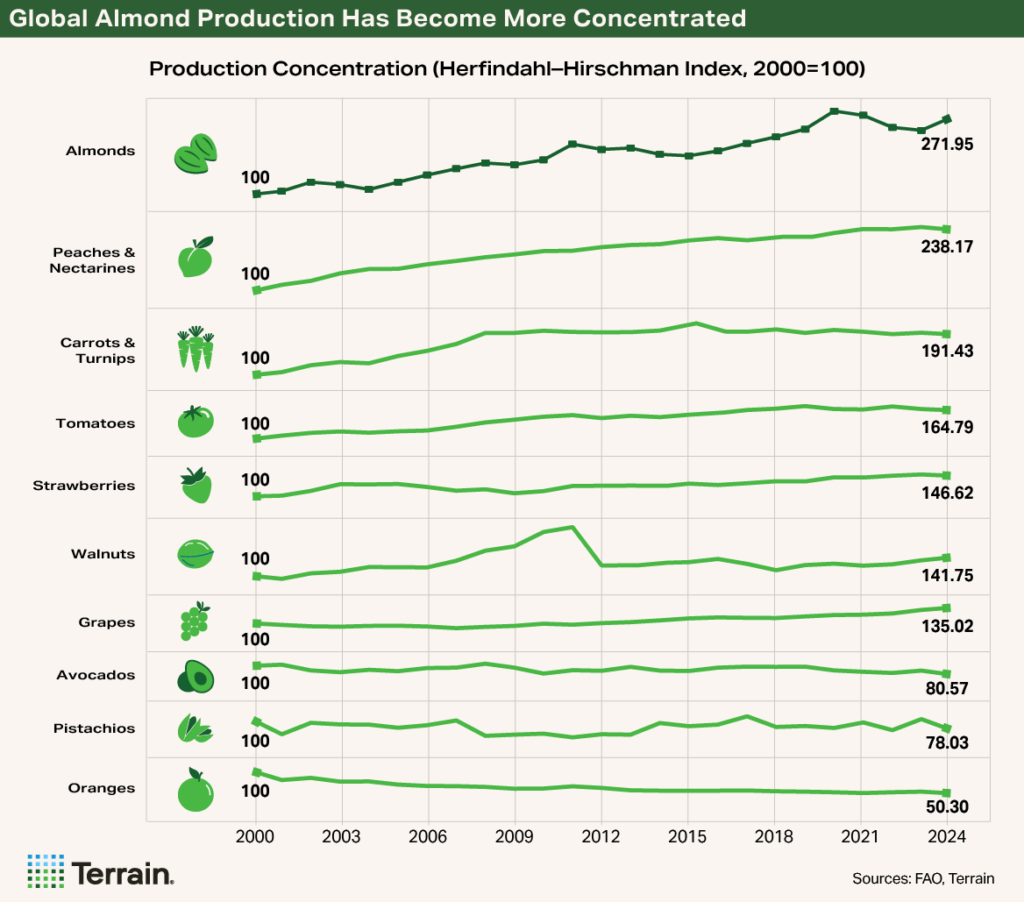
Production, by contrast, is highly concentrated and has become more so. California accounts for about 75% to 80% of global almond supply, far surpassing producers Australia, Spain and Portugal. While foreign competition continues to grow, California remains the world’s dominant supplier, allowing the industry to capture the benefits of scale, innovation and expanding demand.
Over time, success reinforced itself. Growers, handlers and service providers built a dense and specialized ecosystem with about 7,600 almond farmers, nearly 100 handlers, nearly 3 million bee colonies during harvest, and numerous irrigation and farm machinery companies ready to support farmers. One economic study from the University of California’s Agricultural Issues Center put the industry’s direct and indirect contribution to employment at roughly 110,000 jobs. These economies of agglomeration have generated efficiencies, facilitated expertise, and enhanced productivity gains that remain a quiet but durable advantage over competitors, even while costs continue to rise.
Like most growth models, these strengths came with tradeoffs, many of which surfaced simultaneously in the early 2020s.
Weaknesses
Like most growth models, these strengths came with tradeoffs, many of which surfaced simultaneously in the early 2020s. Following an exceptionally strong decade, the industry encountered a convergence of challenges from pandemic-related shipping disruptions to inflation to water constraints to trade frictions. As one farmer told me, it was Murphy’s Law in action: “What could go wrong, did go wrong.”
Export dependence proved an obvious vulnerability. During the pandemic, congestion at the Port of Oakland slowed outbound shipments, leading to inventory buildup and a sharp drop in prices. While the buyer base is geographically diversified, the episode revealed how exposed the industry remains to systemic global shocks even if it’s reasonably hedged against individual country shocks.
Shortly after, pandemic-induced inflation showed that the high cost of farming in California could rise even further, exposing farmers to record-high losses. The cost of inputs, labor and regulatory compliance all increased. With prices depressed, breakevens moved higher, intensifying financial stress across the industry.
Water policy introduced a structural constraint. The rollout of Groundwater Sustainability Plans (GSPs) under the Sustainable Groundwater Management Act (SGMA) (due in 2020 or 2022 depending on the basin) introduced a constraint that, along with low prices, resulted in acreage removals.
Groundwater limits will remain a binding long-term challenge. Statewide estimates suggest that hundreds of thousands of acres, many of them in permanent crops, may be repurposed.
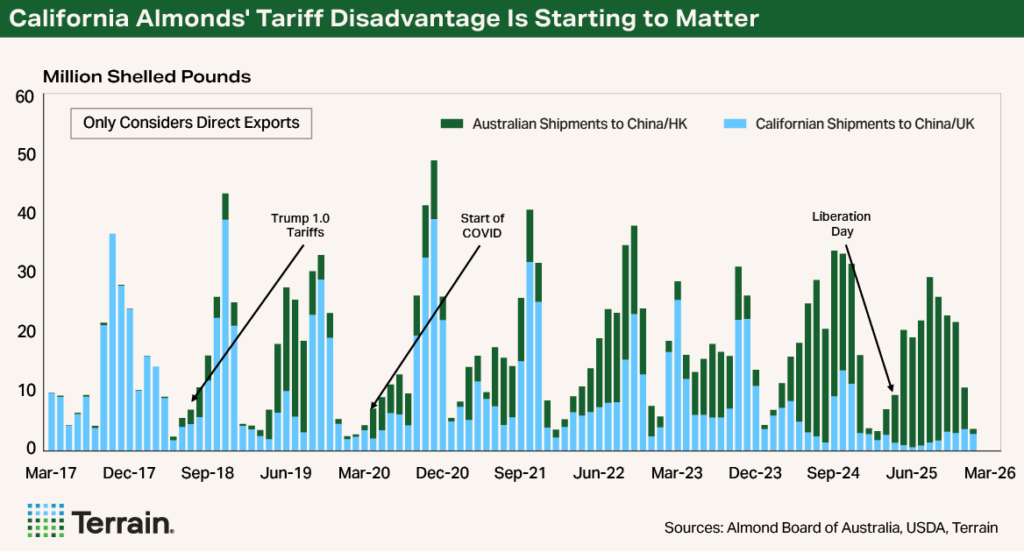
Trade policy has also become a risk. Though not immediately visible in aggregate shipment data, market-trading trends show shifts in competitiveness. China (and Hong Kong), once our top destination, now consistently imports more almonds from Australia due to preferential trade agreements, despite Australia producing a fraction of California’s volume. Though re-exports through Southeast Asia can complicate how much California product gets to China, rerouting introduces more trade risk, friction and cost into the supply chain.
Opportunities
With the industry’s strengths and weaknesses clear, the focus turns to how they interact to shape future opportunity. While volatility has made optimism harder to muster, many foundational strengths remain intact. The constraints revealed under stress also help clarify where adaptation is most viable, echoing Churchill’s quote that “difficulties mastered are opportunities won.”
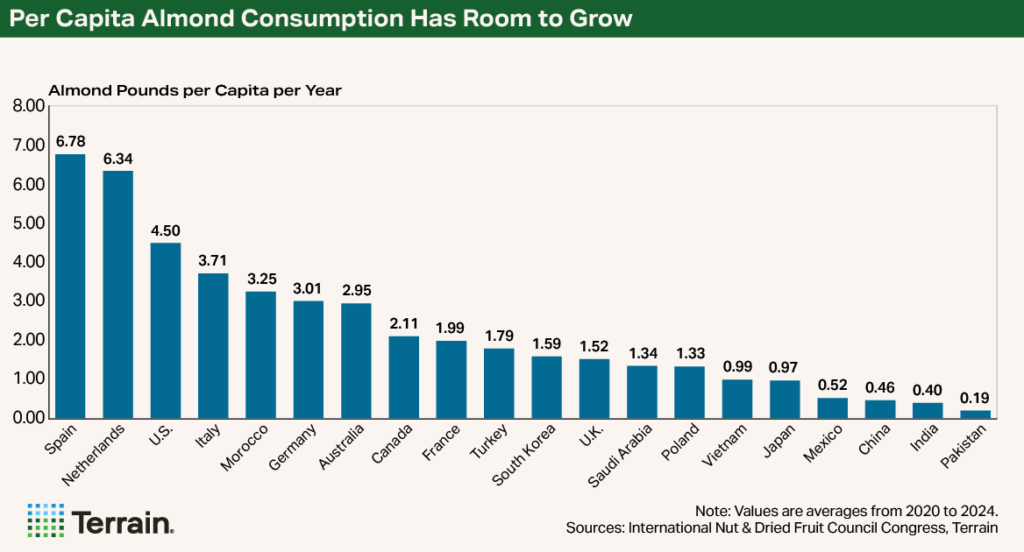
Market development is one such opportunity given that per capita consumption remains low in many countries. India has emerged as the industry’s largest destination, supported by population growth, rising incomes, and improving policy dynamics. But India is well behind even the modest U.S. consumption and would need to import 6 billion shelled pounds (about two years of total California production) to reach U.S. per capita consumption levels. Recent reductions in sales taxes on nuts and a new U.S.–India trade agreement could further support long-term demand growth, reflecting a shift in India’s cautious stance toward free trade historically.
Food trends also create avenues for adaptation. Interest in health-oriented, protein-dense foods has never been higher and is likely to introduce new opportunities for almonds if innovation remains a focus, even as competition intensifies across categories. Given the health profile and versatility of almonds, they have much to gain as consumer preferences continue to shift.
At the grower level, lower land values may also present entry or expansion opportunities as the market continues to adjust, especially for:
- Younger growers looking to enter the industry
- Existing growers expanding operations
- Strategic buyers looking for ground for water purposes
With new plantings remaining low, replanting in anticipation of lower almond supply down the line may be a smart strategy for some growers.
Threats
Persistent risks can limit the opportunities. While many risks cannot be identified before their impacts are felt, proactively hedging against known risks helps support long-term economic sustainability.
Geopolitical instability continues to threaten global demand, particularly in the Middle East, a key export region. Rising energy prices and renewed inflationary pressure could further weaken global growth and consumer purchasing power. Because almonds are a higher-priced, more discretionary food product, demand is likely to be more price-sensitive than for staple, demand-inelastic commodities such as rice and wheat.
Domestically, changing consumer habits pose another challenge.
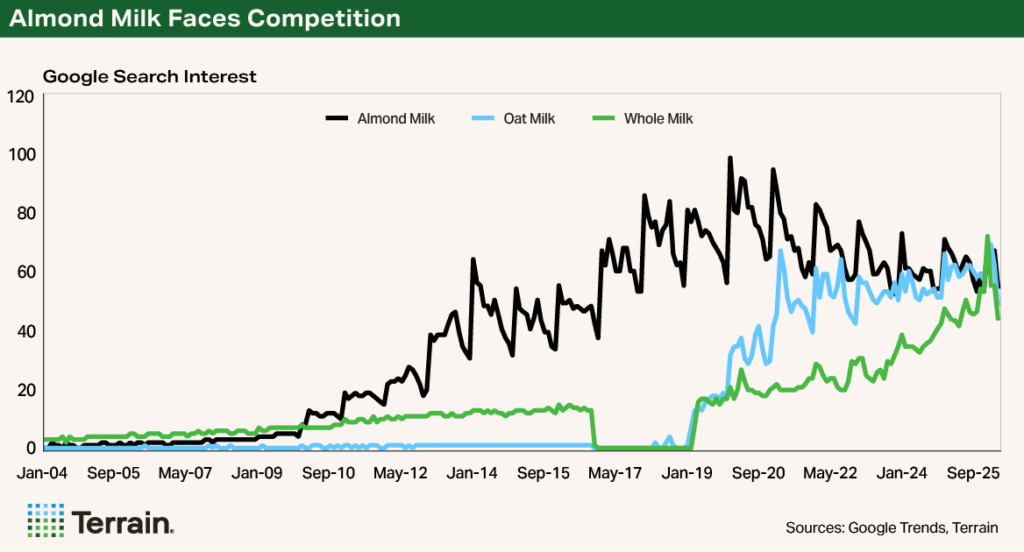
Though data is scarce, Google Trends data suggest almond-based categories face increased competition, with interest in almond milk, butter and oil lagging alternatives such as oat milk, animal proteins, and other alternative oils like avocado and sunflower.
Additionally, the emergence of more accessible GLP-1s has implications for consumer demand. Early evidence suggests users reduce consumption and spending on nuts as snacking declines, potentially creating additional headwinds for almond demand. Though almonds have many desirable characteristics for GLP-1 users, snacking tends to decrease. Depending on how prevalent GLP-1s may become, this trend among early-wave users could affect the high percentage of almonds sold through snacking channels.
While recent stress highlighted real vulnerabilities, it did not erase the structural strengths that supported decades of growth.
Forging Ahead
Reflection is not always easy, particularly after years defined by low prices and rising costs. Yet it remains essential. While recent stress highlighted real vulnerabilities, it did not erase the structural strengths that supported decades of growth.
The industry will continue to face risks but also identifiable opportunities.
Growers and handlers evaluating these dynamics or exploring specific opportunities should talk with their Farm Credit lender as they navigate what comes next for their operation. Identifying partners with industry knowledge has always mattered, but it has never carried a higher premium.

Terrain content is an exclusive offering of AgCountry Farm Credit Services, American AgCredit,
Capital Farm Credit, Farm Credit Services of America and Frontier Farm Credit.