Quarterly Outlook • October 19, 2026
Better Margins, Bigger Questions for Soybeans

Report Snapshot
Situation
Average operating margins for U.S. soybean farmers are improving, while uncertainty around trade with China and the outlook for Brazil’s crop, among other factors, could drive Q4 volatility.
Outlook
My forecast for the 2026/27 season-average price is about $12.50/bu. (with a range of $12.20-$12.80/bu.), up from last quarter’s forecast.
Price volatility, and potential opportunities for farmers, this quarter will be tied to USDA supply estimates, crush demand, export sales to China, and the outlook for Brazil’s crop.
Regional Supplies Still Skew East
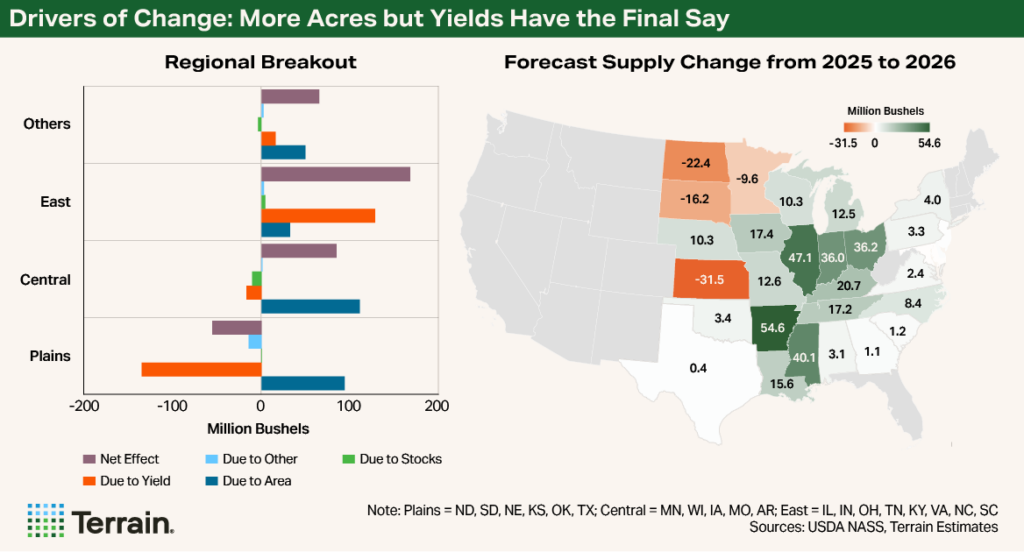
The September 30 USDA report brought little surprise for soybean stocks. For the 2026/27 marketing year, beginning stocks were estimated at 315 million bushels, just 6 million bushels below expectations. On-farm stocks were down just 1% overall from last year, but the total masks regional shifts.
These tighter supplies across the Plains relative to the eastern parts have been reflected in basis levels.
When accounting for the USDA’s September production estimate of 4.562 billion bushels, supplies still skew higher in much of the eastern and central U.S. Since my initial estimates in the July outlook, upward revisions to acres raised supply estimates across all regions. Yields have raised supplies in eastern regions while reducing the supply prospects for the central and Plains regions.
These tighter supplies across the Plains relative to the eastern parts have been reflected in basis levels, with those in the west generally running above their 10-year average while those in the east are much closer to their 10-year average. These trends are expected to continue through Q4 once we make it through harvest.
Soybean crush is forecast to rise 5.1% this year to reach 2.78 billion bushels.
Riding the Crush Wave
The strength of crush demand this year rests in part on finalizing the complete reallocation of the excess Small Refinery Exemption volumes above what was previously estimated by the Environmental Protection Agency (EPA) and included in the Renewable Volume Obligations this spring. The EPA has indicated it intends to propose these reallocations by the end of October. Be on the lookout for those, as they could offer crush strength if confirmed, or weakness to soybean oil and soybean markets if they fall short of complete reallocation.
Supported by biofuel policy and protein meal demand in the U.S. and globally, soybean crush is forecast to rise 5.1% this year to reach 2.78 billion bushels, according to the USDA. CHS recently announced plans to build a new 80 million-bushel crush plant in Evansville, Wisconsin, with operations expected to start in fall 2028, emphasizing the positive medium-term outlook for soybean crush.
Beans as a Bargaining Chip
Leading up to the U.S.-China meeting, two things were influencing markets:
- Since around July, China was buying U.S. soybeans on a mostly regular basis, giving the market optimism that China would buy the 25 million metric tons (918 million bushels) of soybeans it is said to have committed to. China bought at least 43% (and likely closer to half) of this target prior to the meeting.
- There was optimism headed into the meeting that soybeans could be featured as an easy win with a commitment post-meeting for additional purchases.
Post-meeting, however, there have been no new substantial export sales to China, leaving the market largely disappointed, with futures prices moving lower accordingly. Additionally, soybeans (except for seed) were not included in the “30-for-30” tariff reduction list submitted by China to the newly formed U.S.-China Board of Trade, leaving U.S. soybean sales to China largely confined to state buyers — unless the price gap versus Brazilian soybeans widens enough to overcome the remaining 10% tariff.
It appears that China has retained soybeans as a bargaining chip for ongoing negotiations, as the trade truce to halt the retaliatory tariffs and other restrictions from last fall (the “Busan Agreement”) has been extended to January.
With soybean exports to China potentially under the purview of the newly formed U.S.-China Board of Trade, they have attracted another level of policy oversight. Price volatility likely comes with “managed trade” in soybeans between the U.S. and China.
The Brazilian Slowdown
Brazilian farmers are expected to increase planted soybean area at the slowest rate in 20 years (since the reduction in 2006/07), according to CONAB’s September forecast. Area is forecast to expand by 1.4% to 49.3 million hectares, less than half the 3.1% expansion forecast by the USDA in October.
While unforeseen, any changes to planting pace that reduce the size of Brazil’s crop could lead to price volatility in Q4 for soybeans.
Differences in yields and area forecast lead to a nearly 4.4 million-metric ton production gap between the two agencies. CONAB yields are forecast at 3.68 metric tons/hectare, 2% above my forecast but below the USDA’s assumed yield of 3.72 metric tons/hectare. Watch Brazil’s total number of soybean acres planted, their planting pace, and yield prospects throughout Q4 2026.
I forecast the 2026/27 season-average price at about $12.50/bu.
So far in early October, the weather outlook is generally favorable for normal planting progress in mid- to late October. While unforeseen, any changes to planting pace that reduce the size of Brazil’s crop could lead to price volatility in Q4 for soybeans.
Better Margins, Bigger Questions
I forecast the 2026/27 season-average price at about $12.50/bu., with a range of $12.20-$12.80/bu., which is above last quarter’s forecast. Outside money flowing into soybean futures contracts has driven part of the recent rally in prices. Managed money was record-long soybeans at over 265,000 contracts as recently as September 21 and still ranks in the 99th percentile historically with over 258,000 contracts as of October 5. This represents a downside price risk if this large group of speculators decide to reduce their net position.
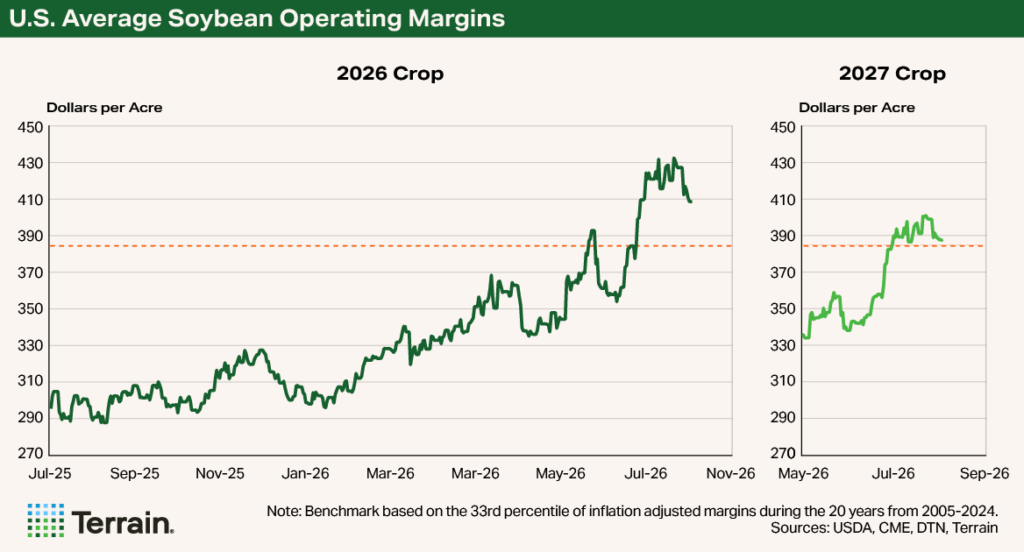
Average operating margins for U.S. soybean farmers have improved steadily throughout the year, rising from a 2026 low of $296/ac. in January to a high of $433/ac. on September 10 before settling back to end September at $416/ac. This estimate is above the long-run benchmark. Depending on a farm’s yields and local basis offers, the profitability for this crop could be better than the benchmark.
Looking out to the 2027 crop, early estimates of those operating returns are near the long-run benchmark, which should offer better opportunities for risk management for the 2027 crop than we saw earlier this summer.

Terrain content is an exclusive offering of AgCountry Farm Credit Services, American AgCredit,
Capital Farm Credit, Farm Credit Services of America and Frontier Farm Credit.