Quarterly Outlook • July 7, 2026
Falling Input Costs, Persistent Risks


Report Snapshot
Situation
Following a year of volatile input prices for fertilizer and fuel, lower prices could be ahead for the 2027 crop.
Outlook
I forecast average operating costs for corn and soybeans to decline for 2027 based on lower fertilizer and fuel prices, with higher use partly offsetting the decline. More expensive repairs and custom services will also limit the overall decline in costs. This outlook is contingent on normalizing energy flows through the Strait of Hormuz and ongoing peace between the U.S. and Iran.
Lower prices for nitrogen are not without risk.
For farmers who typically purchase inputs during late summer or early fall, timing this year could be challenging as market prices adjust downward in the months ahead.
Wholesale market prices for urea (New Orleans) have fallen recently and are currently down about 50% from their peak in early April. These lower prices are expected to continue through fall, though retail price adjustments to these lower prices have taken time historically.
Lower prices for nitrogen are not without risk. A re-escalation of the conflict between the U.S. and Iran could push prices higher.
These are risks not only for urea but diesel, too. Markets currently price an average monthly decline of about 3 cents per month, with farm diesel forecast to approach $3.50/gallon near the end of the year.
Phosphate production costs remain elevated, leading to announced production cuts, as key inputs (sulfur and ammonia) to that manufacturing process remain at elevated price levels. Prices for phosphate fertilizers look to remain elevated at least through fall, with some decline possible. These declines will likely be tied to either lower sulfur, sulfuric acid or ammonia prices. Though less likely, more significant price declines would require a noticeable increase in supplies, either from larger Chinese exports or another major producer. I forecast U.S. average retail MAP prices to average about $925/ton and DAP prices to average about $850/ton in the fourth quarter.
Nitrogen prices are expected to see the largest price decline this fall, though retail cash prices for urea and UAN may stay elevated through summer before resetting lower toward fall. I forecast U.S. average retail anhydrous ammonia prices to average $850/ton, urea prices to average $570/ton, UAN-28 to average $370/ton, and UAN-32 to average $425/ton in the fourth quarter.
Potash prices have been unaffected directly by the Iran war, though higher transportation costs have likely contributed to some of the slight increases seen since the war started. I forecast U.S. average retail potash prices to decline slightly to average $485/ton this fall.
If talks stall and military action resumes, prices could rise and again be volatile during a key period.
Key Risks Remain
War risk is significantly diminished but not gone. A memorandum of understanding to reopen the Strait of Hormuz and end (at least for now) the U.S.-Iran war was signed June 17, setting off a 60-day window to finalize critical issues. These include major issues such as management of the strait, U.S. sanctions relief, financial incentives for Iran, and the future of Iran’s nuclear program.
The end of this 60-day window is around mid- to late August, an important time for both pre-harvest fuel needs and early fertilizer purchase decisions for the 2027 crop. If talks stall and military action resumes, prices could rise and again be volatile during a key period.
Global stocks of crude oil and refined products helped buffer the impact of the Iran war. Those stocks will get rebuilt, at least to some degree, over time. China significantly cut crude oil imports in the months since March and likely has drawn down stocks while stock releases from International Energy Agency member countries have hit markets. The timing of stock rebuilding, and how fast crude oil and refined product production and consumption return to “normal” levels, will be key for how quickly prices across the energy complex return to more normal, prewar levels.
Concerns about the fragility of the peace agreement could lead to a desire for urgent partial rebuilding, supporting prices and slowing their expected decline over the next three to six months.
Meanwhile, U.S. fertilizer markets are under federal scrutiny due to high industry concentration and complaints of persistently higher fertilizer prices over the past several years. The investigations, one led by the Justice Department with assistance from the USDA and another by the Federal Trade Commission, are examining major fertilizer producers’ pricing and competitive practices. These investigations, which are ongoing and have yet to result in any conclusions or enforcement actions, are worth watching because of their potential to 1) alter the structure of the industry and 2) alter price dynamics.
Lower Operating Costs Expected in 2027
The timing of the Iran war this year has led to a wide range of average operating cost structures in the U.S., with a notable divergence between those buying fertilizer and fuel before the Iran war began in March and those buying these inputs after. For example, two average corn farms could have operating costs that differ by at least $25/ac. and possibly much more due to purchase timing.
Unlike corn, soybeans are not expected to see as much benefit from lower fertilizer prices.
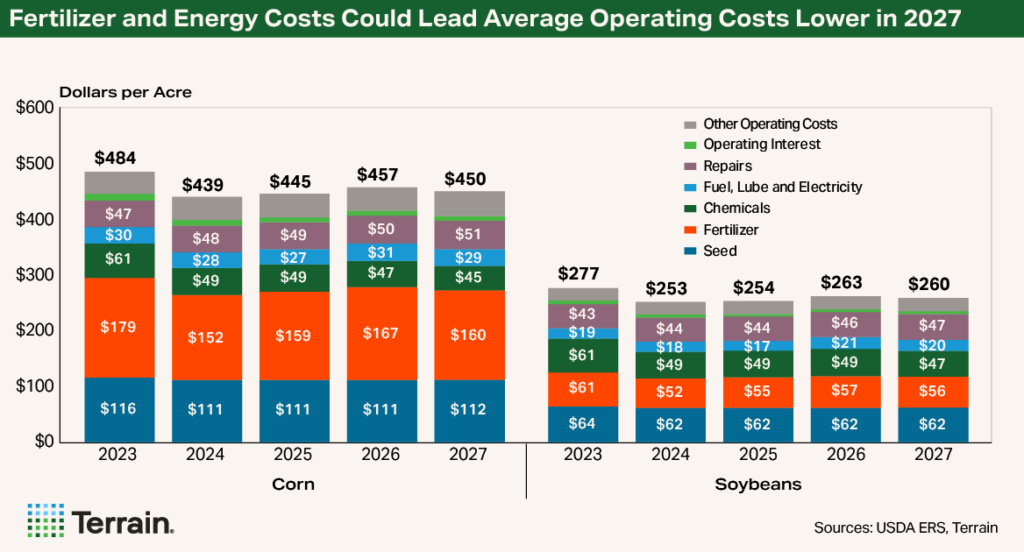
I forecast corn operating costs to average $457/ac. for the current crop. Lower forecast prices for fertilizer and energy items could save farmers about $11/ac. on average in 2027. However, forecast higher spending on custom services and repairs offsets a portion of this decline for a net $7/ac. reduction in operating costs in 2027.
For soybeans, I forecast operating costs to average $263/ac. for the current crop before falling about $3/ac. to $260/ac. for 2027. Unlike corn, soybeans are not expected to see as much benefit from lower fertilizer prices. However, lower energy prices are expected to drive savings on fuel costs and potentially chemical costs. These savings on fertilizer, chemicals and fuel will likely be partially offset by higher repair costs.
For Farmers Pre-Purchasing Inputs
For those who purchase inputs earlier, negotiations or close attention to competing prices may be important this year to make sure the drop in wholesale prices for nitrogen and fuel is reflected in your retail quotes. Cash retail prices tend to lag wholesale prices, so communication with your input suppliers may be important to secure favorable prices in late summer or early fall.
Both cost and margin management have the potential to be significant again this year.
Farm diesel prices are likely to continue falling toward harvest if the Iran deal holds and production and trade in crude oil return to more normal patterns. Diesel stocks are currently low, so prices are not likely to return to prewar levels until those stock levels recover.
Cost management remains key to a profitable farm. Both cost and margin management have the potential to be significant again this year as commodity and input prices evolve for the crop year ahead.


Terrain content is an exclusive offering of AgCountry Farm Credit Services, American AgCredit,
Capital Farm Credit, Farm Credit Services of America and Frontier Farm Credit.