Outlook • October 28, 2026
High Rail Fuel Surcharges Aren’t Only Basis Factor

Report Snapshot
Situation
Fuel surcharges are rising because of record diesel prices, but secondary shuttle freight values suggest rail capacity remains adequate.
Outlook
As we move past harvest 2026, the net impact on basis will depend on whether large crops and mixed demand can counteract lower secondary freight costs and rising fuel prices.
The Full Cost of Record Diesel Prices Has Yet to Reach Rail
Escalating geopolitical tensions involving Russia, Ukraine and Iran have spiked crude oil and diesel prices. With diesel fuel up more than 40% year over year (YOY), rail fuel surcharges weigh on the price farmers receive for grain.
According to the USDA Agricultural Marketing Service, railroads account for roughly one-quarter of all U.S. grain movements. Fuel surcharges charged by North American railroads have more than doubled in the past year. While each railroad calculates its own fuel surcharge, most are mileage-based programs using the Department of Energy’s on-highway diesel fuel (U.S. average) price index. However this rail fuel surcharge system has a two-month lag. This means that rail shippers (and farmers’ local basis) won’t feel the full brunt of the record-high fuel prices printed in September 2026 at $6.53/gallon (up $2.50/gallon YOY) until November 2026.
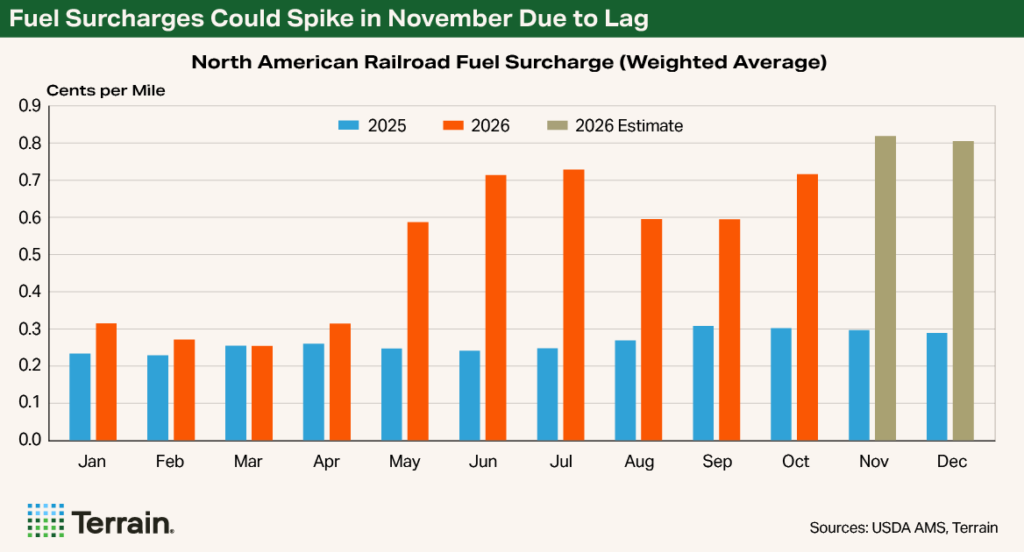
Elevated fuel surcharges have persisted for most of 2026, with November and December estimates remaining record high, above 80 cents per mile. If my forecast comes true, fuel surcharges in November could nearly triple YOY. Depending on the destination and length of haul, rail fuel surcharges can add anywhere from $500-$1,300 per railcar shipment, or 13 to 33 cents per bushel1. For example, in October 2025 fuel costs on the Union Pacific Railroad from Southeast Nebraska to the Pacific Northwest (PNW) costs about 13 cents per bushel, compared to October 2026 fuel costs for the same lane is now 27 cents per bushel, an increase of 14 cents per bushel year over year – pressuring interior basis for locations bidding PNW exports. Add in the railroads’ average rate increases on grain and oilseed commodities, and rail transportation costs 10-20% more than it did for harvest 2025.
Due to the upcoming expected rise in rail fuel surcharge costs, basis could widen further in November and December at interior elevators, especially in heavy rail dependent states such as Kansas, Nebraska, Missouri, Minnesota, and the Dakotas – all of which rely more on export demand too, compared to the Eastern Corn Belt states.
Many factors can affect basis, such as local supply and demand, storage, and transportation capacity, all of which interacts in complex ways. Fuel surcharge costs are only a portion of transportation’s overall cost to delivered grain.
Rail Demand Isn't Following Diesel Higher
Seasonally, every grain marketing year, demand for freight is at an all-time high following U.S. corn and soybean harvests in the fall. Soybeans are typically the first priority given a fixed number of shuttle supply and global supplier shifts to the U.S. as soybeans become competitively priced against South American alternatives, leaving domestic corn and wheat to compete for rail freight. As a new calendar year approaches, typically U.S. corn exports begin to accelerate, as soybean sales taper off turning back to South American alternatives.
To manage the demand surge and logistics throughout the year, railroads offer shuttle trains (guaranteed 110-car freight trains with typically a one-year commitment) to grain shippers which is considered the “primary” rail market. Those shippers can then use a broker to trade their committed rail freight in the “secondary” market, (similar to eBay-styled auction with bids and offers fluctuating daily). Keep in mind, the cost of secondary shuttle freight is in addition to the base transportation rail rate and fuel surcharge, so it is an important factor in determining delivered transportation costs and competitiveness to key rail destination markets.
Each year, according to the USDA Agricultural Marketing Service, Burlington Northern Santa Fe (BNSF) Railway typically offers 140 shuttle trains and Union Pacific (UP) around 80 shuttle trains, with BNSF accounting for double the rail-originated grain carloads as UP. For 4th Quarter 2026, secondary shuttle freight premiums for BNSF range from $0.02 to $0.08 per bushel and $0.05 per bushel for UP as of October 15, 2026, remaining below year-ago and most five-year average levels. Lower secondary shuttle freight values suggest surplus rail capacity, which could offset some of the grain basis pressure created by rising rail fuel surcharges. Trains delivered in October were down 5 cents per bushel YOY on BNSF and down 7 cents per bushel on UP. Both railroads’ secondary shuttle freight is trading 13 cents per bushel below the five-year average, reinforcing surplus freight availability compared with recent history.
Additionally, transportation costs for shuttle train demand in November and December also indicate surplus shuttle freight capacity. Lower delivered costs in the future secondary freight shuttle market will partially offset the higher fuel surcharge caused by rising diesel prices.
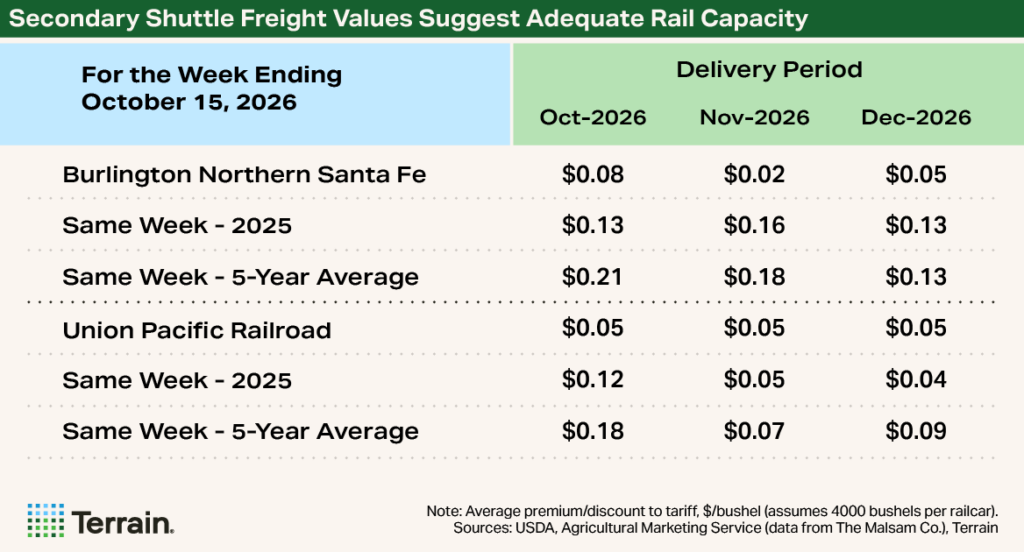
While the secondary market snapshot in time can signal future rail capacity and demand for grain and/or oilseeds, exports remain in focus, as rail shipments account for nearly half of grain and oilseed’s mode of transportation. For origins relying much more on export demand — such as the Dakotas and Minnesota via the Pacific Northwest ports — rail shuttle values can have a meaningful impact on export competitiveness and local basis levels.
What Rising Fuel Surcharges and Lower Shuttle Freight Mean for Grain Basis
While fuel surcharges will rise and weaken basis accordingly, the good news is the seasonal secondary freight values are not as steep as in prior years, shielding basis somewhat from higher fuel surcharges. As we look to 2027, Terrain expects a slow, not steep, decline in diesel prices. However, if surplus freight continues, which current secondary shuttle freight values signal, basis could strengthen post-harvest, offsetting some of the fuel surcharge pressure. Using the UP lane example above, with fuel rising 14 cents per bushel year over year, plus the decline in secondary shuttle freight values for trains delivered in October declining 7 cents, the net effect is 7 cents per bushel decline in basis tied to these rail transportation costs.
By knowing which railroad serves their local elevator and paying attention to USDA’s weekly reported forward trade of secondary shuttle freight, farmers can plan better marketing decisions, beyond prices in the futures market. Record fuel surcharges will continue to increase transportation costs through late 2026 and are likely to remain elevated with a slower decline into early 2027. However, secondary shuttle freight values indicate rail capacity remains readily available, which will help offset some of those higher fuel surcharge costs. If shuttle values remain near rail rate tariff levels and diesel prices begin to decline in 2027, delivered grain and oilseed costs tied to transportation could become less burdensome to export terminals and interior basis could narrow.
Endnote
1 Assumes 4,000 bushels per railcar
Terrain content is an exclusive offering of AgCountry Farm Credit Services, American AgCredit,
Capital Farm Credit, Farm Credit Services of America and Frontier Farm Credit.