Quarterly Outlook • October 19, 2026
Lower Hog Prices, Higher Feed Costs Reshape Margin Outlook

Report Snapshot
Situation
Hog margins have been pressured sharply since Q3 as lower lean hog futures and higher feed costs have reduced margins by roughly $20 per head, pushing many production windows from modest profits to breakeven or losses.
Outlook
Q4 hog prices are expected to trend seasonally lower, with domestic demand a notable headwind. Supportive supply fundamentals include tighter inventories, below-average cold storage stocks, and elevated disease pressure.
Finding
Profitability will depend on production efficiency, disciplined risk management, and capturing opportunities in deferred marketing periods.
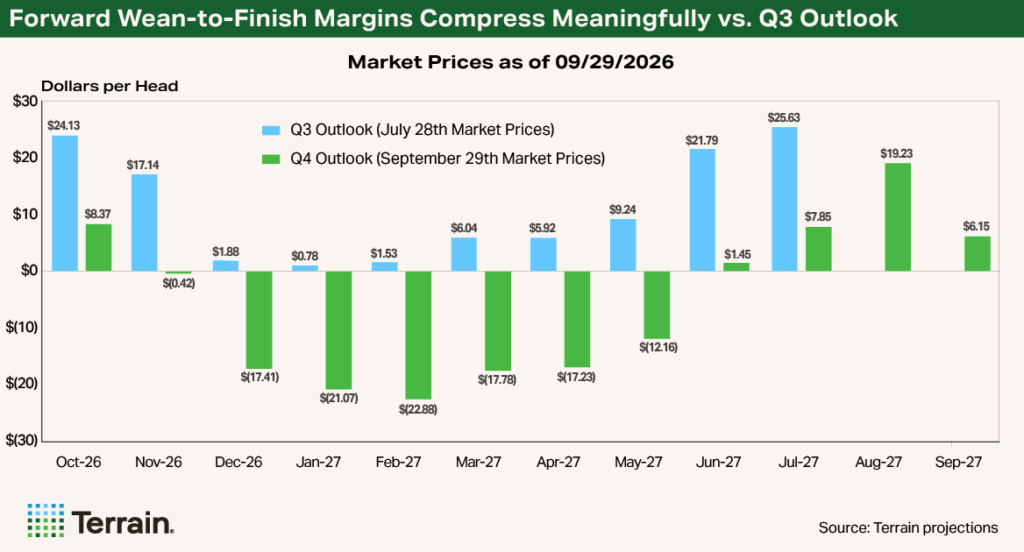
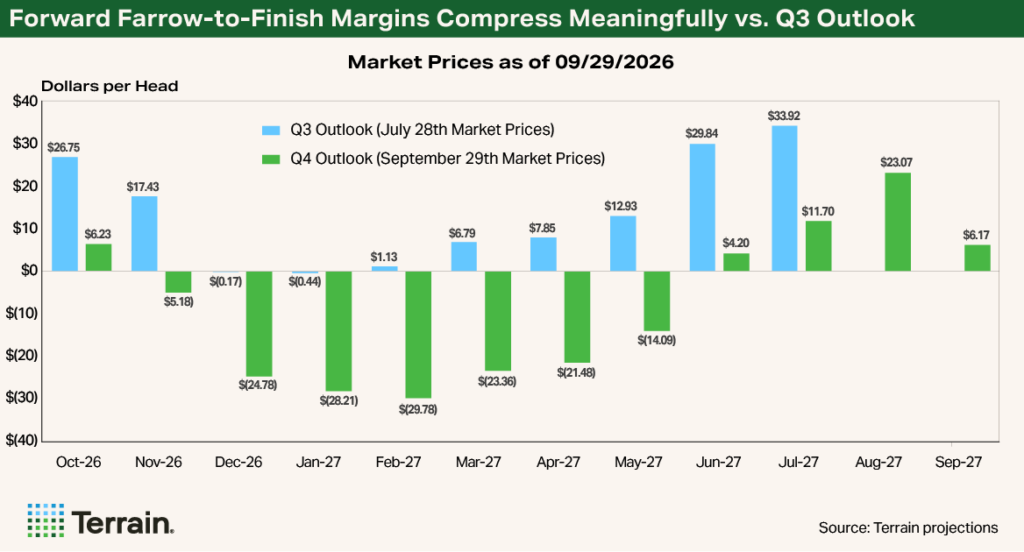
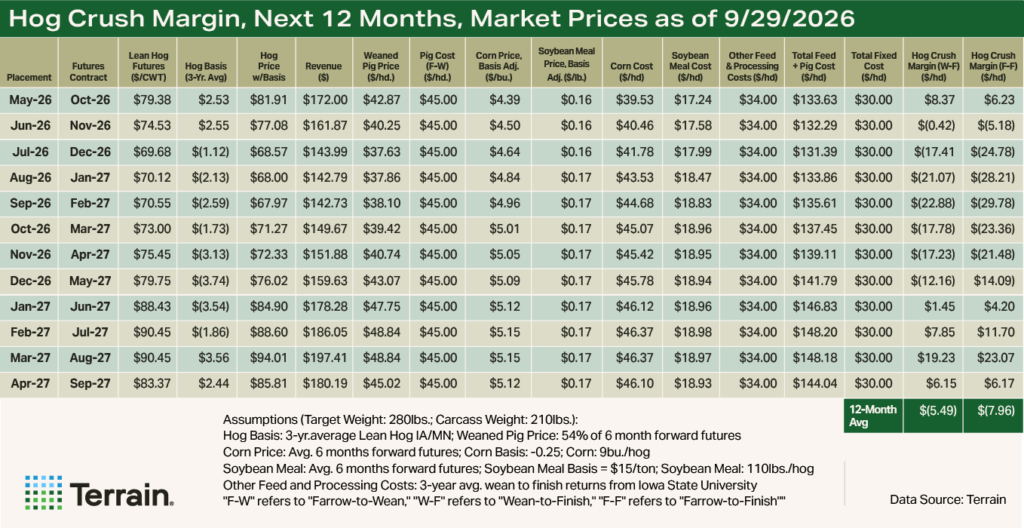
The forward hog margin outlook has weakened noticeably, shifting from modest profitability to breakeven or outright losses across much of the production curve. On July 28, projected 12-month average margins were approximately $16.80 per head for wean-to-finish operations and $20.07 per head for farrow-to-finish operations. By September 29, those projections had fallen to approximately -$5.49 per head and -$7.96 per head, respectively. In other words, producers lost roughly $20 to $28 per head of expected profitability in just two months, assuming risk management positions remained open.
The primary driver was a sharp decline in deferred lean hog futures. Across the overlapping October 2026 through July 2027 marketing window, futures prices declined by approximately $10/cwt on average, reducing projected revenue by roughly $22 per head. Average expected revenue fell from $180.44 per head in late July to $158.89 per head by late September. While lower weaned pig prices provided some relief, the decline in expected market revenue was far larger and accounted for most of the margin compression.
Feed costs moved in the opposite direction. Basis-adjusted corn prices increased from roughly $4.52 to $4.88 per bushel, while soybean meal prices also moved higher. However, lower weaned pig prices largely offset the increase in feed costs, leaving average wean-to-finish production costs relatively unchanged. As a result, weakening hog prices, rather than rising production expenses, were the primary source of margin deterioration.
Weaker hog price expectations and higher feed costs have largely erased the profit opportunities that existed earlier in the quarter.
The seasonal outlook also weakened considerably. In late July, nearly every projected marketing month remained above breakeven. By late September, margins turned negative from November 2026 through May 2027, with projected wean-to-finish losses exceeding $20 per head during January and February. While the market still anticipates improved profitability during summer 2027, the expected recovery is substantially smaller than it was just two months earlier.
Overall, the updated crush margin framework reflects a market that has grown considerably more cautious about producer profitability. Weaker hog price expectations and higher feed costs have largely erased the profit opportunities that existed earlier in the quarter, shifting the focus toward cost discipline and risk management heading into 2027.
Preserving liquidity and maintaining marketing flexibility remain critical heading into 2027.
The sharp deterioration in forward margins reinforces the importance of disciplined risk management. While current markets offer limited opportunities to lock in attractive profits for winter and spring marketings, producers should continue monitoring opportunities as volatility remains elevated. Protecting feed costs, evaluating flexible hedge strategies, and stress-testing cash flow assumptions may be prudent given the concentration of projected losses from November through May. With profitability increasingly dependent on a recovery in deferred hog prices, preserving liquidity and maintaining marketing flexibility remain critical heading into 2027.
Q4 2026 Price Forecasts
Lean Hog Index
October: $78 to $80 (High-confidence range: $73 to $86)
November: $74 to $75 (High-confidence range: $69 to $81)
December: $71 to $72 (High-confidence range: $67 to $76)
Pork Cutout
October: $86 to $87 (High-confidence range: $82 to $92)
November: $82 to $83 (High-confidence range: $79 to $86)
December: $80 to $81 (High-confidence range: $77 to $84)
Q4 2026 Price Risks
Upside Risks
U.S. Hog Inventory: In the September Hogs and Pigs report, inventories came in below trade expectations, reinforcing the view that the industry remains in a non-expansionary phase. While total hog and pig inventory increased 2% from the previous quarter, inventories remained 2% below year-ago levels. The breeding herd also declined 1% from a year earlier and edged lower from the prior quarter, signaling continued producer caution.
One notable exception was farrowing intentions. Producers indicated plans to farrow 2% more sows during the December to February quarter, exceeding expectations. While there is not yet evidence of a broad expansion cycle, the increase suggests improving producer sentiment and bears monitoring as a potential early sign of industry stabilization after several years of contraction.
Cold Storage: USDA cold storage data remain modestly price-supportive heading into Q4. Although inventories have rebuilt from the exceptionally tight levels observed in 2025, total pork stocks remain 5.6% below the five-year average, indicating supplies are not burdensome.
The primal-level picture is mixed. Ham, loin and butt inventories remain above historical averages, while several other categories remain comparatively tight. Overall, below-average pork inventories suggest a smaller inventory cushion than a year ago and should provide some support to hog prices and pork values, particularly if retail demand, holiday purchases or exports improve during the fourth quarter.
Animal Disease: Elevated Porcine Reproductive and Respiratory Syndrome (PRRS) activity continues to provide underlying price support to the hog market. Seasonal positivity rates remain above normal across several key production regions, increasing the risk of higher death loss and fewer market-ready hogs. Notably, September PRRS positivity reached its highest monthly level of the 2020s, with Missouri, South Dakota and Illinois continuing to report above-normal activity.
Balanced Risk
Feed Costs and Weights: The USDA’s September 1 Grain Stocks Report had old-crop corn inventories of 2.10 billion bushels, substantially above year-ago levels and trade expectations, suggesting larger beginning supplies for the new crop year than previously anticipated. Even so, global corn stocks-to-use is projected at 21.2%, the lowest level since 2012/13, and weather, yield and demand uncertainty could still support periods of price volatility. Higher feed costs remain a downside risk to producer margins, but the larger-than-expected corn stocks figure may help temper some of the recent upside pressure on feed prices.
Producer-owned weights have remained well above historical averages throughout 2026, contributing to larger pork supplies even without meaningful breeding-herd expansion. If corn prices stabilize or move lower, incentives to add additional pounds could persist. Conversely, any renewed rally in feed markets could encourage more disciplined feeding strategies, helping tighten pork supplies and providing support to hog prices and the pork cutout.
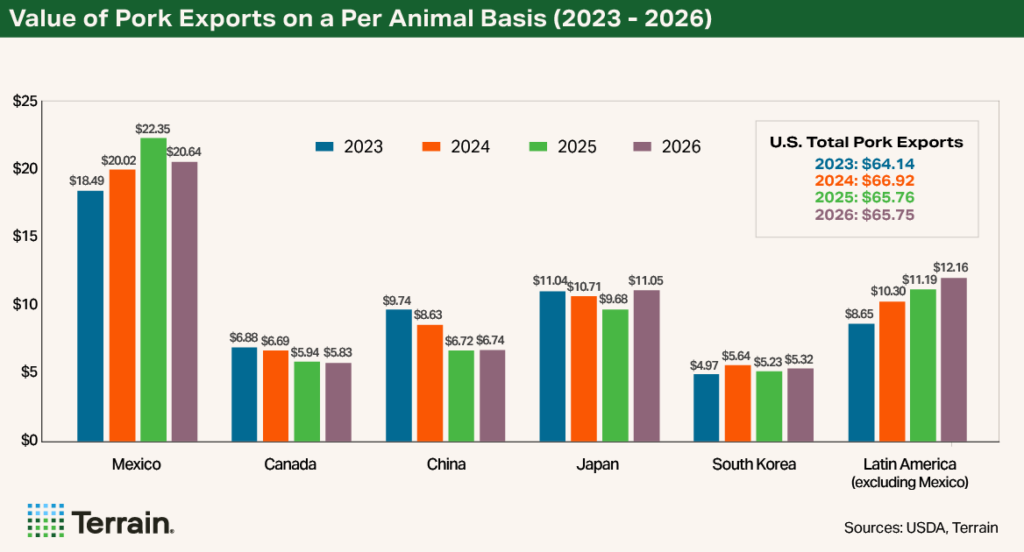
Exports: While exports have shown signs of slowing, year-to-date (January through August) exports remain slightly ahead of last year’s pace. Through August, exports totaled over 4.64 billion pounds, up 1.4% from 2025; however, export value is down by over 0.3% to $5.46 billion. Exports are projected to account for over 25% of U.S. pork production, with export value averaging $65.75 per head on a cumulative basis over the past eight months.
For the cumulative total so far in 2026, Japan has been a bright spot for U.S. pork exports. Supported by Japan's restrictions on Spanish pork imports following recent African swine fever outbreaks, 2026 shipments are ahead of last year’s pace by 13.7%, with export value averaging $11.05 per head slaughtered, compared with $9.68 in 2025. Canada (+5.7%), the Dominican Republic (+22.6%), and Latin America excluding Mexico (+8.8%) have also posted strong cumulative year-to-date growth. Mexico remains the largest U.S. market at over 1.765 billion pounds through August but is only 0.2% ahead of last year's pace. Increased competition from other major pork-exporting countries and expanding domestic pork production in Mexico are creating additional challenges for U.S. exporters.
Overall, export momentum has softened. August exports declined 4.9% from a year earlier to over 515.8 million pounds, and the USDA recently lowered its 2026 and 2027 export forecasts due to increased competition and softer overseas demand. Maintaining strong shipments to Mexico, Japan, and other Western Hemisphere markets will be critical as seasonal pork production increases during Q4. If export growth slows while supplies expand, additional pork will need to clear through the domestic market, creating pressure on hog prices and pork values.
Domestic demand remains the primary downside risk heading into Q4.
Downside Risks
Sluggish Domestic Pork Demand: Domestic demand remains the primary downside risk heading into Q4. The second-quarter retail pork demand index fell to 88, down from 93 in 2025 and well below the 115 recorded in 2022, indicating consumers have not responded strongly to pork's relative affordability.
Pork continues to compete with both ends of the protein complex. Beef demand remains exceptionally strong, with the all-fresh beef demand index reaching 140, the highest reading in the series, limiting trade-down demand despite record-high beef prices. At the same time, the pork-to-broiler price ratio remains near historical averages, leaving pork with little additional value advantage relative to chicken.
While household wealth remains elevated, wage growth has recently lagged inflation, creating a mixed consumer backdrop. As a result, domestic demand appears more likely to cap rallies than drive a sustained improvement in hog prices or the pork cutout.
Overall Q4 Assessment
The Q4 pork outlook remains characterized by meaningful two-sided risk, though the near-term balance is tilted modestly to the downside. Supportive factors include a breeding herd that is 1% below year-ago levels, pork inventories that remain 5.6% below the five-year average, and elevated PRRS activity across key production regions. However, domestic demand remains a notable headwind, with the retail pork demand index declining to 88, while several key primals (including hams, bellies and loins) have struggled to provide consistent support.
The most credible upside scenario involves stronger exports, tighter-than-expected hog supplies, and a seasonal improvement in ham and retail pork demand.
The primary downside risk is that demand fails to absorb seasonally larger Q4 production. With exports accounting for just over 30% of U.S. pork production and abundant, competitively priced chicken limiting pork's competitive position, softer domestic or export demand could pressure both pork cutout values and hog prices heading into year’s end.

Terrain content is an exclusive offering of AgCountry Farm Credit Services, American AgCredit,
Capital Farm Credit, Farm Credit Services of America and Frontier Farm Credit.