Quarterly Outlook • October 19, 2026
Machinery Cost per Acre Expected to Stay High

Report Snapshot
Situation
Even as new equipment sales continue to struggle and farm fleets get older, machinery cost per acre remains elevated due to higher repair costs.
Outlook
Total machinery costs in 2027 will continue to remain elevated near or above 2026 levels.
Impact
Farmers need to work with their Farm Credit lender to double-check their cost of production and benchmarks.
Sales of new large farm tractors and combines in the U.S. continue to struggle in 2026. Farmers, who have faced consecutive years of tight crop margins, have held back on purchases of new tractors and combines to keep rising machinery costs in check. However, inflation in repairs, maintenance and insurance may curtail some of the desired savings.
Machinery Costs for Crop Farmers
Crop production in the U.S. is a capital-intensive industry. The average crop farm had just under $900,000 in machinery assets in 2025, according to accountant records from more than 3,000 farms in the University of Minnesota’s Center for Farm Financial Management. When considering farms with at least 5,000 acres, the level of machinery assets jumps to nearly $4.8 million. These farms have rapidly expanded their equipment line. From 2005 to 2025, the compounded annual growth rate of machinery assets for these large farms was just under 8%, compared with a 9% increase in net cash income over the same period of time.
To manage their cash flow and balance sheets, most farms rely on a mix of owned equipment, leased equipment and traditional debt on equipment. Total intermediate debt, which includes machinery and some other assets, was $829,604 for farms with at least 5,000 acres.
Cumulative purchases of large farm tractors and combines are on pace to set a multiyear low.
As the machinery and equipment line has grown, so too has the per acre cost of equipment. Machinery costs per acre grew at a 4.2% compounded annual growth rate from 2005 to 2025 for crop farmers in the University of Minnesota’s dataset. The increase in machinery costs per acre is consistent with the growth in total costs, but slightly less variable. Since 2005, the machinery cost per acre has declined by more than a percent year over year only in 2015 and 2016. Comparatively, all other farm expenses have declined by more than 1% six times during the same period.
Declining New Tractor and Combine Sales
The decline in sales of new tractors and combines is one sign of farmers adjusting to higher machinery costs. Through September, cumulative sales of tractors with more than 100 horsepower are down 27% from the 2015 to 2025 average. Sales of larger four-wheel-drive tractors and combines are down 32% and 37% from the 2015-2025 average, respectively. Taken together, cumulative purchases of large farm tractors and combines are on pace to set a multiyear low.
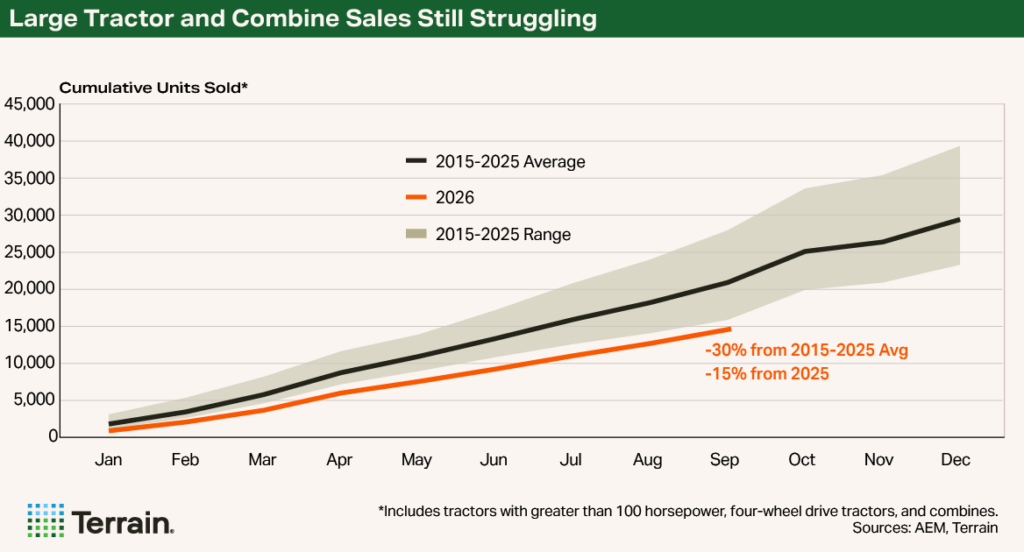
Typically, when crop margins tighten, farmers slow the pace of new tractor and combine purchases to help manage their machinery cost line item. As year-over-year crop receipts declined sharply in 2024 and 2025 on an inflation-adjusted basis, so did new tractor and combine purchases.
The current environment is complicated by uncertainty around yields and gross revenue, government support programs, and rising interest rates. As such, I expect cumulative sales of new tractor and combines to remain subdued in the last portion of 2026. Purchases of used equipment are harder to quantify, but the Federal Reserve Bank of Kansas City’s National Survey of Terms of Lending indicates a sharp uptick in equipment loans, both number and volume, in the first half of 2026. Combined with the decline in new equipment sales, this may indicate a shift to upgrading equipment lines with newer used equipment than new equipment.
There are several reasons that I expect machinery costs per acre to stay elevated.
Per Acre Machinery Costs May Not Decline Much
The decline in new equipment purchases does help slow the march of higher per acre machinery costs; however, unless there is a significant reset of equipment assets, I still expect machinery costs per acre to increase from, or remain very near, 2026 costs. There are several reasons that I expect machinery costs per acre to stay elevated.
First, interest rates will tick higher for any existing loans on a variable interest rate. According to the Federal Reserve Bank of Kansas City’s National Survey of Terms of Lending, about 30% of farm machinery loans originated since the start of 2025 are on a variable interest rate product. Farm equipment lease rates may also tick slightly higher as a response to higher interest rates.
Second, repair costs are likely to rise. The cost of repairs on crop machinery has increased at a compounded annual growth rate of more than 3% since 2008, according to farm tax return data from Kansas State University’s Kansas Farm Management Association. Given the slightly older age of equipment (due to slower sales of new equipment in the last several years) and general inflation in labor and goods inflation, I expect machinery repair costs per acre to continue to increase. Anecdotally, this has become a common migraine for farmers trying to manage their equipment line against expenses.
Finally, I expect insurance costs to remain sticky as well. Albeit a very small piece of a farm’s total cost, general farm insurance has increased at about a 5% compounded annual growth rate, according to Kansas Farm Management data. The rate of increase is slightly slower than the rate of increase in equipment assets, but to the extent that equipment assets and insurance rates stay elevated, so too will insurance costs.
For farmers, the combined impact of these costs implies that the machinery cost portion of their cash flow is likely to stay high and could increase in 2027.
Once the 2026 harvest is complete, and final machine maintenance is accounted for, it will be important to work with your accountant and Farm Credit lender to have an accurate understanding of costs for your break-even analysis and equipment asset allocation. Additionally, an accurate understanding of your costs for 2026 and an early estimate for 2027 can improve grain marketing strategies and guide any additional equipment upgrade decisions during the winter months.
Terrain content is an exclusive offering of AgCountry Farm Credit Services, American AgCredit,
Capital Farm Credit, Farm Credit Services of America and Frontier Farm Credit.