Outlook • May 27, 2026
Optimizing Overhead for Dairy Profitability
Article Originally Published in Hoard’s Dairyman Intel

Report Snapshot
Situation
In 2025, operating costs for producing milk fell while overhead increased, which tends to disadvantage smaller farms. In particular, the opportunity cost of unpaid labor was significantly higher for small farms.
Finding
Managing overhead is becoming just as important as — if not more important than — operational efficiency for continued success.
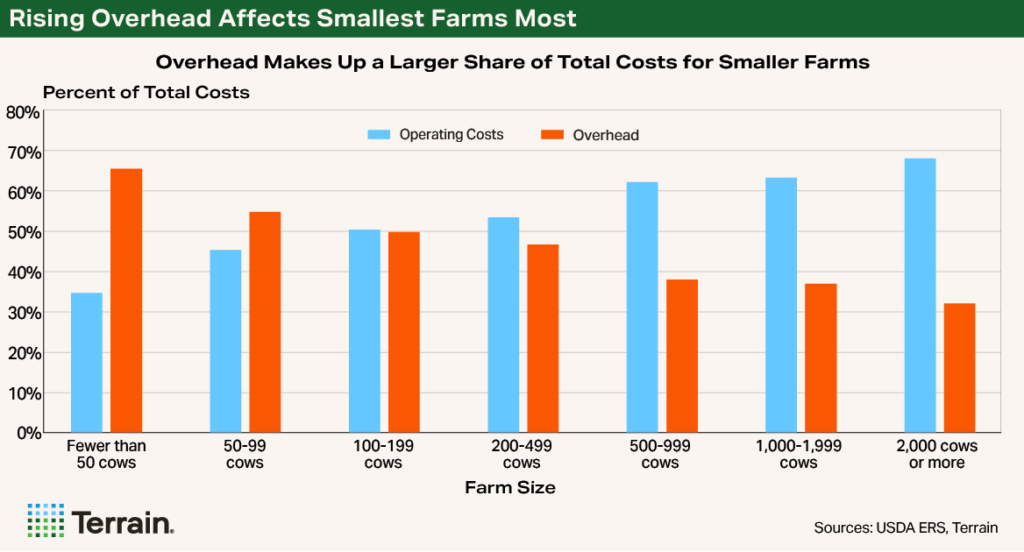
The cost of producing milk fell in 2025, but not across the board. Operating costs fell while overhead increased, which tends to disadvantage smaller farms. Managing overhead may be the best strategy, on the cost side, to improve a farm’s profitability.
Operating Costs vs. Overhead
Milk cost-of-production estimates for 2025 were recently released by the USDA Economic Research Service. The numbers represent averages and extrapolations based on a survey completed in 2021, but the trends within those averages reveal telling divergences among the cost structures of different-size operations.
The distinction between operating costs and overhead is important. Their differing trends have been developing for several years. How a farm handles these costs, through either operating efficiency or the ability to spread overhead efficiently across a herd, can explain why farms experience varying degrees of profitability.
Total costs peaked (along with milk prices, luckily) in 2022 at an average of $27.34/hundredweight (cwt). They have fallen each year since, to $23.37/cwt in 2025. But breaking those costs into operating costs and overhead reveals that total allocated overhead has continued to climb each year, from $8.77/cwt in 2022 to $9.62/cwt in 2025, while total operating costs have fallen from $18.57/cwt to $13.75/cwt over the same period.
Opportunity Cost of Unpaid Labor Varies the Most
The categories that climbed the most within overhead are labor costs, capital recovery cost (the cost of replacing capital used up in production over the year plus the interest remaining capital could have earned if invested elsewhere), and taxes and insurance. Within the labor cost category, there is a telling divergence between the opportunity cost of unpaid and hired labor.
Hired labor is the wages that are paid to employees. The opportunity cost of unpaid labor represents the wages that could have been earned by operators and family members working on but not taking a salary from the farm.
This opportunity cost, while economically important, is often not directly accounted for. But it represents possibly the starkest difference across farm sizes:
- On farms with fewer than 50 cows (which rely heavily, sometimes completely, on unpaid family labor), the opportunity cost equates to $17.60/cwt.
- On farms with 2,000 or more cows, the opportunity cost is only 10 cents/cwt.
Able to allocate that overhead across a bigger volume of production, larger operations can reduce the overhead cost per hundredweight of milk. Farms that cannot spread overhead across more milk production suffer disproportionately from these rising costs.
Managing Overhead Matters as Much as Efficiency
Farms benefit from improving operational efficiency as well, but those operating costs have been falling, making the rewards less dramatic. Additionally, farms across all scales and geographies are already operating at a consistently efficient level.
There is a much wider variance for overhead across different farm sizes than for operating costs. The smallest farms, those with fewer than 50 cows, had a total allocated overhead of $30.96/cwt in 2025, while farms with 2,000 or more cows had only $5.96/cwt. Operating costs, meanwhile, had a much tighter range, from $16.37/cwt to $12.69/cwt.
These costs represent averages. Understanding the specifics of your farm’s cost of production is critical. U.S. dairy farms are generally good at milking cows efficiently, across all sizes. Now, managing overhead is becoming just as important as — if not more important than — operational efficiency for continued success.
Terrain content is an exclusive offering of AgCountry Farm Credit Services, American AgCredit,
Capital Farm Credit, Farm Credit Services of America and Frontier Farm Credit.