





Report Snapshot
Situation
Lack of clarity on federal biofuel policy has stalled renewable diesel production and incentivized non-soybean oil feedstocks such as imported waste fats.
Outlook
The future of renewable diesel expansion, and soybean crush, is dependent on both federal policy and state programs that prefer soybean oil as a biofuel feedstock. California’s Low Carbon Fuel Standard holds particular influence among these programs.
Impact
Local crushers’ demand for soybeans to produce soyoil for biofuel production leads to better basis for farmers.
Renewable Diesel: Boom or Bust?
Biofuels, especially renewable diesel, have become a major driver of U.S. soybean oil demand. Renewable diesel stands out for its chemical similarities to petroleum-based diesel and ability to replace fossil diesel one-for-one (unlike biodiesel, which requires additional blending). This makes it an ideal candidate for use by large states that involve heavy transportation, and a win for the farmers who grow crops for the feedstocks — especially soybeans.
Renewable diesel can be produced from several types of oil or fat feedstocks, including soyoil, canola oil, corn oil, animal fat like tallow, and used cooking oil (UCO). Each feedstock is measured by a carbon intensity (CI) score based on its lifecycle and/or other non-biofuel uses. With the support of their credit mandate systems, West Coast states — led by California — are the primary consumers of renewable diesel.
Between 2022 and 2024, renewable diesel consumption almost doubled before collapsing in 2025 because of uncertainty around federal biofuel tax credits, feedstocks and producer eligibility. The switch from a blender’s to producer’s tax credit, along with a lack of guidance from the Treasury and IRS, has caused widespread disruption to renewable diesel production. In 2025, production declined 10% from 2024, according to the Energy Information Administration (EIA), causing plants to idle capacity.
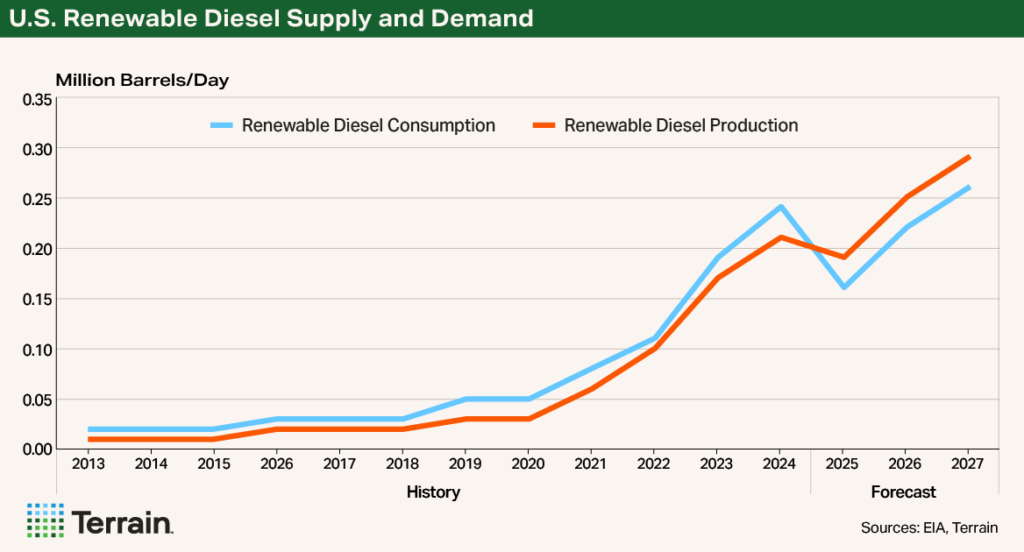
Fortunately, biofuel policies should become somewhat clearer in 2026. The Environmental Protection Agency (EPA) is expected to issue final Renewable Volume Obligations (RVO) in the coming weeks, including clarification on whether imported fuels and feedstocks receive 50% RIN (Renewable Identification Number credits tied to biofuel production). More clarity is also expected on the treatment of past and future small refinery exemptions (SREs) — waivers that have historically reduced overall volume blend obligations.
The lack of federal guidance around biofuel policy has also limited domestic feedstock demand and limited future soybean crush capacity expansion.
With more clarity expected around biofuel policy, the EIA forecasts a recovery in renewable diesel production and consumption in 2026, followed by growth in 2027 (with nearly 90% capacity utilization, versus less than 60% forecast in 2025).
Ports, Plants and Pretreatment
The lack of federal guidance around biofuel policy has also limited domestic feedstock demand and limited future soybean crush capacity expansion.
While stronger demand for feedstocks in renewable diesel production is anticipated later in 2026, logistics and geography will continue to play a significant role in purchase decisions between biofuel feedstocks.
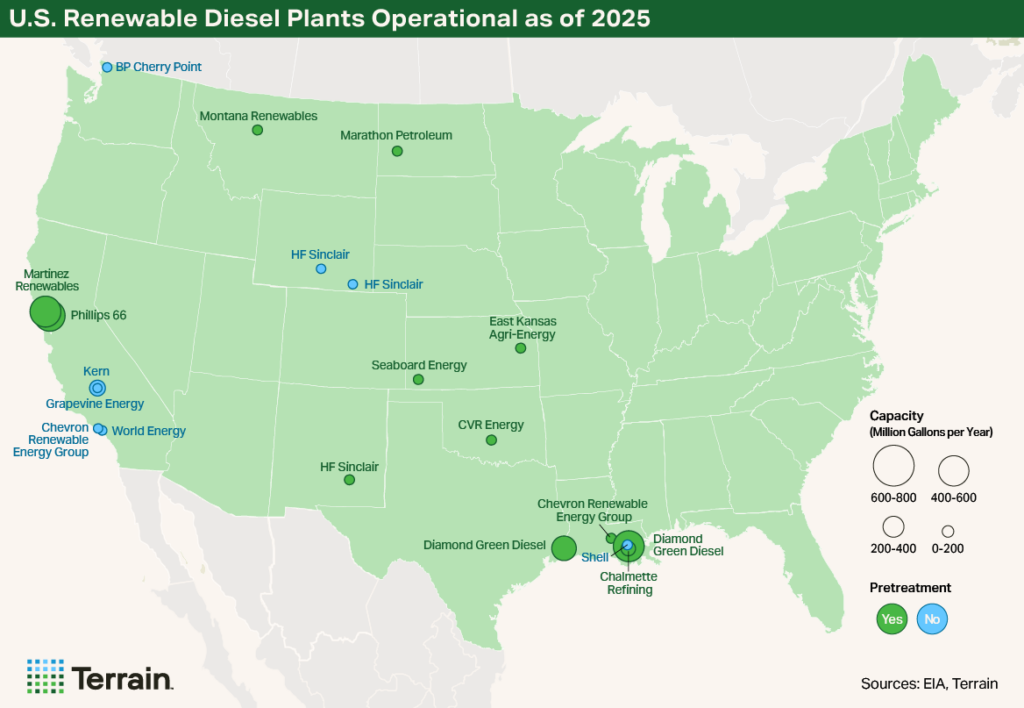
Over 80% of current renewable diesel capacity in the U.S. is located near ports, with easy access to imported waste fats (UCO from China, tallow from Brazil, imported canola oil via Vancouver). While UCO and tallow have favorable CI scores and higher associated tax credits, the renewable diesel plants must also have pretreatment1 abilities to utilize these types of feedstocks.
I estimate that over 70% of total renewable diesel capacity is located at favorable port access and has pretreatment abilities and, therefore, will continue to use a combination of soyoil and non-soyoil feedstocks.
The remaining 20% of renewable diesel capacity is spread out across the western two-thirds of the U.S. and in landlocked regions. These facilities are less likely to use imported feedstocks.
Importantly, facilities without pretreatment ability will likely depend heavily on vegetable oil (including soyoil) feedstocks as their primary source for renewable diesel. Of existing U.S. capacity, only 12% of facilities are set up to use vegetable oil, with the remaining 88% able to continue to use beef tallow, UCO, corn oil or other feedstocks.
Federal Tailwinds, but Uncertainty Persists
The Treasury and IRS issued proposed regulations for 45Z in February and affirmed that the maximum $1 per gallon clean fuel tax credit (as outlined in the One Big Beautiful Bill Act) will apply to fuel produced in the U.S. from January 1, 2025, and sold by December 31, 2029. This is only a proposal, and next steps include a public hearing on May 28.
Farmers interested in growing low-CI soybeans need to engage their local crush plants early to learn if and how the tax credit would be shared — if at all.
Critical details impacting farmers interested in producing low-CI grain are still unknown. The USDA needs to release its new carbon calculator; finalize the farm climate-smart agricultural practices to qualify; determine the specific carbon reductions associated with those practices; and address how data recordkeeping will be managed and verified. Most importantly, the tax credit goes to the biofuel producer, and sharing with farmers who produce low-CI grain and oilseed commodities is not mandatory.
When it comes to soybeans, the likelihood of the tax credit being shared down the supply chain from the biofuel producer to the crusher and farmer is complex. Farmers interested in growing low-CI soybeans need to engage their local crush plants early to learn if and how the tax credit would be shared — if at all.
A big win for domestic feedstocks in the One Big Beautiful Bill Act is only North American feedstocks qualify for the federal tax credit starting in 2026. If the EPA finalizes its proposed RVO of 5.61 billion gallons in 2026, over 75% of biofuel feedstocks could be domestically sourced, according to the EPA.
Because of the lack of clarity on federal tax incentives and qualifying feedstocks, soyoil demand will be limited in the first half of 2026.
According to a study by the National Oilseed Processors Association, current U.S. domestic feedstocks could support 4.3 billion gallons of biomass-based diesel production annually. And with future crush capacity, domestic feedstocks could supply 5.7 billion gallons by 2030 (while still supporting food and feed). However, because of the lack of clarity on federal tax incentives and qualifying feedstocks, soyoil demand will be limited in the first half of 2026.
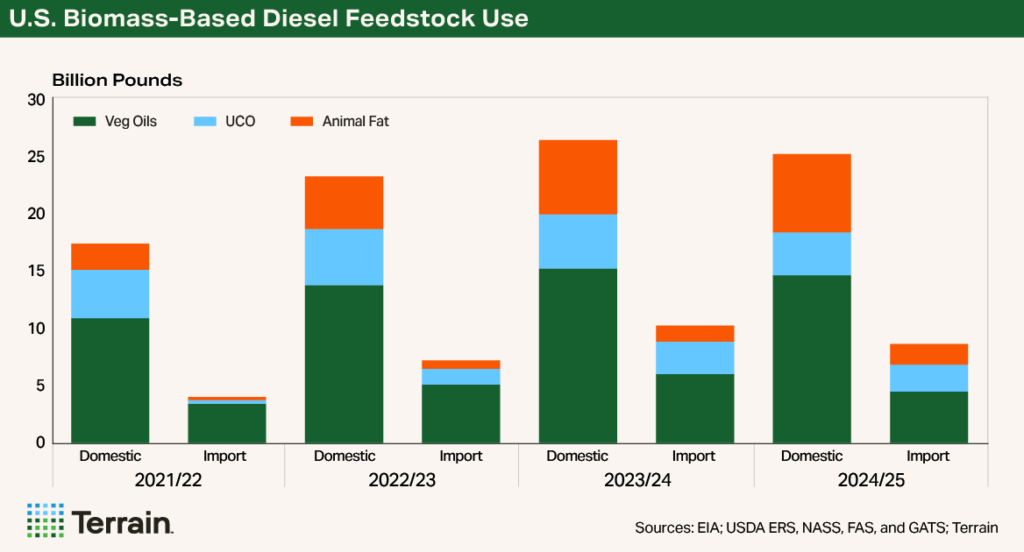
The 45Z tax credit was originally anticipated to be finalized in early 2025, and the EPA’s final RVO decision was anticipated in fall 2025. In the interim, renewable diesel production and consumption declined, and soyoil feedstock in biofuels fell by 1.2 billion pounds in 2024/25 versus 2023/24.
I estimate soybeans lost 375 million bushels of demand over the past three crop years to other substitutes.
At the same time, feedstock substitutability has also eroded soyoil’s market share in biofuel utilization. Since 2021/22, soyoil’s feedstock market share for biofuel production has lost 10% in favor of UCO and tallow. Given this, I estimate soybeans lost 375 million bushels of demand over the past three crop years to other substitutes.
During the peak year of biofuel feedstock utilization in 2023/24, over 60% of UCO was imported and nearly 30% of tallow was imported. The critical revisions made to the 45Z tax credit last summer prioritize domestic feedstocks like soyoil over imported substitutes, which should help claw back some of the lost demand and increase vegetable oil’s market share in feedstock use. (Note: In the chart that follows, Veg Oils include corn oil, coconut oil, cottonseed oil, olive oil, peanut oil, canola oil, safflower oil, soybean oil, palm oil, palm kernel oil, sesame oil and sunflower oil. Animal Fat includes lard, poultry fat, edible tallow, inedible tallow and technical tallow. UCO, or Used Cooking Oil, includes yellow, white and other greases.)
In addition to the preference for domestic feedstocks, another favorable change for U.S. farmers in the One Big Beautiful Bill Act is the removal of Indirect Land Use Change penalties from carbon emission calculators at the federal level. These penalties affect feedstocks produced from U.S. row crops. Their removal from carbon emission calculators improves the CI score of soyoil by roughly two‑thirds.
The American Soybean Association estimates that soybean‑based credits will double based on the removal of the Indirect Land Use Change penalties, with the renewable diesel fuel tax credit increasing from 20 cents per gallon to 40 cents. This change will help shift demand back toward domestically produced feedstocks like soyoil.
California Roadblock: Low Carbon Fuel Standard Changes
States can also have their own biofuel tax credit policies, which can differ from federal policy but can be stacked with 45Z. California’s Low Carbon Fuel Standard (LCFS) program to reduce the CI of transportation fuels (with credits rather than a direct volume mandate) drove the renewable diesel boom that began in 2021. The nation’s largest consumer of renewable diesel, California seeks to reduce carbon emissions by 30% in 2030 and 90% by 2045 from 2010 levels, according to the California Air Resources Board (CARB).
Today, CARB manages the LCFS and estimates nearly 70% of diesel utilization is from renewable diesel. California still includes the Indirect Land Use Change penalty in its version of carbon emission calculations, resulting in higher CI scores and lower associated tax credits for land-based feedstocks like soyoil.
The state also does not have a feedstock import restriction, meaning foreign UCO and tallow will likely continue to be utilized in the state, eroding soyoil’s renewable diesel market share. For example, the CI score for soyoil feedstocks is nearly 2.5 times UCO’s and 1.5 times higher than tallow’s, which directly influences the tax credit amount and, therefore, feedstock purchase decisions of biofuel producers. In California, the LCFS tax credit on UCO is nearly three times as high as soyoil’s and tallow is nearly double.
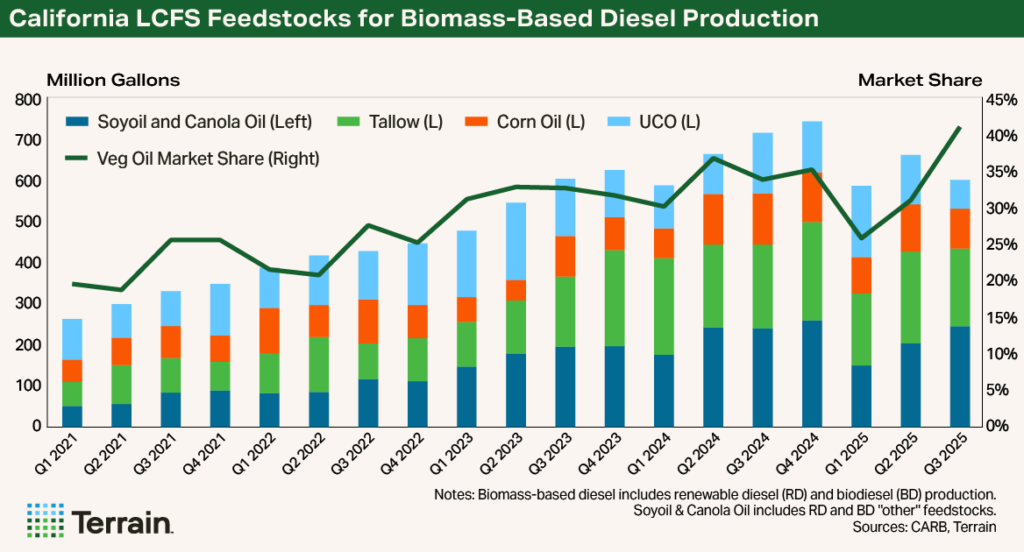
Importantly, effective July 1, 2025, California will restrict vegetable oil feedstock use in biofuel production to 20%, with existing pathways exempt through 2027. Since 2023, canola oil and soyoil combined accounted for over 30% of the feedstocks used to produce biomass-based diesel, including renewable diesel. Based on actual soyoil feedstock used from Q1 2025 to Q3 2025, the lost soybean utilization would be nearly 45 million bushels annually.
The paradox is that the soyoil market is both buoyed and capped by California biofuel policy.
These state-level policies may constrain the role of soyoil in key domestic markets and influence renewable diesel production decisions, particularly where feedstock flexibility is limited. Additionally, the current state programs will undermine the federal incentives, unless the Indirect Land Use Change penalty is removed from states’ carbon emissions calculator for crop-based feedstocks, and imports are removed from LCFS eligibility. The paradox is that the soyoil market is both buoyed and capped by California biofuel policy.
The soybean futures price may not radically shift, but farmers are likely to see stronger, or narrower, basis and more favorable pricing optionality.
What This Means for Soybean Basis
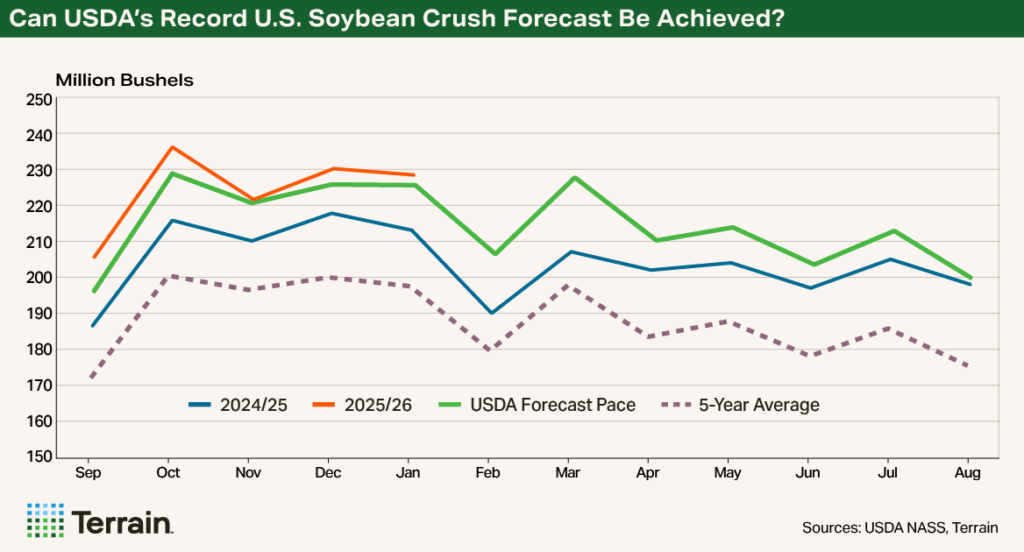
Strong soyoil demand can improve crusher margins, which increases crush pace. Greater domestic demand for crushed soybeans could partially offset long-term lower export demand. (Terrain projects China’s slowing economic growth and Brazil’s stronger global competition will curtail foreign demand for U.S. soybeans.) This implies that the soybean futures price may not radically shift, but farmers are likely to see stronger, or narrower, basis and more favorable pricing optionality.
The biggest winners will be farmers who are located near both soybean crush plants and the renewable diesel plants that rely on soyoil from those local crush plants as the primary feedstock.
The benefits of the new federal 45Z tax credit are not likely to materialize until the latter half of 2026 or early 2027 because of the regulatory thresholds needed. Additionally, the tax credit goes to the biofuel producer, not the farmer, so engaging with local buyers is critical for farmers interested in participating in the USDA’s proposed climate-smart agricultural practices.
However, these benefits are only realized with further biofuel policy clarity. Without more clarity, renewable diesel production is at risk and domestic soybean crushers could reduce their pace if margins get squeezed. Recent crush data per the USDA have shown consecutive months of rising soyoil stocks.
The USDA’s National Agricultural Statistics Service reported soyoil on hand at the end of the month at 1.7 billion pounds in December 2025, a 44% increase from December 2024, highlighting the concern of future soyoil utilization when policy doesn’t reinforce demand for domestic, crop-based feedstocks.
Can Soyoil Win Back Market Share?
Continued delays in policy will linger in the first half of 2026, causing these headwinds to persist in the short term. Additionally, the misalignment between federal incentives and state programs will continue to limit soyoil’s upside potential in the largest U.S. consumption markets. The ability of soyoil (and indirectly soybeans) to regain lost feedstock market share will depend heavily on:
- The EPA finalizing 2026 to 2027 RVOs, RINs credits for imports versus domestic, and SREs (past and future policy).
- The USDA releasing the new 45Z CI calculator, outlining on-farm sustainability practices and the associated CI scores, and addressing verification and recordkeeping requirements.
- Whether conflicting carbon policies in LCFS-driven states can be addressed. Until then, they will continue to favor imported feedstocks.
The outcome of these decisions will determine where soyoil use falls in feedstock priority and will influence future crush demand for U.S. soybeans.
For U.S. farmers, a stable tax credit policy provides biofuel stakeholders and soybean crushers the clarity to support consistent, year-round soybean demand, which results in higher basis, improved pricing opportunities, and sustained long-term profitability. If federal and state policies move toward alignment and prioritize domestic feedstocks, the U.S. is positioned for stronger crush demand in the latter half of 2026 and beyond.
Without that clarity, the industry risks the continuation of 2025’s stagnation, resulting in weaker renewable diesel production and consumption, risk to future industry buildout of renewable diesel plants and soybean crush capacity, reduced crush pace from existing plants, continued rising soyoil stocks, and overall softer soybean demand during a period of questionable export demand for soybeans.
Endnote
1 A cleaning process that removes impurities.
Terrain content is an exclusive offering of AgCountry Farm Credit Services,
American AgCredit, Farm Credit Services of America and Frontier Farm Credit.