Quarterly Outlook • June 25, 2026
Summer Reset for Dairy Markets

Report Snapshot
Situation
After rising more than expected in April and May, nonfat dry milk prices have fallen rapidly in early June, seeking a new equilibrium. The initially high prices, due to tight supplies in the scramble for protein, became out of line with global prices, which isn’t sustainable long term.
Impact
Nonfat dry milk and whey have been the commodities that have seen prices climb because of strong protein demand from consumers, but neither of these commodities impacts the protein component value in federal order calculations.
Outlook
Continued export strength will be important support for Class III and Class IV prices. I project Class III prices to average $17.25/cwt in the second half of 2026 and Class IV to average $18.50/cwt. Whether macroeconomic impacts shake up consumer behavior will also be an important risk factor to watch.
Production of high-protein whey cannot keep up with the boom in demand.
Dairy markets have transitioned to summer mode. School milk programs are off for the summer, ice cream season is here, and cheeseburgers are hitting the grill. But aside from the seasonal shift, a longer-term shift continues to unfold as consumers seek more protein wherever they can get it.
Production of high-protein whey cannot keep up with the boom in demand. A side effect of the scramble for protein has been tight supplies of nonfat dry milk that sent those prices higher than anticipated levels, surpassing $2.20/lb. on the CME spot market in April and May.
Nonfat Values Are Falling From Peaks
Those $2.20-plus values appear to have been the peak. Nonfat dry milk prices have been falling rapidly in early June, seeking a new equilibrium. The high prices had become dramatically out of line with global prices, which isn’t sustainable long term. Skyrocketing powder prices and higher milk production growth ultimately drove more milk into driers in 2026, pushing combined nonfat dry milk and skim milk powder production up 6% year over year (YOY) through April.
Exports continue to be a critical underpinning of price support in U.S. dairy markets.
Butter production is up 6% through April as well, and cheese is up 3%. All this growth in product output is supported by continued growth in cow numbers and milk production, up 3% through April.
More Fat Is Heading Abroad
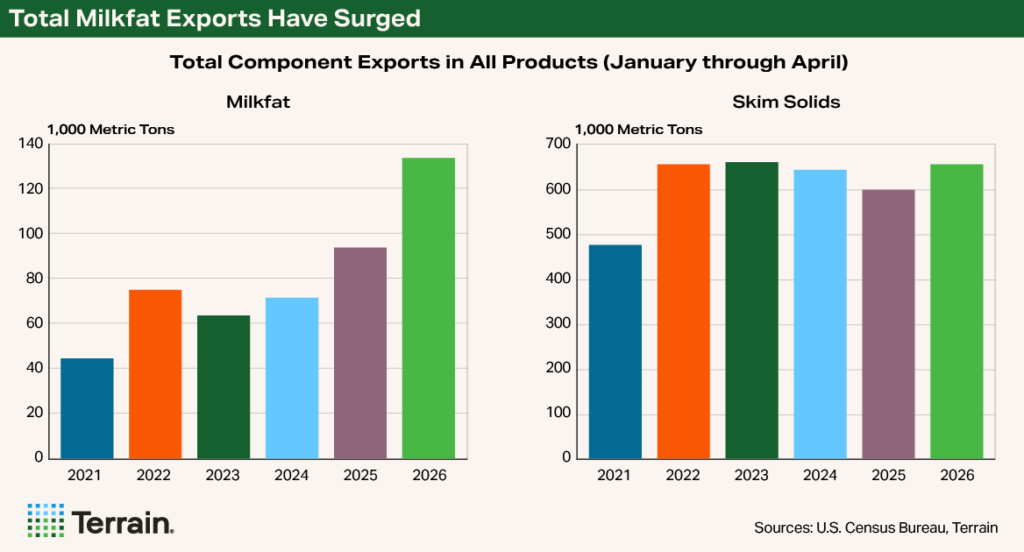
Exports continue to be a critical underpinning of price support in U.S. dairy markets. April data show a continuation of exceptionally strong exports of butter and cheese. As a result, at the component level, export growth of milkfat (in all products to all destinations) is surging, up almost 40% YOY in April and up 80% compared with April 2024. Skim solid exports, meanwhile, were up a respectable 15% YOY in April but are still similar to where they had been two years ago, up 3% from April 2024.
Protein prices have moved into the starring role on milk checks, but this is still more related to weak butter prices than the strong protein demand. Nonfat dry milk and whey have been the commodities that have seen prices climb because of strong protein demand from consumers, but neither of these commodities impacts the protein component value in federal order calculations.
Price and Margin Outlook
Second-quarter milk prices were swept away in excitement around sky-high nonfat dry milk prices. This lifted Class IV milk prices substantially higher than expected. Heading into the third quarter, prices are normalizing to the reality that we are making plenty of milk and experiencing no shortage of the core commodities. The strong spike in Class IV prices during Q2 is leading to a downward revision to my previous second-half projection, now $17.50/cwt. Second-half average Class III milk prices are currently projected to be $17.25/cwt. Continued export strength will be important support for both prices.
Feed prices remain favorable, and many operations have high levels of on-farm storage. Combined with ongoing strong beef revenues, margins should remain healthy. The calculated milk feed margin used for Dairy Margin Coverage insurance is projected to remain above the maximum insurable level of $9 for the remainder of the year.
The primary risk factors in domestic markets are whether macroeconomic impacts shake up consumer behavior, especially as rising fuel costs eat into disposable income. And, with exports growing into an increasingly greater share of U.S. milk production, the risk of any disruption to exports would translate into a heightened risk to milk prices.
Terrain content is an exclusive offering of AgCountry Farm Credit Services, American AgCredit,
Capital Farm Credit, Farm Credit Services of America and Frontier Farm Credit.