Quarterly Outlook • October 19, 2026
Threads Tighten

Report Snapshot
Situation
Cotton markets are entering the 2026/27 marketing year with ending stocks expected to draw down as global mill consumption continues to grow. U.S. cotton production is forecast at just 13.44 million bales, reduced primarily by severe heat and moisture stress in the southern Plains.
Finding
A growing forecast deficit between world mill use (123.1 million bales) and world production (118 million bales) offers support to prices by lowering global ending stocks by over 5 million bales.
Outlook
I forecast the upland cotton farm price to average about 75 cents/lb. this year, up 13 cents/lb. over last year. Macroeconomic headwinds or increased export competition from Brazil are downside price risks.
The 2026/27 U.S. cotton crop has faced severe weather, reducing production prospects as we end the growing season. Globally, continued growth in mill use in the face of a decline in global cotton production will likely tighten stocks and support prices in the marketing year ahead. That is not to say there won’t be price volatility in the months ahead, with questions for the demand outlook given energy prices, inflation and consumer spending.
Below-Trend Yields
U.S. cotton farmers planted 10.45 million acres this year but will likely harvest only 8.16 million as heat and dryness have led to abandonment across the Southwest and Plains.
The USDA’s national average yield estimate dropped by over 80 lbs./ac. to 790 lbs./ac. from July to October.
Nationally, the abandonment rate is expected to be about 22%, with most of this happening in Oklahoma (37%), Texas (34%) and Kansas (11%). Some quality issues or losses are also possible, as rains at or after boll opening were seen across parts of Texas, northern Delta regions, and parts of the Southeast.
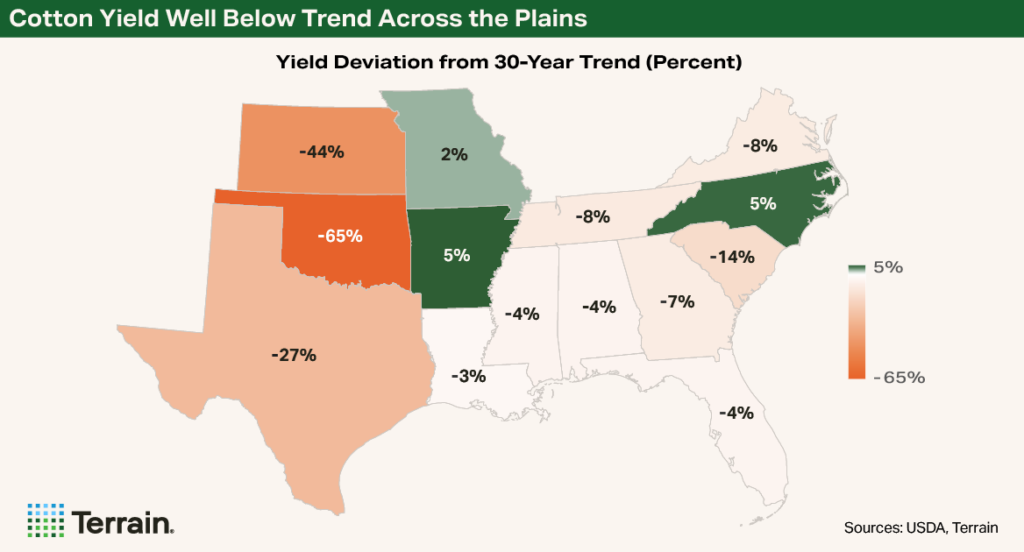
The USDA’s national average yield estimate dropped by over 80 lbs./ac. to 790 lbs./ac. from July to October. The current yield forecast for Texas is the lowest in over 20 years, and Oklahoma’s is the lowest in over 30 years. However, yields across many of the other cotton-growing states range from about 14% below to 5% above their trend levels.
This growth forecast is supported by a cotton/polyester relationship that is more favorable to cotton than in previous years.
Overall U.S. cotton production is forecast at 13.4 million bales, of which 13.1 million are upland cotton and 383,000 are extra-long staple cotton.
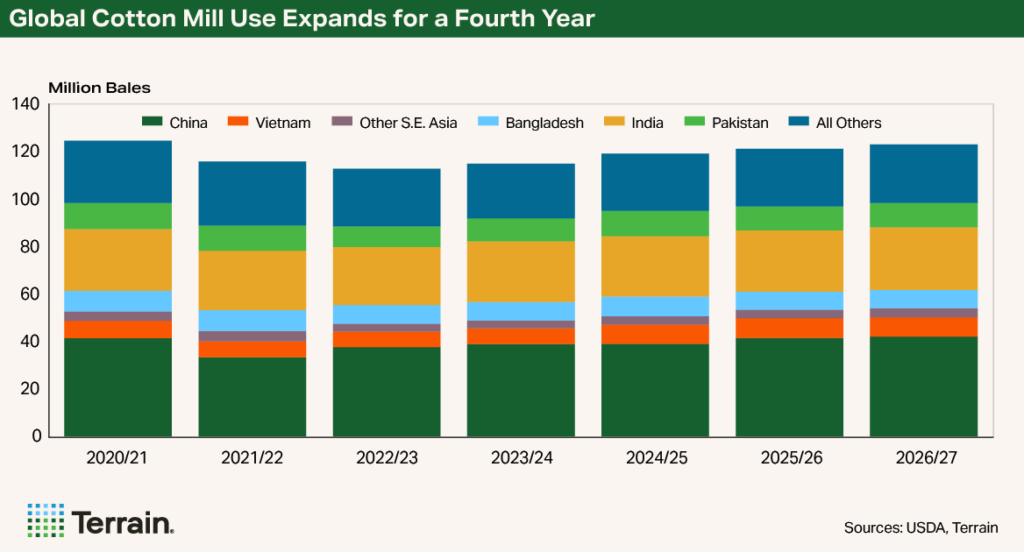
The USDA projects global cotton demand to rise for the fourth consecutive year, reaching 123.1 million bales, the highest since 2020/21. This growth forecast is supported by a cotton/polyester relationship that is more favorable to cotton than in previous years. Relative competitiveness has been volatile this year, as price spikes of synthetic fiber manufacturing costs following the beginning of the Iran war improved cotton competitiveness. That was later followed by higher cotton prices and lower synthetic fiber costs, bringing that relationship back near pre-war levels.
While the current outlook for relative competitiveness is for a slight reduction in cotton competitiveness throughout the marketing year, an escalation of the U.S.-Iran war could shift the outlook again in favor of cotton.
While cotton may be benefiting to some degree from a fiber competitiveness perspective, the total pie remains influenced by people’s disposable incomes.
Key Demand Indicators
Global energy prices, inflation and economic growth also remain important demand indicators to watch in the months ahead. While energy prices and inflation remain elevated across many countries, global economic growth has helped to offset the inflation pressures on consumers, so far preventing a significant drag on textile or apparel consumption. While cotton may be benefiting to some degree from a fiber competitiveness perspective, the total pie remains influenced by people’s disposable incomes. And those incomes could be pressured if energy prices and inflation remain elevated and growth weakens.
Exports and Brazil Competition
U.S. export commitments are on pace this year to exceed the USDA’s current forecast of 12.3 million bales. Based on the latest export commitment pace through October 1 and the average pace over the last three years, U.S. exports are on track to reach 12.9 million bales. Fluctuations in the exchange rates of our export partners and competitors could shift this outlook as the marketing year progresses. Watch commitments in the weeks ahead to see if the recent declines in cotton prices may be met with more export sales.
Cotton exports could help satisfy part of China’s non-soybean purchase commitment, but so far, these sales have not materialized.
China is the world's largest user of cotton, but U.S. export commitments to China remain the third smallest in the past 10 years at just 224,000 bales as of October 1. Cotton exports could help satisfy part of China’s non-soybean purchase commitment, but so far, these sales have not materialized. Watch for, but don’t count on, these sales, as they would likely offer a lift to U.S. cotton prices.
The U.S. continues to face strong competition from Brazil for export market share. Brazil is expected to export about 16 million bales, though that forecast is not without risks.
The majority of Brazil’s cotton crop is planted as a second crop following soybeans. The current outlook is for favorable soybean planting weather in the weeks ahead, favorable for the prospects for Brazilian cotton and likely contributing to recent price weakness in cotton. However, a timely soybean harvest is needed next to ensure cotton is planted in a favorable time. A strong El Niño also presents some uncertainty for yields, though the historical relationship is relatively weak and does not reliably indicate yield potential.
For the 2026/27 marketing year, I forecast the U.S. upland cotton season-average farm price at about 75 cents/lb.
Any challenges to the Brazilian cotton crop prospects could offer support to cotton prices in late Q4 2026 or Q1 2027.
Price Forecast
For the 2026/27 marketing year, I forecast the U.S. upland cotton season-average farm price at about 75 cents/lb. Managed money was recently net long almost 101,000 cotton contracts at the end of August but has since reduced that position by about one-third, coinciding with the decline in nearby futures prices. Watch for further reductions, as it could mean continued short-term weakness. Looking to 2027, I forecast total cotton acres at 9.9 million to 10.1 million acres, which should keep stocks under 4 million bales if the U.S. exports 12.5 million bales or more next year.
Terrain content is an exclusive offering of AgCountry Farm Credit Services, American AgCredit,
Capital Farm Credit, Farm Credit Services of America and Frontier Farm Credit.