Quarterly Outlook • July 10, 2026
Margins Narrow as Hog Futures Reprice Lower

Report Snapshot
Situation
Hog sector profitability has remained solid, with margins still above historical averages and the industry extending a multiyear streak of positive returns.
Outlook
Forward margins have tightened sharply from spring highs due to weaker-than-expected hog prices, leaving producers with a thinner cushion and greater sensitivity to market risk.
Finding
Margins remain positive but have compressed significantly, shifting the hog market from broad profitability to a more risk-sensitive environment where price declines can quickly erode returns.
Forward hog crush margins have tightened notably from my Q2 outlook.
Profitability across the hog sector remains resilient. Iowa State University estimates May farrow-to finish returns at $21.03/head, extending the industry’s profitability streak to 26 consecutive months. Margins continue to run above seasonal norms, particularly when viewed against the five-year ($16.04/head) and 10-year ($18.75/head) May averages.
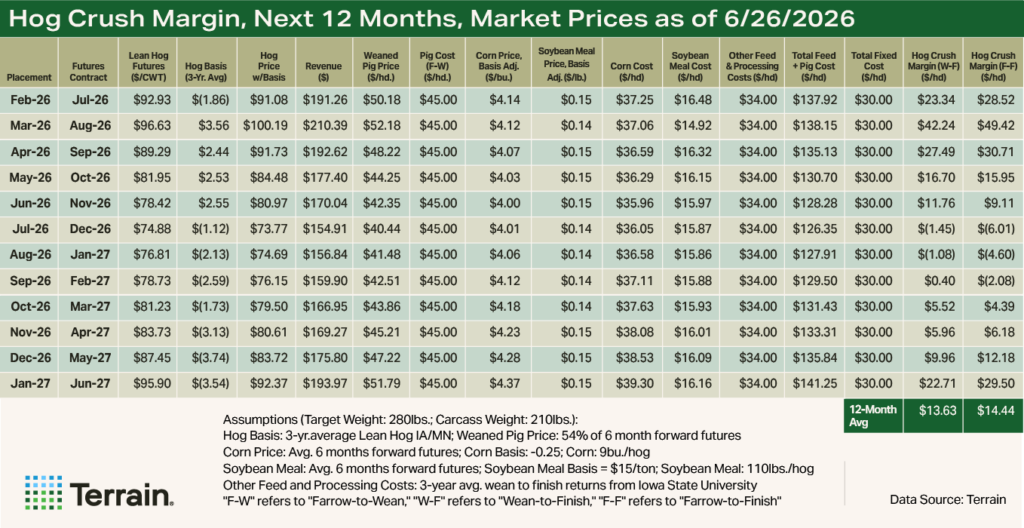
Forward hog crush margins have tightened notably from my Q2 outlook. Based on futures prices as of June 26, I project average returns of roughly $13-$14/head for wean-to-finish operations and $14-$15/head for farrow-to-finish operations over the next 12 months. That’s a sharp pullback from March levels of $28-$29/head and $35-$36/head, respectively, leaving producers with a much thinner profitability cushion.
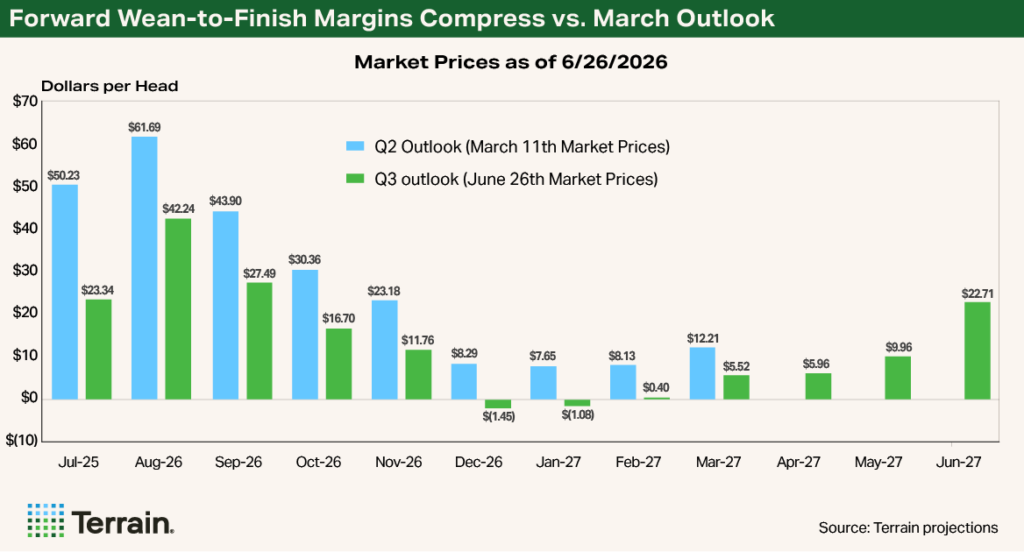
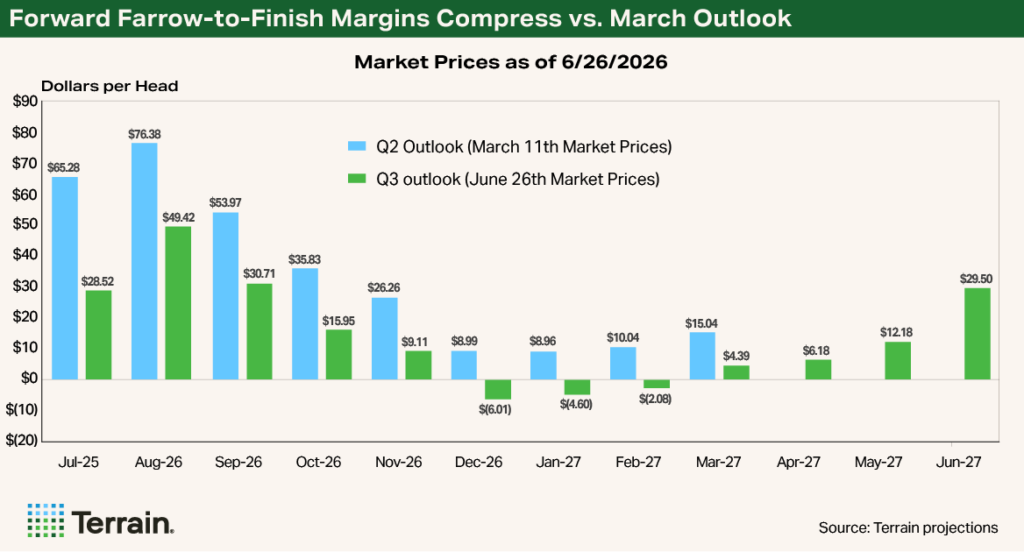
The primary driver continues to be weaker hog prices. Lean hog futures remain well below levels seen back during March, reducing expected revenue by roughly $20-$30/head across comparable windows. While hog prices have stabilized somewhat since early June, they have not recovered enough to restore earlier margin strength.
Feed costs have moved lower and provided a meaningful offset. Corn prices near $4-$4.20/bu. have reduced feed costs by about $4-$5/head, with soybean meal relatively stable. This has helped support margins, but the improvement in costs has been a small portion of the revenue decline, meaning margins remain compressed. Feed costs are acting more as a stabilizer than a bullish driver.
Margin structure has also shifted from broadly positive to more narrow and seasonal. Summer and early fall marketing windows still offer the strongest opportunities but these are well below March peaks. At the same time, several late-2026 placements remain near breakeven or negative, highlighting increased downside exposure.
This tighter margin environment increases risk across the board. With 12-month average margins now in the $13–$15/head range, small adverse moves in hog prices, feed costs or basis can quickly eliminate profitability. There is also two-sided feed risk — while lower costs have helped, any weather-driven rebound in corn or soybean meal could quickly pressure margins further. Meanwhile, hog prices remain the dominant risk factor, with limited cushion against additional downside.
Q3 2026 Price Forecasts


Pork supplies remain relatively tight heading into the peak summer demand period.
Q3 2026 Price Risks
Upside Risks
U.S. Hog Inventory: The June Hogs and Pigs report came in neutral to slightly bullish with few meaningful changes relative to either last quarter or a year ago. Total hog and pig inventory declined modestly — down 33,000 head year over year (YOY) and 277,000 from last quarter — while the breeding herd was 1% lower at 5.88 million head compared with June 1, 2025.
That said, some near-term supply pressure is building, as improved productivity continues to offset herd contraction. Specifically, litter size for the March-May pig crop increased from 11.75 in 2025 to 11.87, pointing to larger pig crops and greater production potential in the months ahead.
The total inventory position creates upside to pork cutout values and hog prices.
Cold Storage: USDA cold storage data for May 2026 point to a net supportive price signal for the pork complex. Total frozen pork stocks were 451.9 million pounds, roughly in line with year-ago levels but 8.7% below the five-year average. Pork supplies remain relatively tight heading into the peak summer demand period, limiting the buffer available to the market if retail, food service or export demand strengthens. Overall, the total inventory position creates upside to pork cutout values and hog prices, particularly if slaughter supplies tighten seasonally or disease pressure continues to limit market-ready hog availability.
At the primal level, the signal is mixed but still leans supportive.
Rib stocks were notably tight at roughly 76.5 million pounds, below both last year and the five- and 10-year averages. Belly stocks were also below longer-term averages, despite being slightly above last year, creating some upside for bacon values if retail featuring remains active. While bacon prices have come down since peaking last September, prices were relatively expensive last summer, possibly creating some pullback with cost-conscious customers.
Trimmings and “other pork” stocks were below year-ago and historical levels, adding support to the broader pork cutout and suggesting that processing items are not burdensome. Variety meats were near year-ago levels but still below the 10-year average, which is also supportive, especially if export demand remains steady.
The main downside risk is concentrated in hams and picnics. Ham stocks, at roughly 123 million pounds, were above both last year and the five-year average, signaling heavier availability and potential pressure on ham values unless export demand improves. Picnic stocks were also above last year and historical averages, though the price impact is likely more limited given the smaller volume.
Loins and butts appear more balanced, with inventories near recent norms, suggesting a more neutral price signal for those cuts.
Overall, stocks in cold storage suggest the pork market is not facing a burdensome inventory environment. While larger ham and picnic supplies could cap gains in those specific primals, tighter stocks in ribs, bellies, trimmings and other pork items point to more upside than downside risk for pork prices heading into Q3 2026.
Animal Disease: Higher-than-average Porcine Reproductive and Respiratory Syndrome (PRRS) positivity continues to provide structural support to the hog market. In May, PRRS positivity was 28.8%, above the five-year seasonal average of 27.7%. The wean-to-market segment also remains elevated, with positivity near 43.5%. Overall, PRRS cases in Iowa, South Dakota and Illinois were very high compared with each state’s baseline for typical May levels.
Meanwhile, positivity from Porcine Epidemic Diarrhea Virus (PEDv) reached 10.4% in May, slightly above the five-year average of 10.1%. Contrary to that of PRRS, PEDv cases remained within state-specific baselines across the 11 states monitored by the Swine Health Information Center.
Exports: Pork exports remain supportive heading into Q3 2026. Through April, U.S. pork exports totaled roughly 2.46 billion pounds, up 3.9% YOY. Mexico and broader Latin America continue to drive growth. Exports to Mexico are up 5.2%, while shipments to Latin America (excluding Mexico) have increased 7%, led by a 9% gain in Central America to 186.7 million pounds. Outside the region, demand has also improved, with exports to Japan and Canada rising 16.8% and 10.4%, respectively.
Strong export demand should help offset stagnant domestic consumption.
That said, May data will reflect a disruption in variety meat trade after Mexico halted imports of skins, fat, feet and other offal following the detection of pseudorabies virus (PRV) antibodies in boars in Iowa. As of June 8, those restrictions have been narrowed to product sourced specifically from Iowa and Texas.
Despite heavier hog weights boosting pork production, strong export demand should help offset stagnant domestic consumption. A key risk to monitor includes Mexico’s ongoing antidumping and countervailing duty investigations on certain U.S. pork products, particularly ahead of the USMCA review later this summer.
Overall, with export volumes running ahead of last year, Latin America continuing to outperform, and demand from key partners like Japan improving, the export outlook remains favorable and should provide support to hog and pork markets through Q3 2026.
Downside Risks
Weights: Producer-owned barrow and gilt weights are up 0.5% YOY and up 1.9% relative to the 2019 to 2023 average. Packer-sold weights are also elevated, up 2% YOY and 2.9% above the 2019 to 2023 average, while packer-owned weights are up 3.2% YOY. Heavier seasonal weights throughout 2026 have been adding supply to the market, creating limited price upside in a hog market with relatively tight cold storage. As a result, the USDA projects a 1.5% increase in pork production from 2025 to 2026 and a 1% increase from 2026 to 2027.
Summer Temperature Outlook: A cooler leaning outlook across the Midwest during July through September suggests the potential for less heat stress in the core hog-producing region, supporting better feed intake and weight gains. As a result, the typical summer drop in hog weights may be smaller than usual, with hogs finishing heavier and potentially earlier in the fall.
For the market, the implication is added pressure on hog prices and pork cutout values during a period when demand typically softens following peak summer grilling demand. The usual seasonal tightening that develops from summer weight losses may also be diminished, which could delay or dampen any fall price recovery. While regional heat in the Southeast may temper performance slightly in smaller production areas, the broader Midwest cooling signal dominates the national outlook.
Consumer Demand: Retail pork demand enters Q3 2026 slightly bearish. The first-quarter retail pork demand index per the Livestock Marketing Information Center slipped to 93, down from the pandemic high of 123 in 2022 and below the stronger post-pandemic demand environment.
The recent softness suggests domestic retail demand is more of a downside risk than an upside catalyst, particularly as wage growth has lagged inflation since April, keeping consumers price-sensitive at the meat case. Elevated fuel prices add another headwind by reducing discretionary spending and raising distribution costs, which can pressure both retail movement and margins across the pork complex.
Household balance sheet strength is helping to temper, but not eliminate, downside risk, even as financial conditions continue to support beef demand at the upper end of the protein complex. Along with a resilient job market, that support could help explain why meat demand for certain cuts is holding up, despite ongoing pressure on real incomes for lower- and middle income consumers.
Relative meat prices remain one of the more constructive offsets for pork demand heading into Q3, but they also help explain why beef demand has remained resilient despite elevated prices. Beef is expensive relative to pork, with the beef-to-pork ratio at 1.93 — well above the five-year average of 1.58 and 10-year average of 1.55. Beef is similarly elevated versus broilers, at 3.9 compared with longer-run averages near 3.2 to 3.1. Even so, beef demand has held up, supported by stronger purchasing power among higher-income consumers and broader wealth effects. While these wide spreads create a clear value advantage for pork, particularly during the summer grilling season, the trade-down from beef is likely to be incremental rather than broad-based.
However, pork’s advantage is far less pronounced versus poultry. The pork-to-broiler ratio sits at 2.03, essentially in line with its five- and 10-year averages, indicating pork is not gaining meaningful ground on chicken from a value perspective. This keeps poultry firmly positioned as the primary competitor for budget-conscious consumers, particularly in an environment where real wage growth has lagged inflation and inflation remains sticky.
Overall, the Q3 2026 demand outlook is mixed but modestly tilted to the downside. Elevated beef prices create some substitution opportunities into pork, but those gains are likely to be limited, as beef demand remains resilient at the high end and poultry continues to anchor the value segment. Without a stronger improvement in real purchasing power, domestic retail demand is more likely to cap upside rather than drive a sustained rally in hog and pork prices.
In this environment, active margin management is critical.
Protecting Margins in a Tighter Environment
In this environment, active margin management is critical. Producers may want to lock in positive margins when available, particularly in stronger seasonal windows, by pairing hog revenue protection (futures, forward contracts or Livestock Risk Protection) with feed cost coverage. Options strategies can be especially useful, allowing producers to protect downside risk while maintaining upside flexibility. An incremental, layered approach to hedging can help reduce timing risk and improve overall outcomes.
In addition, producers may benefit from focusing on the full margin rather than individual prices, ensuring that hog revenue, feed costs, pig values and basis are managed together. Basis risk, in particular, can become more impactful when margins are thin, making it important to monitor local market conditions alongside futures. Maintaining flexibility in feed procurement and monitoring production efficiency can also help preserve margins when price-driven opportunities are limited.
The market has shifted from one of broad profitability to one where margins are tighter, more uneven, and more sensitive to market moves. Opportunities remain, but protecting them requires more disciplined and proactive risk management.

Terrain content is an exclusive offering of AgCountry Farm Credit Services, American AgCredit,
Capital Farm Credit, Farm Credit Services of America and Frontier Farm Credit.