Outlook • August 11, 2026
Weighing In on Weight Loss Drugs and Agriculture


Report Snapshot
Situation
Surveys suggest that around 12% to 18% of American adults have used a GLP-1 drug, and adoption appears likely to grow. Early evidence points to two broad effects of GLP-1 use: a reduction in overall food consumption, and a change in food choices.
Finding
GLP-1s have the potential to drastically change consumer habits. Two key takeaways stand out today for producers as they consider what this means for their operation: 1) Account for GLP-1 consumption changes in long-term decisions, and 2) Continue to monitor consumer behavior as GLP-1 adoption evolves.
Impact
Producers should pay attention to not only new research but also the actions of major food companies and restaurant chains, which are among the first to feel changing consumer preferences.
GLP-1 drugs are quickly reshaping consumers’ relationship with food. Although we’re in the early stages of understanding this technology and its impacts, research suggests the effects could be significant. Some commodities could see benefits while others may have to reposition.
In this report, I argue that the agricultural industry should be watching the rise of GLP-1s because they are a highly effective technology that changes what consumers put on their plates.
I also discuss preliminary research that shows these drugs are affecting consumer decisions by reducing overall food consumption and prompting different food choices.
Last, I share two key takeaways for producers as they consider what weight loss drugs mean for their operation: 1) Account for GLP-1 consumption changes in long-term decisions, and 2) Continue to monitor consumer behavior as GLP-1 adoption evolves.
Why GLP-1 Drugs Matter
Some of the most important changes that have occurred on the demand side of markets include trade and farm policy, demographic shifts, and health trends.
GLP-1 drugs may need to be added to that list. What makes medications such as Ozempic, Wegovy, Mounjaro, Zepbound and Foundayo noteworthy for agriculture is their effectiveness, growing use and potential.
A 2021 article in the medical journal JAMA discussed a clinical trial where overweight or obese adults who received a GLP-1 medication alongside lifestyle interventions saw a 16% reduction in body weight after 68 weeks. By comparison, participants who received a placebo alongside lifestyle interventions saw only a 5.7% reduction.
Surveys suggest that somewhere around 12% to 18% of American adults have used a GLP-1 drug.
Whereas traditional dieters must try hard not to eat that extra slice of pizza, GLP-1 users seem to not have that pesky food noise to begin with.
Effectiveness alone, however, would not make GLP-1s relevant to agriculture. It’s the scale that also matters.
Though global percentages are unknown, surveys suggest that somewhere around 12% to 18% of American adults have used a GLP-1 drug. Adoption is generally higher among women, higher-income households and older consumers. Some observers even suggest adoption has been widespread enough to contribute to recent declines in U.S. obesity rates.
Adoption appears likely to grow. To date, cost has been a frequently cited hinderance to remaining on the medication. This may change as manufacturing expands, active ingredient costs decline, and patents expire in major markets. Eli Lilly CEO David Ricks summarized this dynamic when he stated, “In the GLP-1 category, we observe prices are elastic. The more we lower the price, the more users we get. That’s the path we’re on.”
As these medications become more affordable, they will likely become more accessible to a broader share of the global population.
If a highly effective technology that changes what consumers put on their plates is becoming increasingly popular, the industry that produces that food needs to pay attention. Many food companies are already watching these medications closely and starting to reconsider or double-down on existing strategies.
How GLP-1 Consumers Are Changing Food Demand
Though research literature is still emerging, a growing body of surveys and transaction data have begun to paint a striking picture of how GLP-1 users differ from the rest of the population. While estimates vary across studies, the evidence generally points to two broad effects:
1. A reduction in overall food consumption
2. A change in food choices
Let’s start with overall food consumption. Survey results from a study published in the August 2025 issue of Food Quality and Preference show GLP-1 users reduce their caloric intake by 720 to 990 calories per day, a remarkably high reduction.
Household spending data tell a similar story. According to a 2024 paper by researchers at Cornell University, households with at least one GLP-1 user reduced grocery spending by 5.3% within six months, reducing their average annual grocery spend from $7,400 to $7,010. Higher-income households experienced the largest declines.
Beyond the first six months, dietary changes mostly persisted, though with some waning over time.
More GLP-1 users increased their intake of fruit, leafy greens and water than reduced it.
Consumers who discontinued medication returned to pre-medication spending levels.
Changes in food choices is the other half of the story.
Survey evidence suggests nearly all food categories experience large reductions in consumption, with a few exceptions. According to the 2025 Food Quality and Preference study, more GLP-1 users increased their intake of fruit, leafy greens and water than reduced it, while the opposite was true for processed foods, refined grains, alcohol and most other categories. The results for meat consumption are mixed. Some surveys say more GLP-1 users decreased consumption while others indicate meat intake remained unchanged.1
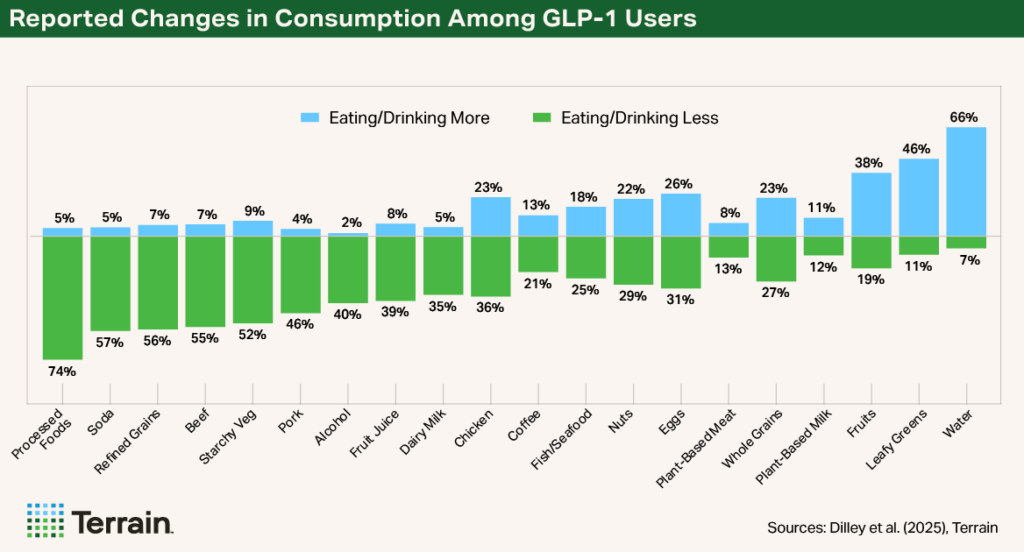
Transaction data point in the same direction, with spending declining across nearly every food category, according to the Cornell paper. Alternatively, spending on yogurt, nutrition bars, fresh fruit and meat snacks all increased (but only yogurt was statistically significant).
These changes extend beyond the grocery store, with spending on food away from home declining by 8% following GLP-1 adoption. A May 2026 article in The Wall Street Journal showed survey respondents similarly reported fewer visits to coffee shops, quick-service restaurants, fast-casual restaurants and full-service restaurants. Many also reported increasing their consumption of salads and bowls while cutting back on foods such as burgers, pizza and sandwiches.
The existing research provides valuable insight into how GLP-1 users are changing their eating habits, but important questions remain. It is possible, for instance, that early adopters exhibit more dramatic behavioral changes than future users or that some dietary changes weaken over time.
Nevertheless, if adoption continues to expand, the initial evidence suggests the implications for food demand could be meaningful. The question for agriculture is how to prepare.
For producers, the challenge is not simply understanding where demand is today but anticipating where it may be headed tomorrow.
Preparing for a GLP-1 World
As with many topics that affect agriculture, broad generalizations should be approached with caution. What makes sense for a grower of fresh produce and tree nuts in California may differ considerably from what makes sense for a cattle rancher in Colorado or a corn farmer in Iowa. Nevertheless, there are two broad takeaways that appear relevant to the entire agricultural community:
Account for GLP-1 consumption changes in long-term decisions
A consumer can change what they put in a grocery cart within days of starting a GLP-1, but agricultural production systems adjust slowly. Land use, processing facilities, distribution channels and other forms of infrastructure take years to adapt. For producers, the challenge is not simply understanding where demand is today but anticipating where it may be headed tomorrow.
For some operations, the change in consumption for what they produce may be minimal; for others it could be substantial.
For industry groups, wider adoption of GLP-1s may also warrant a different and/or varied approach to marketing or branding our commodities.
Continue to monitor consumer behavior as GLP-1 adoption evolves
Our understanding of these medications and their consequences will continue to evolve. Assumptions made today may need to be revised as new information emerges. Producers should pay attention not only to new research, but also to the actions of major food companies and restaurant chains, which are among the first to feel changing consumer preferences. Their product launches, earnings calls, and strategic decisions can be valuable signals long before widespread media coverage or academic studies.
Producers who understand these trends early will be best positioned to manage risks, identify opportunities and adapt accordingly.
GLP-1s have the potential to drastically change consumer habits. For an industry that often focuses on the supply side, GLP-1s serve as a reminder that we should take changing habits among our end consumers seriously. Whether these drugs ultimately prove to be a modest influence or a transformative force, the producers who understand these trends early will be best positioned to manage risks, identify opportunities and adapt accordingly.
Endnote
1 Other results (published in the January 2026 issue of Food Policy) show that willingness to pay increases.



Terrain content is an exclusive offering of AgCountry Farm Credit Services, American AgCredit,
Capital Farm Credit, Farm Credit Services of America and Frontier Farm Credit.