Quarterly Outlook • October 19, 2026
Patience in the Cornfield

Report Snapshot
Situation
Overall corn supplies remain tighter year over year despite the bearish surprise by the USDA's increase in old-crop ending stocks.
Outlook
While harvest pressure may create near-term weakness, stronger demand and global production risks are expected to support a firmer corn market as we move into 2027.
Bin There, Done That
The USDA’s September 1 grain stocks report shocked the corn market, reporting 2.095 billion bushels (BBU) of old-crop ending stocks (and subsequently rising new-crop beginning stocks). This was well above all trade estimates and 173 million bushels (MBU) above the USDA’s own September World Agricultural Supply and Demand Estimates (WASDE). Old-crop production and residual demand were also adjusted down 57 MBU and 230 MBU, respectively. Regardless of the surprise, U.S. corn supply is still forecast to decline year over year (YOY), creating a firmer price floor than the market has had in the past few years.
The supply shocks continued for the 2026/27 corn crop. In the October WASDE, the USDA raised the average national yield to 181.2 bu./ac., lifting production forecasts an additional 234 MBU. Although expected to decline 5.5% YOY to slightly above 16 BBU, stocks-to-use climbed to 11.34%.i Combining the old-crop ending stocks increase and the rise in new-crop yield prospects, the USDA raised supplies for the new-crop year by 407 MBU, nearly equivalent to Texas and Tennessee production.
Harvest progress had a slow start due to excessive rainfall throughout September, leading to washed-out acres and damaged stalks, increasing disease pressure. This could still reduce yield prospects ahead when combined with the dry conditions during the summer in the western corn belt. Corn harvested for silage could also increase, which could further reduce total production.
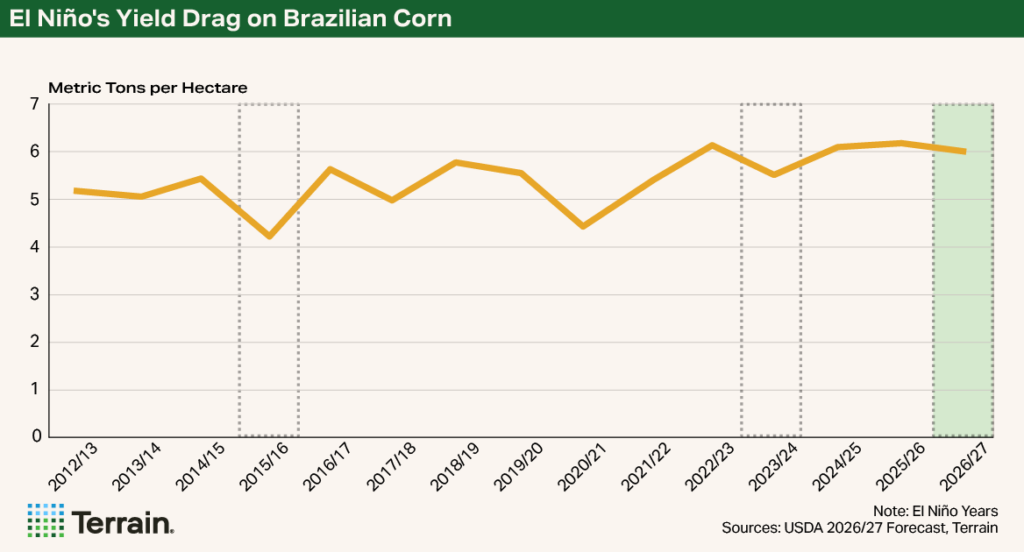
Post-harvest, the market will shift attention from U.S. supplies to South American supplies. Any delays in Brazil’s planting of soybeans could result in lower planted acres of second-crop corn. Given the forecast of a strong El Niño, yields could also be reduced in Brazil. The USDA currently forecasts 2026/27 yields to decline only 3% YOY. A sharper decline in South American supplies could lift U.S. corn prices.
The USDA forecasts 2026/27 to have the second-highest U.S. corn exports on record.
Exports Need a Boost
Corn exports have had a slower start to the new-crop marketing year, down nearly 30% YOY. However, the USDA forecasts 2026/27 to have the second-highest U.S. corn exports on record.
Exports to “Unknown” and Mexico are the top two negative drivers for the yearly decline. Arguably, Mexico could be slow-rolling its U.S. corn buys as a tactic with the United States-Mexico-Canada Agreement (USMCA) trade negotiations; however, its domestic production is limited and expected to be flat YOY. The European Union also has less domestic corn production forecast for 2026/27, accounting for 3%-4% of total global supply but 11%-12% of total global imports.
However, the U.S. dollar has also strengthened since the start of the year, up almost 6%, as the market expects additional federal rate hikes before year’s end. This makes buying U.S. goods like corn more expensive in the global market. Should Mexico accelerate U.S. corn purchases, farmers could see a rally in prices.
The China-U.S. meeting at the end of September left the market bulls with little clarity on how China will achieve the unspecified, prorated $17 billion in non-soybean sales before year’s end. Both countries agreed to extend the trade truce (“Busan Agreement”) through January, and while China suspended its 10% retaliatory import tariffs on U.S. corn, wheat and sorghum, the timing of the cuts remain unclear with no detailed agreement to buy these commodities.
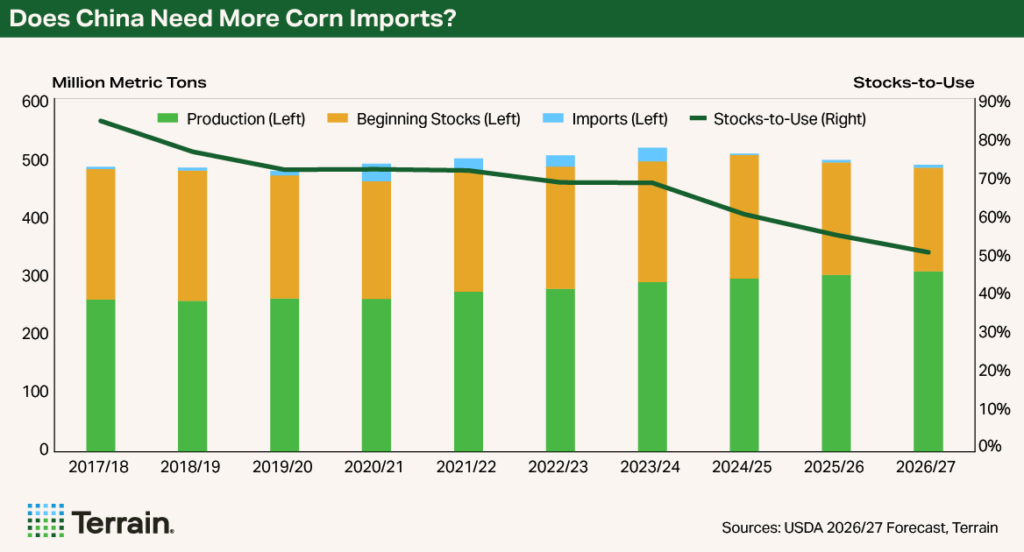
Keep in mind, China still maintains a Tariff Rate Quota of 65% on corn imports exceeding 7.2 million metric tons (MMT). Importantly, China is the world’s second-largest producer of corn, relying on imports for only 1% of its total domestic supply. With a stocks-to-use percentage exceeding 50% (compared with the U.S. hovering around 11%), the prospects of significant corn imports are less likely.
However, if China buys U.S. wheat and/or sorghum, that would reduce their use in U.S. domestic feed and ethanol (as corn substitutes) and increase corn’s market share in overall U.S. domestic use.
Fueling the Next Demand Wave
Ethanol production continues to produce consistent year-round demand for corn, with the potential for increased demand as we look toward 2027. At the federal level, year-round nationwide E15 has passed in the House and now awaits the Senate’s decision. Fuel retailers in California are also now able to sell E15. Given that California is the nation’s largest gasoline market, ethanol’s demand for corn could rise over 200 MBU without delay, as many retailers have existing infrastructure ready to handle the fuel.
While prices might face downward pressure heading into harvest, the decline should not be as severe as in prior crop years.
Higher energy prices combined with the $1/gallon 45Z tax credit for ethanol plants should fuel an aggressive crush pace and help support local corn basis. It is important for farmers to be aware of their local demand outlets and have a proactive dialogue with ethanol plants regarding the 45Z tax credit and low-carbon corn prior to adopting climate-smart agriculture on farm practices. Ethanol plants are not mandated to share the tax credit with their corn suppliers.
Bushels, Basis and Bullish Wild Cards
While prices might face downward pressure heading into harvest, the decline should not be as severe as in prior crop years. In September, funds went record net long over 400,000 corn future contracts, which does provide downside price risk if they begin to liquidate these positions. Record-high diesel prices tied to geopolitical issues with Russia/Ukraine and Iran have increased transportation costs. Crude oil is up nearly 40% since February, pressuring basis and reducing U.S. export competitiveness. This is also inflationary, which could keep funds defending their long positions regardless of the recent increase in domestic corn supplies.
Patience is now the game plan given the following short-term bearish trends:
- The USDA’s unexpected increase in old-crop ending stocks and new-crop yields
- Rising new-crop beginning stocks
- Rising stocks-to-use percentage
- Seasonal harvest pressure as bushels come to town
The U.S. is in an excellent position to increase global export market share and for corn prices to move higher as we look to 2027.
While prices could grind slightly lower in the short term, farmers must stay disciplined in their marketing strategies because several bullish wild cards remain at play as we move past harvest:
- Reduced global stocks as demand continues to outpace supply
- Increased U.S. ethanol demand for corn
- Rising demand from Mexico and/or surprise China purchases
- Reduced production in the EU and Brazil
- The Russia/Ukraine conflict restricting grain flows and the Iran conflict impacting input supplies, and therefore global yields
The U.S. is in an excellent position to increase global export market share and for corn prices to move higher as we look to 2027. Though the USDA adjusted the October WASDE balance sheet to reflect a higher stocks-to-use percentage, it should be temporary. As we move throughout the crop year, I expect increased demand will be supportive of higher prices.
Endnote
i Industry calculation to determine supply relative to demand: stocks-to-use % = ending stocks / (total domestic demand plus exports)


Terrain content is an exclusive offering of AgCountry Farm Credit Services, American AgCredit,
Capital Farm Credit, Farm Credit Services of America and Frontier Farm Credit.