Outlook • June 15, 2026
Slight Progress, but Risks Remain
Winescape Summer 2026 | Market Happenings


Report Snapshot
Situation
The pace of decline in three-tier wine sales slowed in the first quarter, but it’s too early to call it a turnaround.
Outlook
Consumers are apt to be cautious with their spending on discretionary items, including wine, for some time. Wine prices are also likely to feel downward pressure as wineries prioritize moving excess inventory. Still, premium tiers should continue to outperform.
Impact
There will almost certainly be less fruit grown this year than last. Grape sellers may need to act on credible offers, while buyers who know they will need fruit may benefit from moving earlier before harvest-time options narrow.
Wine Market Update:
Wine Sales Improve in the First Quarter
Sales Trends by Channel and Price Segment
Change vs Year AgoTrend Retail: Vallue
 Retail: Premium
 Retail: Super-Premium
 Retail: Luxury
 Direct-to-Consumer
 Export
Following a disappointing 2025, there have been some signs of improvement in the wine market in early 2026. The pace of the decline in three-tier wine sales slowed in the first quarter. But this comes against weak comparisons last year, so it may be too early to declare this a trend.
Based on my analysis of NIQ data, off-premise retail sales fell just 1% in value and 2% in volume in Q1 2026 versus the same period last year. This compares with a 5% year-over-year (YOY) decline in value and 6% drop in volume in Q4 2025. However, progress stalled in April, according to preliminary monthly figures from NIQ.
All market segments performed better in volume terms than value, which suggests price discounts are being employed to stimulate velocity.
Wholesale depletion revenue fell 4% YOY in the first quarter of 2026, according to SipSource data, a narrower loss than the 7% decline in Q4 2025. Depletion volume dropped 8% in the first quarter, versus a 10% decline in the final quarter of 2025. On-premise depletions are holding up better, contracting by just 1% in value in the first quarter, while off-premise depletions fell by 5%.
The middle and upper price tiers continue to hold up better than the lower end. The premium and super-premium segments saw modest YOY gains in value in the first quarter in NIQ outlets, while luxury wine sales were steady. Nonetheless, all market segments performed better in volume terms than value, which suggests price discounts are being employed to stimulate velocity.
Direct-to-consumer (DtC) revenues for Community Benchmark participants dropped 6% YOY in the first quarter, a deterioration from the 3% decline for the trailing 12-month period. On a positive note, the April figure was up sharply versus the same month last year. The first-quarter revenue decline came amid continued losses in visitors (down 4%) and club members (down 5%).
Based on figures from Sovos ShipCompliant and WineBusiness Analytics, DtC shipment revenue fell 3% YOY in the first quarter, versus a 2% drop in Q4 2025. Rising bottle prices continue to buttress shipment revenue. They were 11% higher in the first quarter compared with the same period in 2025. Alternatively, shipment volumes continue to fall at an alarming rate, down 13% in the first quarter.
U.S. wine exports plunged 23% YOY in value in the first quarter and 16% in volume. Nonetheless, this represents a slower rate of decline compared with the prior three quarters, though this was mainly attributable to a weaker comparison as Canadian provincial bans on American alcohol went into effect during Q1 2025.
Consumers are apt to be cautious with their spending on discretionary items, including wine, for some time.
Economic Outlook:
Consumers Are the Biggest Question Mark
The economy performed reasonably well in the first quarter, and we expect it to continue to grow in the months ahead at a rate slightly below trend. Nonetheless, consumer sentiment has taken a turn for the worse and consumers are apt to be cautious with their spending on discretionary items, including wine, for some time.
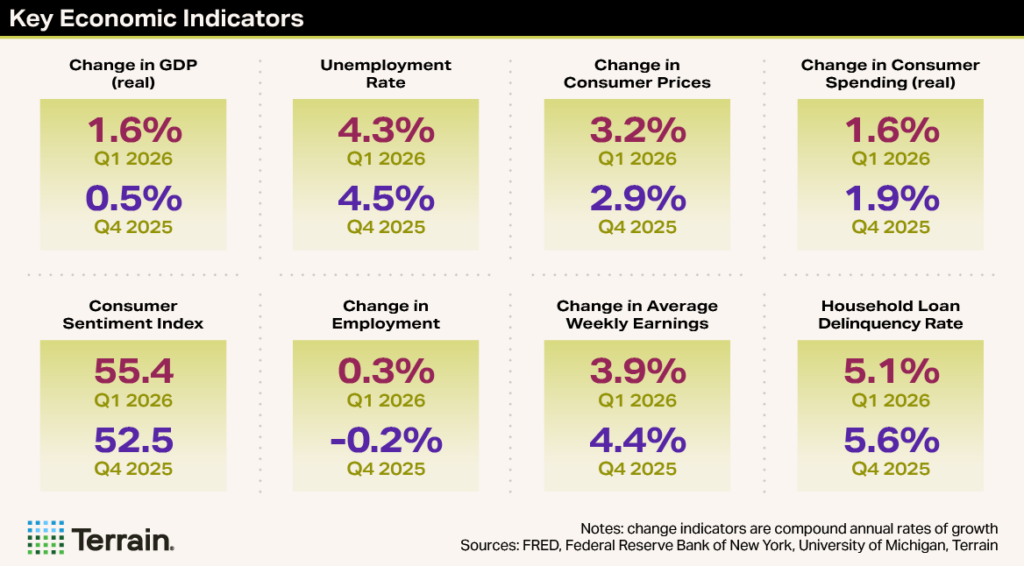
GDP expanded at a 1.6% clip in the first quarter — a nice rebound from the 0.5% reading in Q4 2025 due to the government shutdown. Tax cuts are boosting disposable income, and real consumer spending grew by a respectable 1.6% in the first quarter.
Employment growth was tepid in Q1 2026 (though it accelerated in April), but unemployment dipped to 4.3%, a solid figure by historical standards. Wages also continued to grow in real terms in early 2026. Overall, consumers look to be in reasonably good health, and loan delinquencies have stabilized and remain manageable.
The stock market also continues to trend upward, which is bolstering higher-income and older households’ wealth.
On the negative side of the ledger, higher energy costs associated with the Iran war have reignited inflation, which was above the Federal Reserve’s target before the war began. Consequently, inflation is now beginning to outstrip wage gains, which is a real threat to discretionary spending.
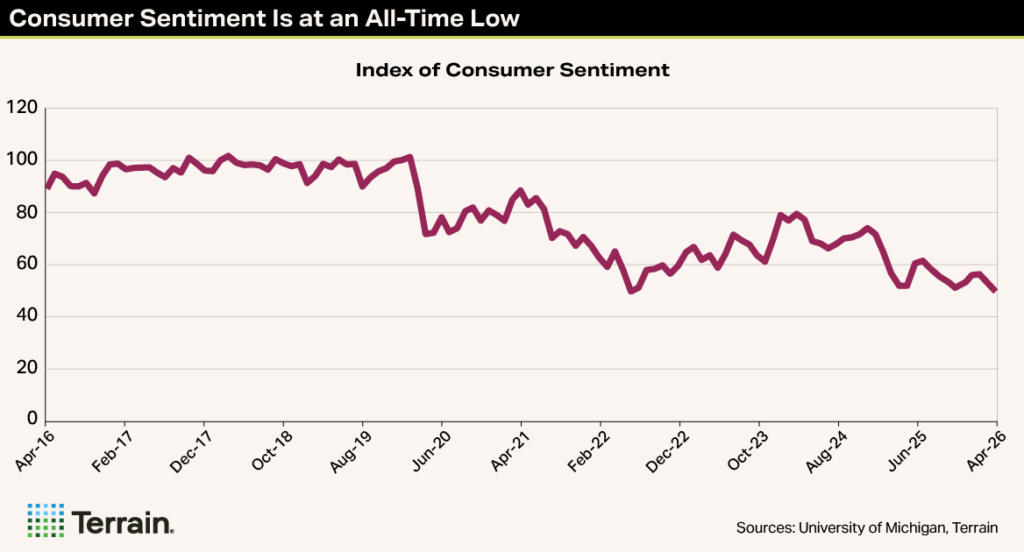
Consumer sentiment firmed a bit in January and February but has plummeted in recent months. The April reading was the lowest on record since the University of Michigan began tracking sentiment in 1978, and the preliminary figure for May was even lower.
Despite these uncertainties, Terrain still expects the economy to grow at a modest pace in the months ahead.
The economic outlook remains uncertain, due in large part to a lack of clarity regarding when the war in Iran will conclude and the Strait of Hormuz will reopen. The tariff situation also remains in flux, as the courts struck down the Trump administration’s global 10% tariff that replaced the original International Emergency Economic Powers Act (IEEPA) tariffs that were disallowed in February, though the administration is appealing the ruling.
Despite these uncertainties, Terrain still expects the economy to grow at a modest pace in the months ahead and unemployment to remain firm.
However, high fuel and food prices will persist for some time even if the Iran war concludes quickly. The impact of higher prices has been dampened thus far by larger tax refunds, but they will begin to bite harder in the months ahead. This is particularly true for lower- and middle-income consumers, who devote a higher share of their budgets to these items.
Sentiment is likely to remain depressed, as consumers loathe inflation and uncertainty. Contentious midterm elections could add to the malaise. Thus, consumers are apt to continue to be tentative and price-sensitive.
Wine Market Outlook:
Near-Term Momentum Will Be Difficult to Maintain
Given this backdrop, I’m not expecting the pace of decline in wine sales to improve through the remainder of the year. The premium and luxury segments should continue to hold up better than the lower end, though there is also likely to be downward pressure on wine prices as wineries prioritize moving excess inventory.
Surging gas prices and airfares are causing households to reevaluate their travel plans. In particular, the wave of Americans traveling abroad looks to be diminishing due to rising international airfares. This could potentially lead to more wine country visits this summer and fall, and improved DtC sales.
Finally, wine exports are likely to remain deeply depressed in the near term. There are no signs yet that additional Canadian provinces intend to lift their bans on American alcohol.
Grape sales continue to be slow, though there are buyers actively sizing up their options.
Grape Market Update:
Still in the Doldrums
There haven’t been any major developments in the grape market in recent months. Grape sales continue to be slow, though there are buyers actively sizing up their options. On the supply side, uncontracted grapes remain abundant and vineyards continue to be uprooted at a steady pace.
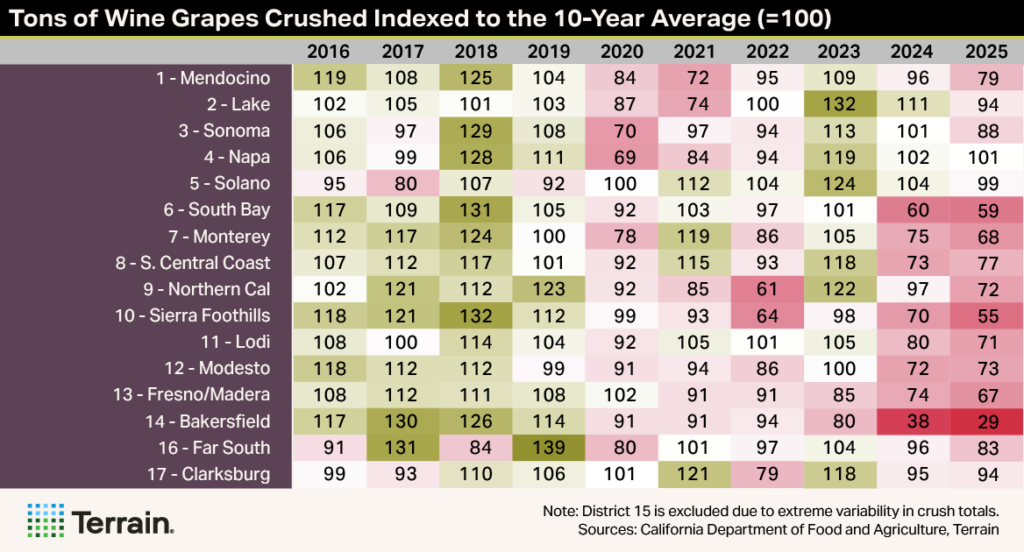
There were few material revisions in the final California Grape Crush Report, released April 30. The 2025 crush total was revised upward by 2,712 tons (just one-tenth of a percent) to 2,626,155 tons.
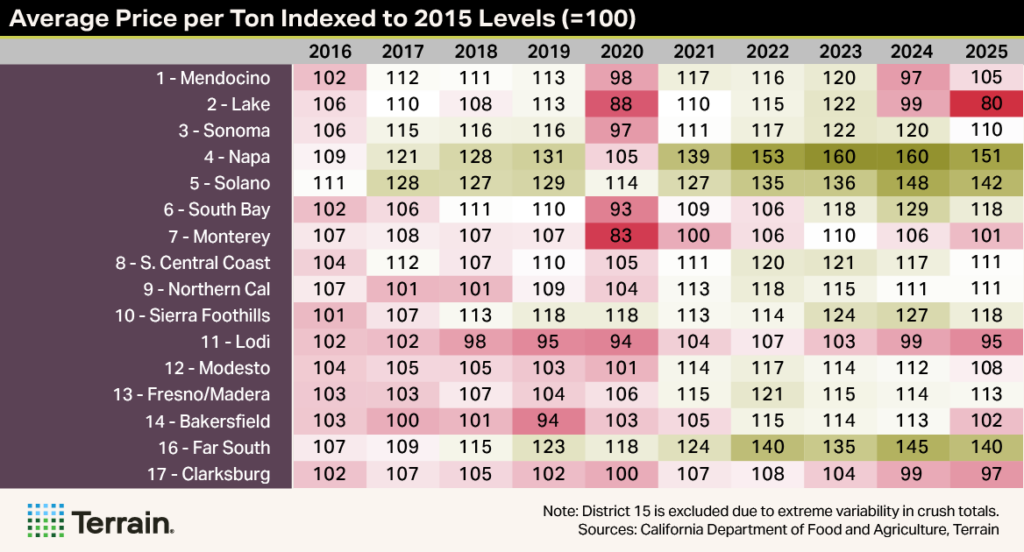
The most notable change was an almost 20% downward revision to the Mendocino County crush (which had looked suspiciously large). Also of note, the weighted average price per ton for Napa Cabernet Sauvignon was revised down by 4% from $8,864 to $8,513. The heat maps show the final crush and price indexes for 2025.
Grape Market Outlook:
Demand Needs an Upside Surprise in Wine Sales
Given the lack of improvement in wine sales, still-excessive inventory at wineries, and an abundance of bulk wine available for sale, grape buyers are in no hurry to commit to fruit. In the near term, demand is unlikely to improve sans an upside surprise in wine sales.
There will almost certainly be less fruit grown this year than last.
I don’t have fresh numbers on overall winery inventory levels, but the quantity of bulk wine available for sale in May was substantially higher than it was at the same time last year, according to figures from Ciatti. However, much of the available inventory consists of older vintages that are attracting less interest from buyers.
Progress continues to be made toward rightsizing supply, and there will almost certainly be less fruit grown this year than last. Allied Grape Growers expects that at least an additional 40,000 acres will be removed this year, with removal activity shifting toward the coastal regions. In addition, abandoned or only minimally farmed vineyards are readily apparent, though there aren’t hard figures on the number of acres that won’t be producing.
It’s difficult to say what the spot market will look like come harvest time. Although there will almost certainly be less fruit available, there isn’t likely to be a great deal of improvement in demand. I expect there will be plenty of fruit to go around again this year unless yields come in low.
California weather conditions have been volatile in early 2026, though no major issues are apparent with the crop at this point. The summer is forecast to be warmer than normal throughout California, with equal chances of above- or below-average precipitation, consistent with the brewing El Niño cycle. Warmer temperatures could accelerate vineyard development, which is already generally running two to four weeks ahead of schedule.
Sellers should give any offers received due consideration, as there may not be another one coming.
Buyers who are fairly certain they’ll need more fruit this year may want to act sooner rather than later. There will be fewer options at harvest time than there were last year.


Terrain content is an exclusive offering of AgCountry Farm Credit Services, American AgCredit,
Capital Farm Credit, Farm Credit Services of America and Frontier Farm Credit.