Outlook • June 15, 2026
Tangled Vines
Winescape Summer 2026 | Trending Topic


Report Snapshot
Situation
A severe decline in grape demand and prices, along with rising grape production costs, have pulled down California’s vineyard values.
Finding
The market is distinctly bifurcated, with an uneven decline across and within market segments. Considerable buyer interest remains for top-tier vineyards in premier appellations, whose value has held up relatively well. Vineyards with strategic appeal to a winery or those that can offer guaranteed income streams are also faring well in the market.
Outlook
A softening in vineyard values in the near term is fairly certain. But under my base-case scenario that the grape market will begin to stabilize in 2027 or 2028 in most regions, the vineyard market bottom shouldn’t be far behind. The longer-term trajectory of vineyard values will depend largely on the strength of grape price appreciation, which will vary across market segments.
The California vineyard market is over a barrel. Sellers continue to outnumber buyers by a wide margin and values have declined substantially over the past several years. The market has been distinctly bifurcated, however, and the decline has been uneven across and within market segments.
The slump in vineyard values is mainly attributable to a decline in the economic productivity of California vineyards brought about by:
- A severe decline in grape demand and grape prices
- Rising grape production costs
Owning vineyards has become a riskier proposition, and capital to finance vineyard acquisitions has become scarcer and more expensive.
There are several reasons to expect more downward, and uneven, pressure on vineyard values in the near term. However, I believe the bottom is nearing, as vineyard removals are bringing the grape market closer to balance.
The midterm outlook is less certain. The trajectory of values will depend on how quickly and forcefully the depressed grape market recovers. A quick snapback in vineyard values doesn’t appear likely, though it is not out of the realm of possibility either. Prospects for appreciation vary widely across appellations.
Considerable buyer interest remains for top-tier vineyards in premier appellations.
State of the Vineyard Market
The California vineyard market remains quiet. Comparatively few transactions have occurred over the past year, so it’s difficult to get a clear sense of where values stand today. What is clear is that sellers outnumber buyers and values are trending down.
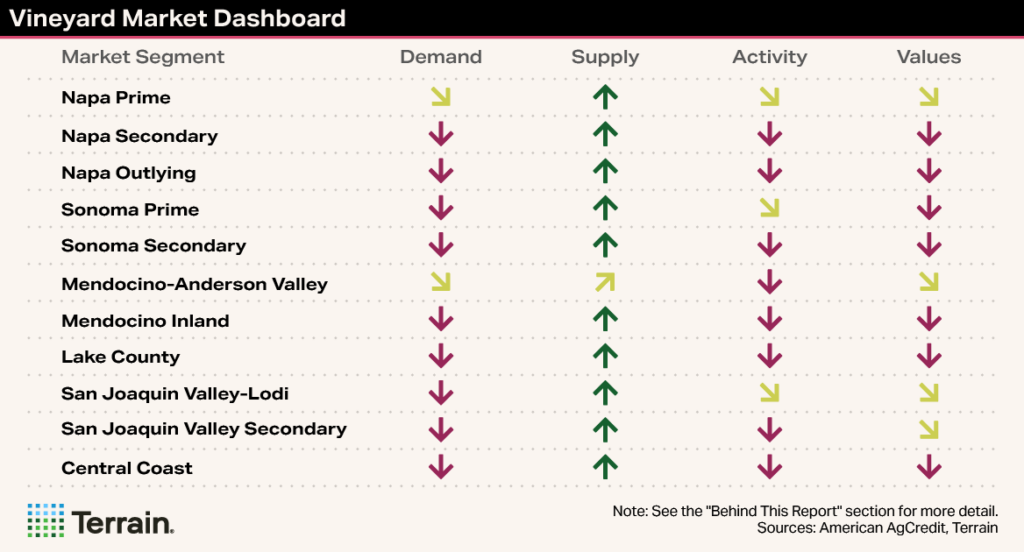
However, the market remains distinctly bifurcated. Considerable buyer interest remains for top-tier vineyards in premier appellations, whose value has held up relatively well. Vineyards with strategic appeal to a winery or those that can offer guaranteed income streams are also faring well in the market.
Alternatively, vineyards in secondary locations — or that have site challenges, vines approaching the end of their life, uncontracted fruit, or poor reputations — are garnering little to no interest and their value has declined more substantially.
The dashboard depicts the American AgCredit appraisal team’s directional view of key market indicators as of the second quarter of 2026.
Buyers Are Laser-Focused
Demand for California vineyards remains weak by historical standards, though more buyers are beginning to express interest in acquiring properties recently as prices have come down.
Investment buyers are the most visible in the market today. They are focused primarily on acquiring high-end properties in premier appellations such as the prime areas of Napa or Sonoma that can offer some form of guaranteed income for at least the next several years, such as solid grape contracts or seller leasebacks, to reduce risk. Young vines are also attractive to buyers due to the high costs of replanting vineyards today.
Investment buyers are being patient and deliberate and are unwilling to compromise on their return requirements. In cases where the seller can’t provide an assured income stream, they are taking an opportunistic approach and holding out for steeper declines.
There have been comparatively few strategic (winery) buyers in the market because there is a surplus of grapes available for low prices. However, wineries will act and pay generous prices under very specific circumstances, such as when an adjacent vineyard or a premier property with a reputation for producing vineyard-designated wines that command high bottle prices becomes available.
Lifestyle buyers have also been relatively scarce. They are often viewing the vines on lifestyle properties as expensive landscaping and attributing little value to them.
In the secondary market segments, there is also demand from buyers seeking to purchase and convert vineyards to alternative uses such as permanent plantings in the San Joaquin Valley or row crops in some parts of the Salinas Valley. They generally attribute little to no value to the vines (or even a negative value due to removal costs) and pay based on the land’s value under its alternative use.
Many Properties Are Available, but Few Deals Get to the Finish Line
Considerably more vineyards are available for sale across California compared with historical norms. There were 131 active vineyard listings* as of May 2026 and many more properties are being quietly or exclusively offered. Inventory is particularly high in the Sonoma Prime and Lodi market segments.
Sellers span the gamut from small growers seeking to exit the grape business because they’ve lost contracts to large wineries attempting to divest vineyards to free up assets and focus on their core business of producing wine. There aren’t many heavily distressed properties on the market today, as lenders have opted to work with their customers rather than take control of assets in a down market.
Only 19 vineyards have transacted this year through mid-May and just eight more sales are pending. Sonoma Prime and Lodi have been the most active, with five completed sales each. No other market segment has seen more than two sales thus far in 2026.
The lack of activity is due to limited demand, lack of heavily distressed properties that sellers would be willing to sell more aggressively, and a disconnect between buyers and sellers in terms of price expectations. Sellers have generally been slow to accept the fact that their property isn’t worth what it was several years ago while buyers are seeking steep discounts to justify the risk of buying during a period of falling wine sales and weak grape demand.
Consequently, marketing times have been extended; average days on market is approaching 400 days. Some listings have expired recently, though most of these properties are expected to come back on the market at lower prices in the months ahead.
Values Are Under Pressure
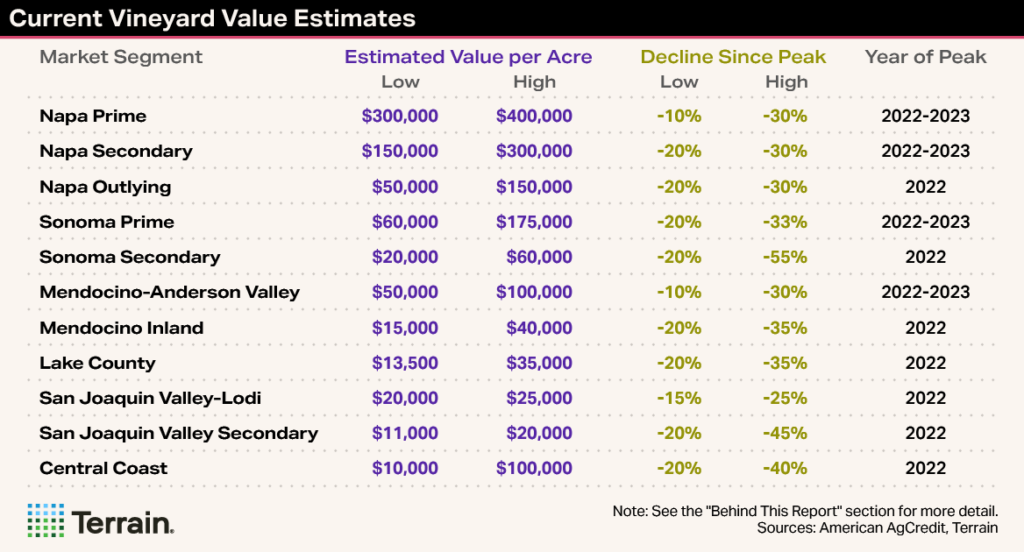
The vineyard value table shows American AgCredit’s appraisal team’s estimated value ranges as of May 2026 as well as the decline in values since the market peak. The ranges are intended to capture where the majority of properties would sell if sold within each market segment. Due to the limited number of completed sales, it is challenging to accurately gauge where values stand today, and some sales will inevitably occur above or below the stated ranges.
Based on the transactional evidence, pending sales, and changes in listing prices, there is clearly downward pressure on vineyard values across California.
The extent of the decline has varied widely across market segments and property types. High-end properties in the prime areas of Napa and the Anderson Valley have held their value reasonably well, though recent evidence suggests that cracks are emerging. Our appraisal team now believes that values are at least 10% below where they were at the peak.
Vineyards in marginal areas for grape cultivation or those with vines nearing the end of their life in secondary areas have lost as much as 50% of their peak value.
Prices haven’t fallen as much in Lodi, simply because at the market peak they weren’t far above the value of land with the next-highest use.
The Causes of the Vineyard Value Reset
The value of a vineyard primarily depends on its ability to produce income, though non-financial motivations may also be important to some buyers. In the case of a stand-alone vineyard, this is the profit that can be achieved through grape sales. For a winery-owned vineyard, it is the profit that can be generated by selling the resultant wine. Thus, grape and wine prices, coupled with production costs, are key drivers of vineyard values. The availability and cost of capital can also impact the equation.
Valuations also depend on the rate of return that buyers require, as it determines the present value of the projected income stream. Return requirements vary over time and depend on many factors, most important of which are the predictability of cash flows, perceived risks, and the returns available from alternative investments.
In addition, shorter-term market forces such as the balance between supply (number of available properties) and demand (number of qualified buyers seeking to purchase vineyards) and market sentiment can play a decisive role in shaping transaction prices.
The recent reset in vineyard values is due to a combination of these factors, but a deterioration in the economic productivity of vineyards — caused by a severe grape surplus and persistent rise in the cost to produce wine grapes — is the most consequential. The surplus of for-sale properties and changing risk perceptions have also impacted vineyard values.
The Grape Glut Has Reduced Vineyard Income Streams
Following several decades of steady growth, California wine sales have declined for four consecutive years and are now approximately 20% below their pre-pandemic level. The slump in wine sales has reduced demand for California wine grapes. Just 2.6 million tons of fruit were utilized in 2025, versus an average of 4 million tons per year at the peak (from 2012 to 2019).
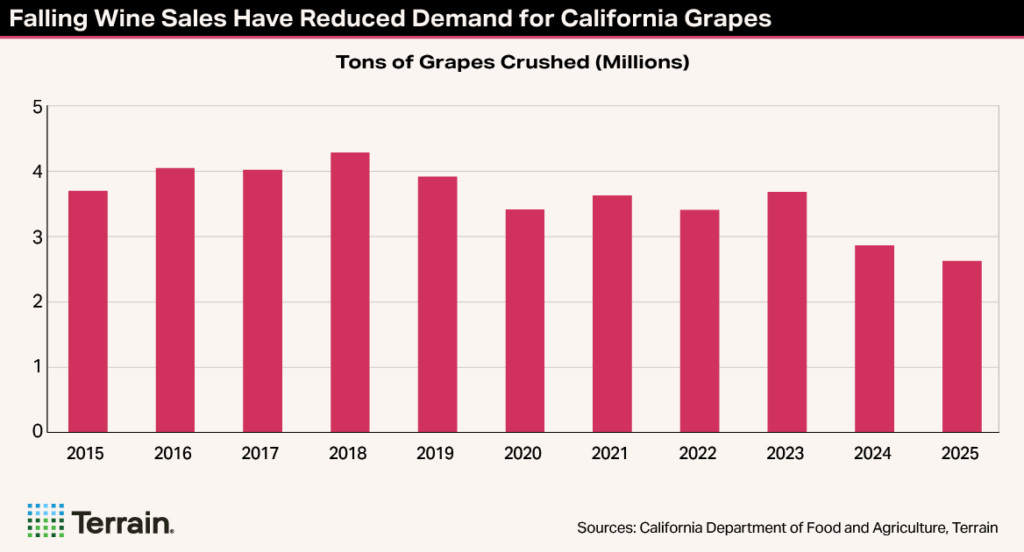
The slump in wine sales appears to be more structural than cyclical, which means fewer vineyards are needed now than in the past and even fewer will be needed in the future. Thus, vineyard use is no longer viable on some properties planted with vines.
The grape surplus has also translated to falling grape prices. While the prices growers received in 2025 were down only modestly versus the peak in most major districts (by 6% to 12%), they are mostly based on deals negotiated in prior years. Prices on new contracts, which have been few and far between, are generally much lower.
Equally important, there have been more grapes available than the market could absorb. As much as 20% of the crop is believed to have been left on the vine in each of the past two years because there was no buyer. Thus, total revenue has fallen more substantially, and vineyard owners can no longer reasonably expect to sell all the grapes their vines can bear unless they have solid contracts in place.
Wine prices are also under pressure due to a surfeit of unsold wine inventory in a time of consumer price sensitivity. This reduces the income wineries can generate, and abundant opportunities exist to purchase discounted fruit on the open market. Thus, their willingness to pay to own vineyards outright has fallen.
The grape glut and falling wine sales have also reduced buyer interest in California vineyards and motivated some owners without grape contracts to sell, causing a surplus of sellers over buyers.
Grape Growing Has Become a Riskier, More Expensive Proposition
The costs associated with growing grapes have also skyrocketed over the past decade.
How much farming and development costs have risen varies widely across regions and sites. I’ve seen estimates ranging from just under 50% to as much as 100% over the past 10 years. Grape prices — vineyards’ income — have risen by far less in all major districts except Napa.
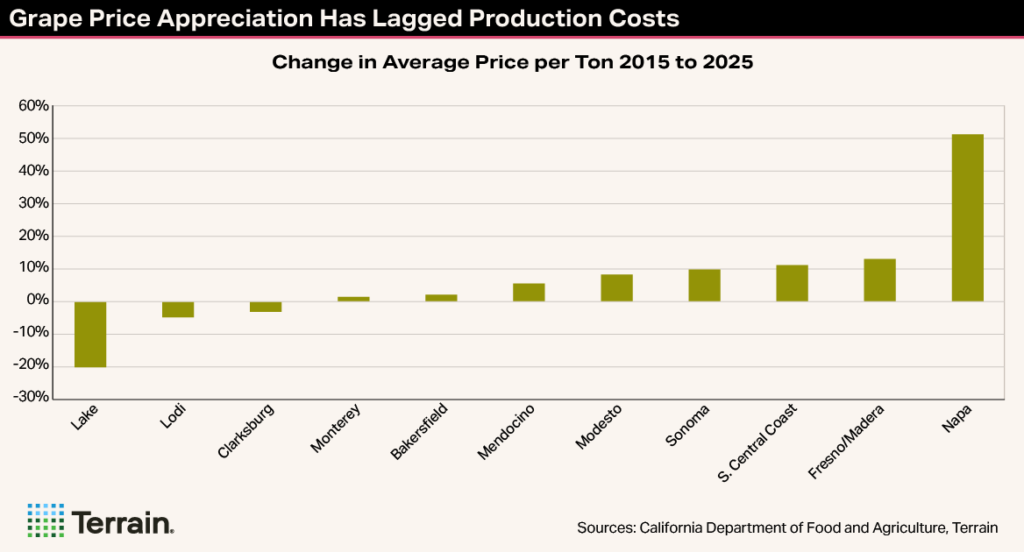
The combination of falling grape prices and rising costs has devoured grower margins. In many cases, prices on contracts being signed today are not even enough to cover farming costs. This has reduced the net income vineyards can generate even if they are able to sell their grapes.
The oversupplied grape market and uncertain timing for recovery also mean that future cash flows have become less predictable, which increases the risk associated with vineyard ownership. Moreover, fires and droughts in the early 2020s and new water regulations have heightened perceptions of the risks associated with growing wine grapes.
Lastly, given the ongoing slump in wine sales and depressed grape market, fewer lenders are willing to finance vineyard acquisitions. Those that are still lending have tightened standards. The cost of loans has also increased because of the post-pandemic spike in interest rates and greater risk premium required for vineyards specifically.
The bottom line is that vineyard ownership has become a less lucrative and riskier endeavor in recent years, which warrants lower values than at the market peak.
Like past cycles, the trajectory of grape demand and prices will ultimately shape the timing and contours of the vineyard market’s recovery.
Where Do We Go From Here?
Recent market cycles don’t provide a useful guide to how long the current vineyard market slump will last. This time is different: It’s being driven by a structural decline in wine consumption, which has reduced demand for grapes, as opposed to a cyclical oversupply of grapes.
But like past cycles, the trajectory of grape demand and prices will ultimately shape the timing and contours of the vineyard market’s recovery.
That said, I find further softening in vineyard values in the near term fairly certain. But under my base-case scenario that the grape market will begin to stabilize in 2027 or 2028 in most regions, the vineyard market bottom shouldn’t be far behind.
The longer-term trajectory of vineyard values will depend largely on the strength of grape price appreciation, which will vary across market segments.
While there may be an initial pop once excess supply has been absorbed, I expect grape prices to grow gradually thereafter in most regions. It will likely take some time for vineyard values to recover lost ground, but a quicker snapback is possible in the event of an overcorrection on the supply side or upside surprise in wine sales.
Expect More Downward Pressure on Vineyard Values in the Near Term
There are several reasons to expect that vineyard values will soften further in the months ahead:
- Wine sales are still declining steadily, with no signs that the grape market has reached a bottom yet. So, demand for vineyards is likely to remain weak.
- Supply of available vineyards remains excessive, and sellers who’ve been unable to attract a buyer after extended marketing periods are beginning to capitulate and lower asking prices.
- The ongoing slump in wines sales and associated wine inventory surplus are likely to compel more wineries to sell vineyard assets to free up cash.
- More distressed properties are likely to come onto the market as lenders lose patience with non-performing loans.
The magnitude of the additional decline is likely to vary widely across regions.
I expect upper-tier properties in the highly desirable coastal appellations (Rutherford, Oakville, Russian River Valley, etc.) that can offer reliable income streams, or are of interest to a well-capitalized strategic buyer, to continue to hold their value relatively well. Any decline from here is likely to be modest.
Values in fringe coastal areas, for lower-tier properties with older vines in secondary coastal areas, and in the San Joaquin Valley in general, can’t go much lower because buyers are already attributing little to no value to the vines. Open land values minus the cost of vine removal provide a floor in these areas.
Alternatively, I believe the potential exists for a more substantial erosion in value for vineyards that occupy the middle ground between these extremes.
Values Will Stabilize Once the Grape Market Recovery Begins
The vineyard market will begin to solidify once there are clear signs that the grape market recovery has begun. More buyers will begin to enter the market when they can be reasonably assured that fruit can be sold at a profitable price. Sales activity will pick up and excess inventory absorbed, creating a leveler playing field between buyers and sellers.
I believe the grape market will be closer to balance, if not in balance, by 2027 in most regions.
While the timing of the grape market recovery is uncertain, I believe we are nearing the bottom in most regions because substantial progress has been made toward rightsizing supply. It is believed that more than 75,000 acres of vines have been retired over the past two years, and removal activity continues at a steady pace in 2026.
The lack of reliable information on key variables, such as how many acres have been removed and how many bearing acres remain, as well as uncertainty in the future trajectory of wine sales makes it difficult to predict when the recovery will begin. However, I believe the grape market will be closer to balance, if not in balance, by 2027 in most regions.
This implies that the bottom is nearing for the vineyard market as well. We’ll have a better sense of where the grape market stands after the 2026 harvest and the release of the Grape Crush Report in early 2027.
A Quick Snapback in Vineyard Values Isn’t Assured — but It’s Not Out of the Realm of Possibility
Once the grape market recovers, the trajectory of vineyard values will ultimately depend on how quickly grape prices appreciate. This is even harder to predict.
What is certain is that it will be a challenging balancing act to bring grape supply back into alignment with demand without overshooting.
If we can stick the landing and leave the proper number of vines in the ground, there may be an initial pop in grape prices once excess supply is absorbed (prices generally aren’t sustainable today) followed by a period of gradual appreciation. Under this scenario, it would likely take at least several years from the point where the recovery begins for vineyard values to recover the ground lost from the peak.
If we overshoot the mark and too many vineyards are removed, or there is an upside surprise in wine sales and hence grape demand, a grape shortage will eventually materialize. Under this scenario, there could be a V-shaped recovery in grape prices. Prices could increase quickly for an extended period because of high vineyard development costs and the long lag time between the decision to plant and when vines begin to bear fruit. Vineyard values should snap back more quickly (within a couple of years from the bottom) if this scenario comes to pass.
I expect a faster recovery in coastal vineyard values.
The odds of a V-shaped recovery in grape prices are low in the San Joaquin Valley, as sales of value-priced wines are apt to continue to decline, and more vineyards will need to be removed over time. In addition, imported bulk wine provides a safety valve for value-wine producers. Thus, any grape shortage is likely to be short-lived. So, I expect vineyard values to remain stagnant or recover slowly. Prospects for appreciation are a bit better in Lodi than in the secondary areas, as it can also supply grapes to premium wine producers.
The odds of a future grape shortage are higher in the coastal regions — perhaps better than even — because there is more potential for premium and luxury wine sales to stabilize. So, I expect a faster recovery in coastal vineyard values.
Among the prime coastal areas, Napa is in a league of its own.
Values in the prime areas of the coast, which produce for the super-premium and luxury segments of the market, are likely to recover fastest. However, rates of appreciation are apt to vary widely across appellations. Grapes from these areas are highly differentiated, as most go into appellation- or vineyard-designated bottles. Thus, grape prices and vineyard values will depend heavily on the ability of wineries to push bottle prices.
Among the prime coastal areas, Napa is in a league of its own.
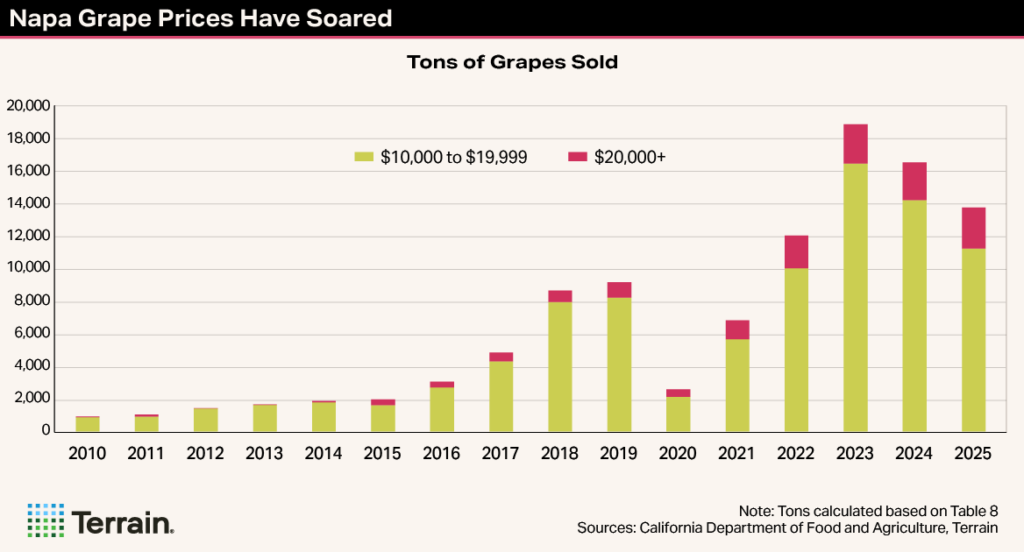
Napa grape prices have increased at a much faster rate compared with the other coastal regions. Over the past three years, 49,000 tons of Napa fruit sold for $10,000 or more per ton. This compares with just 21,000 tons in the prior three years. Thus, there will be a sizable volume of luxury Napa wine to swallow over the next several years. If the market can’t absorb it, there may be more downward pressure on Napa grape prices, and Napa vineyard values could be held in check.
The vineyard market in the secondary areas of the coast, which produce primarily for the premium segments of the wine market, should also recover relatively quickly. Considerable acreage has already been retired, and removal activity is accelerating, so it will be challenging to avoid overshooting if premium wine sales stabilize. That said, grapes from these areas are somewhat more of a commodity, and wineries are apt to be more price-sensitive, which limits the potential for a rapid escalation in grape prices and vineyard values.
In Times Like These, Realistic Expectations Are Key
For those who need to sell vineyards now, the key to getting a deal done in a timely manner will be to go in with realistic price expectations. A reputable appraiser can help you with this. If you aren’t a strategic target, having a grape contract in hand before going to market or being willing to provide some form of assured income to reduce the buyer’s risk will be an asset in this market.
For owners of quality coastal vineyards who do not need to sell immediately, it may pay to hold on until the grape market improves and surplus vineyard inventory has been taken down. If you take this track, prepare to be patient, as it may be some time before values begin to rise again. This may mean additional working capital burn in the near term.
For wineries seeking to acquire vineyards, the current market environment presents an opportunity to purchase at discounted prices. If you find a vineyard that fits your program and the numbers work, it may be wise to act sooner rather than later, as there are apt to be fewer options eventually.
Potential buyers can benefit from staying in close contact with a lender that understands the wine business. They can keep you abreast of changes in interest rates as well as explain the products and strategies available to finance acquisitions so that you can move quickly when you spot an opportunity.
*The figures cited in this section pertain to American AgCredit’s internal study area, which encompasses the vast majority of vineyards within California.

Terrain content is an exclusive offering of AgCountry Farm Credit Services, American AgCredit,
Capital Farm Credit, Farm Credit Services of America and Frontier Farm Credit.