Outlook • September 7, 2026
A Softer Slide for Wine and a Light Crop
Winescape Fall 2026 | Market Happenings


Report Snapshot
Situation
The wine market showed modest improvement in the first half of 2026, with sales still declining but at a slower pace across all channels. Still, most gains came early in the year, and inflation continues to squeeze consumer budgets. Harvest is running well ahead of schedule, and yields look to be light by as much as 50% in some areas.
Outlook
Wine sales are unlikely to improve much in the second half of 2026. Modest improvement is possible in 2027 if inflation abates as we expect.
Impact
Wineries needing fruit should move sooner rather than later, especially for higher-quality vineyards. A smaller crop should help reduce the wine inventory overhang and move the grape market closer to balance next year.
Sales Trends by Channel and Price Segment
Change vs Year AgoTrend Retail: Value
 Retail: Premium
 Retail: Super Premium
 Retail: Luxury
 Direct-to-Consumer
 Export
The trajectory of the wine market improved slightly in the first half of 2026. Sales are still declining, in both the three-tier and direct-to-consumer (DtC) channels, but at a slower rate. The pace of decline in exports has also moderated.
However, most of the improvement occurred in the first quarter, and I’m not expecting further progress during the second half of 2026. The economic backdrop is likely to remain challenging due to sticky inflation, stagnant real wages, and consumer pessimism. However, the economy and consumer look to be on reasonably firm footing, and inflation should begin to abate after the Strait of Hormuz reopens, so there could be modest improvement in wine sales in 2027.
The California grape crop is light, and the 2026 crush could be smaller than last year. Nonetheless, the shortfall hasn’t stimulated a great deal of additional activity and there should still be enough fruit to satisfy demand. The silver lining in a small crop this year is that it will help to reduce the wine inventory overhang, paving the way for stronger grape demand next year.
Wine Market Update:
Rate of Decline in Three-Tier Channel Moderates
Based on my analysis of NIQ data, the pace of the decline in retail sales moderated in the first half of 2026.
Based on my analysis of NIQ data, the pace of the decline in retail sales moderated in the first half of 2026. Sales in NIQ outlets slipped by 3% in value and 4% in volume in the first half year over year (YOY). This compares with a 5% decline in value and a 6% decline in volume during the second half of 2025. However, the improvement was wholly due to a stronger first-quarter performance; the slump re-intensified in the second quarter.
The three-tier market continues to be distinctly bifurcated by price.
The rate of decline in distributor depletions also moderated in the first half, though they are still falling at a faster rate than retail sales. SipSource data indicate distributor depletions fell 4% in value and 8% in volume YOY during the first six months of 2026. This compares with a drop of 6% in value and 9% in volume in the second half of 2025. The second-quarter figures were on par with those from the first quarter.
The three-tier market continues to be distinctly bifurcated by price.
The sparkling wine category performed even better than the white wine category during the first half of 2026.
Sales of wines priced below $15 are falling steadily and haven’t seen a material improvement thus far in 2026. Conversely, sales of brands priced at $15 and above increased slightly in the first half in both value and volume. This was mainly attributable to a solid performance in the premium market segment. On a positive note, the luxury segment looks to be stabilizing. However, the improvement is coming at a cost, as it looks like discounts are being employed to stimulate volume.
White wine sales continue to hold up better than red wine sales due largely to growing Sauvignon Blanc sales. The sparkling wine category performed even better than the white wine category during the first half of 2026, recording only a narrow decline. Sales of wine-based cocktails are still increasing, albeit at a slowing rate.
DtC sales also improved a touch in the first half of 2026.
DtC Sales Stable in First Half Despite Fewer Visitors and Club Members
DtC sales also improved a touch in the first half of 2026. Total DtC sales were roughly flat during the first six months of the year versus the same period last year, according to figures from Community Benchmark and Enolytics. Moreover, the second-quarter figures were slightly better than the first.
On the other hand, DtC shipment figures from Sovos/ShipCompliant and Wine Business Analytics show weaker revenue growth and suggest that sales volume is contracting at an alarming rate (down 15% YOY in the first half of 2026). I tend to put less weight on these data because they only capture sales that are physically shipped to consumers, and I believe they substantially overstate the decline in overall DtC sales volume.
On a less optimistic note, Community Benchmark and Enolytics data indicate that tasting room visitor counts haven’t improved (down around 5% YOY in first-half 2026). However, the decline in visitors was partially offset by growth in revenue per visitor. Both data sources also indicate that wine club membership continued to contract during the first six months of 2026.
Exports Still Dropping, Albeit at a Slower Rate
U.S. wine exports dropped by 14% in value and 13% in volume YOY during the first half of 2026. Still, this represents a substantial improvement compared with the steep slide in the second half of 2025, and exports were essentially flat YOY in the second quarter.
While Canada is mostly responsible for the severe slump in wine exports over the past 18 months, the problem is broader.
The stronger second-quarter figure was mainly attributable to a slight rebound in Canadian exports relative to the near total collapse that occurred in Q2 2025. Canadian exports have edged back up since Alberta and Saskatchewan lifted their bans on American alcohol, but they’re still tracking about 80% below their level from two years ago.
While Canada is mostly responsible for the severe slump in wine exports over the past 18 months, the problem is broader. Excluding Canada, exports were still down 8% in value and 9% in volume YOY during the first six months of 2026.
Wine Market Outlook:
Economy Holds Up Reasonably Well in First Half Despite Inflation
The U.S. economy continues to hold up reasonably well despite the ongoing war with Iran and near total closure of the Strait of Hormuz.
Real GDP came in at 1.5% in Q2 2026, a soft reading but not alarmingly so. The labor market was also solid in the second quarter. Employment growth accelerated relative to the first quarter, though it remains weak by historical standards. Nonetheless, the unemployment rate ticked down as labor force growth stalled. Wage growth slowed but remains positive.
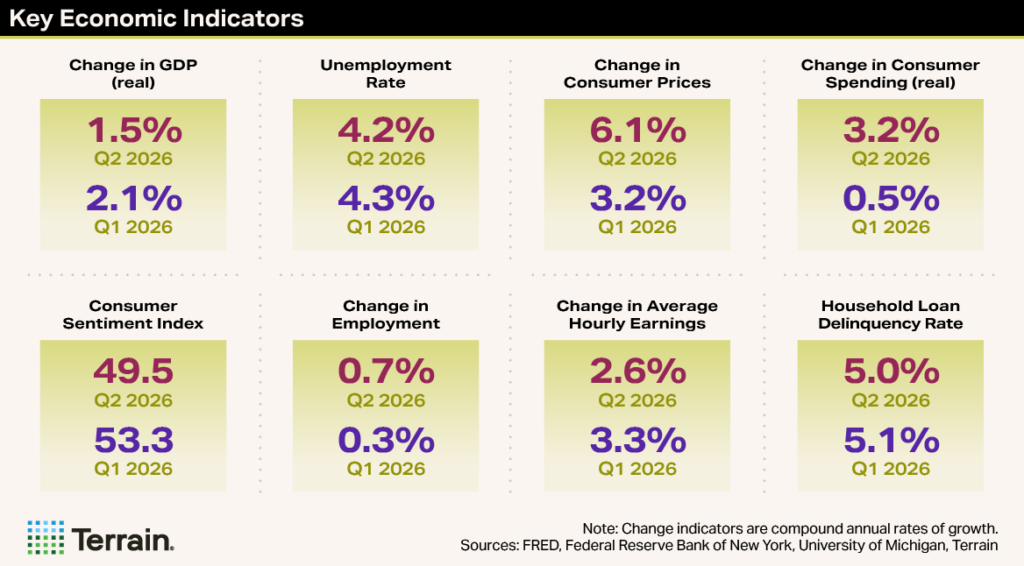
However, more recent data indicate that employment fell in July, though I’m not reading too much into this because the monthly figures can be volatile and are subject to revision. In addition, unemployment ticked down another notch in July to 4.1%, a very respectable reading by historical standards.
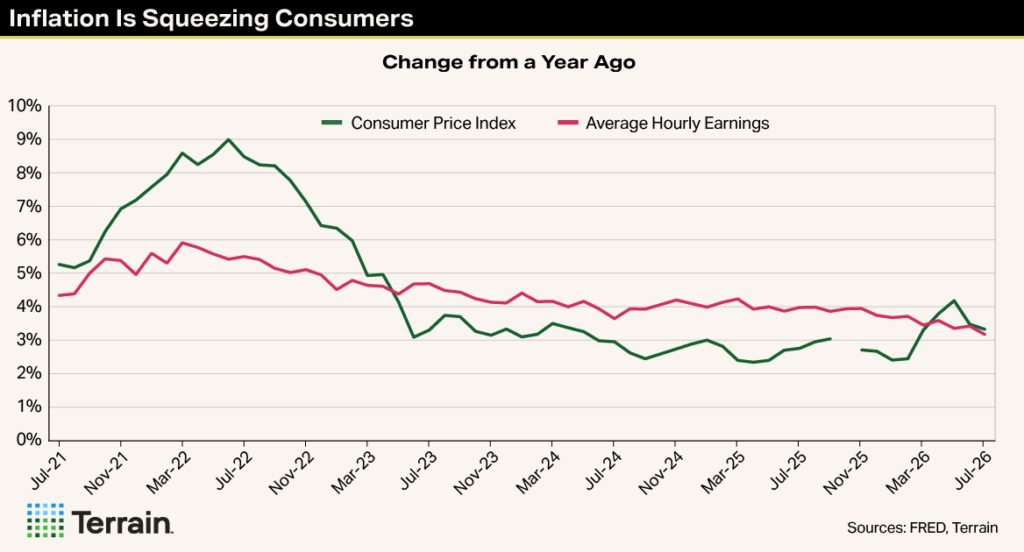
The combination of higher prices and softening wage growth is beginning to squeeze consumer budgets.
On the negative side of the equation, inflation remains stubbornly high. The Consumer Price Index (CPI) surged in the second quarter, mainly due to rising energy costs. The CPI has moderated a touch over the last couple of months on a YOY basis. Even so, the 3.3% YOY figure for July is still well above the Federal Reserve’s 2% target.
The combination of higher prices and softening wage growth is beginning to squeeze consumer budgets. Inflation-adjusted earnings — which have risen steadily over the last several years — have declined in recent months.
Given this, it’s not surprising that consumers continue to feel dour. Consumer sentiment softened in the second quarter, and while the most recent reading is a bit higher, it’s still hovering near an all-time low.
Despite the wage squeeze and lack of consumer confidence, consumer spending remains solid. Personal consumption expenditures grew 3.2% annualized in the second quarter, a substantial improvement from the first quarter. However, necessities like gas and groceries sucked up most of the additional spending and consumers are saving less (or borrowing) to augment their spending power. The personal savings rate fell to 2.7% in June, its lowest level in four years.
Near-Term Economic Outlook Remains Muted, but 2027 Could Be Better
The Terrain team isn’t expecting a great deal of change in the economic picture during the second half of 2026.
The AI investment boom and associated productivity advances should continue to propel modest economic growth and support a healthy labor market, though some softening is possible. The relatively benign July CPI reading and soft job report have also taken some pressure off of the Fed to raise interest rates this fall.
We are optimistic that the economic backdrop will brighten a bit in 2027.
On the other hand, with no clear end in sight to the Iran war and its disruptions to the oil and energy markets, inflation is likely to remain elevated through at least the end of the year and will continue to squeeze budgets and depress sentiment. But household balance sheets are in reasonably good shape, particularly for affluent households, whose wealth has been boosted by a surging stock market. Thus, we’re only expecting modest softening in consumer spending. That said, consumers are apt to remain cautious with their discretionary spending.
We are optimistic that the economic backdrop will brighten a bit in 2027. Underlying price pressures appear to be muted, so inflation should begin to gradually abate once the Strait of Hormuz is reopened and energy supply chains normalize. This in turn would pave the way for some relief on interest rates, which would stimulate the housing market, consumer spending and business investment.
Consequently, consumers should become more optimistic and more willing to open their wallets for discretionary purchases.
Modest improvement in the wine sales picture is possible in 2027 if inflation abates as we expect.
I’m Not Expecting Much Near-Term Change in the Wine Market
Given the subdued near-term economic outlook, I’m not expecting to see much change in the trajectory of wine sales in the second half of 2026.
Three-tier wine sales are likely to continue to decline at a modest pace, with the premium and luxury segments continuing to hold up better than the lower end. DtC sales, too, should hold up relatively well, though I’m not expecting any improvement. A stock market bust, which isn’t out of the question, could alter this picture, as it would hit the high end of the market harder than the low end.
Modest improvement in the wine sales picture is possible in 2027 if inflation abates as we expect.
The recent collapse in trade negotiations with Canada and ensuing escalation in tariffs doesn’t bode well for wine exports. Provincial bans against American alcohol are likely to remain in place for some time.
The 2026 California grape crop is shaping up to be both the earliest and lightest in decades.
Grape Market Update:
The 2026 California grape crop is shaping up to be both the earliest and lightest in decades.
A spring heat wave accelerated vineyard development and led to widespread shatter that lightened crop loads. In consequence, harvest is running two to five weeks ahead of schedule depending on the region and yields look to be light by as much as 50% in some areas. While there is considerable variability by region and varietal, yields generally look lighter on the coast than in the interior.
Lower yields, coupled with vineyard removals and mothballing, will result in what could well be the smallest grape crop of the 21st century. Nonetheless, it still looks like there will be at least enough fruit to satisfy demand.
Indeed, the smaller crop hasn’t stimulated a great deal of additional activity thus far, and a large quantity of uncontracted fruit is still available for sale. Activity has picked up a bit, just not as much as would normally be expected with a crop this light. That said, many of the choicest vineyards have already been cherry-picked. For this reason, and because the compressed harvest will narrow windows of opportunity, wineries who need grapes should act sooner rather than later.
Among the white varieties, Sauvignon Blanc is receiving more attention than Chardonnay, as yields look much lighter. Activity has also picked up on Pinot Gris. Among the reds, Cabernet Sauvignon continues to receive more activity than Pinot Noir. Red varieties, including Zinfandel, are receiving a little more interest in the interior than they have in recent years.
The lack of a stronger uptick in demand isn’t too surprising given the large overhang of available bulk wine, surplus winery inventories, and persistent decline in California wine sales.
Bulk wine availability remains stubbornly high, as bulk sales activity has been sluggish in 2026 as well. However, as Ciatti and Turrentine have emphasized, much of it is concentrated in older vintages.
The silver lining in a small harvest, which would be the third in a row, is that it should put a sizable dent in the wine inventory overhang.
While it’s too early to predict how large the 2026 crush will be, I’d say the odds are better than even that it will be smaller than last year’s, which was the lightest in 25 years. And it is a near certainty that less unsold fruit will be left hanging on the vine this year than last.
The silver lining in a small harvest, which would be the third in a row, is that it should put a sizable dent in the wine inventory overhang. This will set the stage for stronger grape demand next year. Ongoing vineyard removals are also reducing productive capacity, so the grape market should be closer to balance next year.


Terrain content is an exclusive offering of AgCountry Farm Credit Services, American AgCredit,
Capital Farm Credit, Farm Credit Services of America and Frontier Farm Credit.