Outlook • September 7, 2026
Sizing Up the Competition
Winescape Fall 2026 | Trending Topic


Report Snapshot
Situation
Imports now account for about 35% of all wine consumed in the U.S., near an all-time high and up meaningfully from 2020. The rise has gained more attention as overall U.S. wine sales have slowed.
Finding
Import substitution represents an enticing opportunity to stimulate domestic wine and grape sales in today’s challenging environment. But efforts to improve competitiveness must be thoughtful and not create unintended consequences for wineries that rely on imports.
Outlook
Regaining market share will be difficult in the entry-level segment, where imports have a clear cost advantage. The better opportunity likely lies in the popular-premium and premium segments, where U.S. producers can compete more effectively on quality.
Imports have captured a growing share of the U.S. market over time while exports have steadily declined.
The Import Challenge
The U.S. has a notable trade deficit in wine. Imports have captured a growing share of the U.S. market over time while exports have steadily declined.
The equivalent of 115 million cases of wine, valued at nearly $6.2 billion, was imported in 2025. Conversely, U.S. wineries exported fewer than 22 million cases, valued at just $800 million, last year. Imports now constitute about 35% of all wine consumed in the U.S., up from 29% in 2020 and 21% in 2000.
While imports have been gaining market share for decades, the import competition issue has taken on more urgency since U.S. wine sales began to slump in 2022. Bulk imports, in particular, have become a hot-button topic in the wine industry in recent years.
The rise in import market share has come at the expense of U.S. wine and grape producers to some extent, though it’s more complicated than a simple one-to-one replacement. Moreover, some U.S. wineries directly benefit from imported bulk wine. Nonetheless, regaining lost market share represents an opportunity to boost domestic wine and grape sales at a time when a boost is sorely needed.
My objectives are to:
- Provide context on import competition to better frame the debate
- Discuss how the U.S. wine industry could improve its position and potentially regain market share
The drivers of rising import penetration are varied, but a loss of cost competitiveness is at the heart of the matter.
While cheap bulk imports from the Southern Hemisphere are receiving most of the attention today, the challenge is broader, with packaged wines from Europe responsible for the recent gains in market share. On the other hand, imports tend to be concentrated in a few key categories, including crisp whites and sparkling wines. The competition isn’t just an issue in the value segment of the market; imports also achieve high penetration in the premium segment.
The drivers of rising import penetration are varied, but a loss of cost competitiveness is at the heart of the matter. Rapidly rising domestic production costs are largely to blame, though foreign subsidies exacerbate the situation and U.S. regulations could be incentivizing imports.
I believe there is more potential to regain market share in the premium segment of the market.
Thus, anything that can be done to reduce domestic production costs or level the playing field with imports should help to stimulate domestic market share. However, efforts to address the latter must be thoughtful to prevent unintended consequences.
That said, the economics are daunting for entry-level wines, and it may not be feasible to take back market share here. The U.S. wine industry’s future lies in competing on quality — not cost — and I believe there is more potential to regain market share in the premium segment of the market.
Wine Imports in Perspective
To set the stage and frame the import competition issue, I’d like to highlight a few key observations regarding the trajectory of imports over time and the role they play in the U.S. wine market today.
Imports Have Gained Considerable Market Share in the U.S.
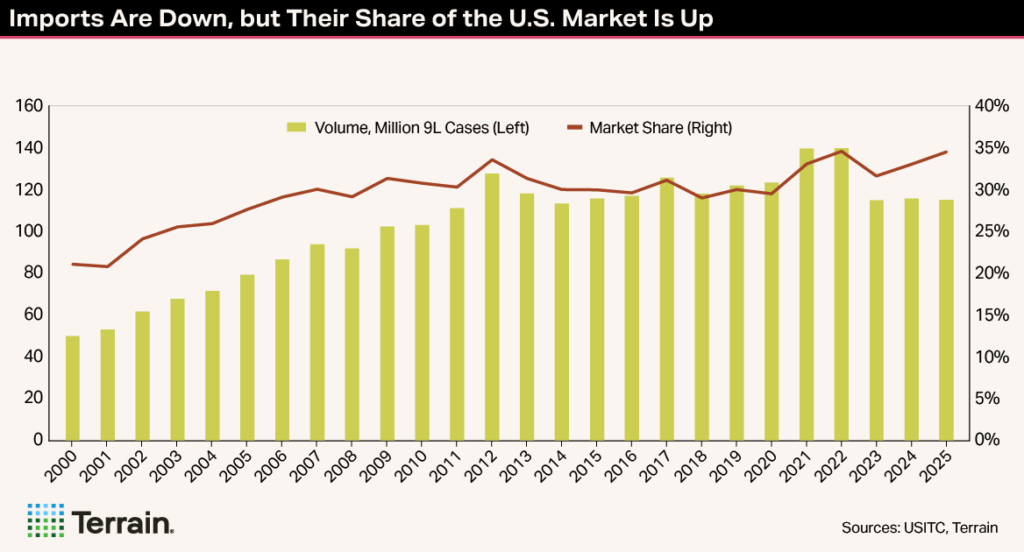
Imports have gained considerable traction in the U.S. wine market over the last quarter-century. While the volume has declined in recent years, the market share stands near an all-time high.
Most of the gains in market share came early on. Foreign wines constituted just 21% of all wine consumed in the U.S. in 2000 by volume. But imports boomed during the first dozen years of the 21st century, growing from 50 million cases in 2000 to 128 million in 2012, and their market share surged to 34%.
Import penetration fell back to 30% in 2014 and remained within a narrow range through 2020. A surge during the pandemic in 2021 and 2022 drove imports up to a record 140 million cases, and their market share in the U.S. reached nearly 35%.
Import volumes have fallen substantially since then, averaging 115 million cases over the past three years. However, imports have gained share over the past two years as the U.S. wine market has continued to shrink. At 34.5%, imports’ market share is 5 percentage points higher than in 2020 and stands just a touch below the high-water mark set in 2022.
The Import Challenge Is Broader Than Bulk
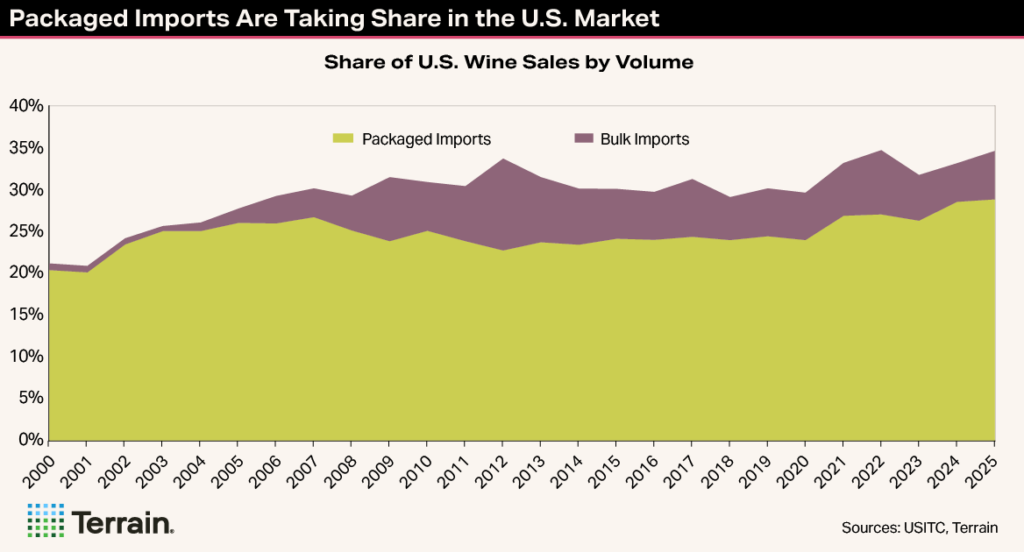
While bulk wine imports are in the spotlight today, they’ve contracted in recent years and compose a relatively modest share of total imports. Packaged wines capture a much larger share of the U.S. wine market and account for all the increase in market share since 2020.
Bulk imports were negligible at the turn of the 21st century, but advances in shipping technology propelled shipments to a record 41.5 million-case equivalents in 2012. Bulk imports moderated to an average of 24 million cases between 2016 and 2020, before surging to 31 million in 2022. They’ve since fallen to an average of 18 million cases over the last three years.
At their peak, bulk imports represented a third of total imports by volume. Over the last three years, they’ve made up less than a sixth. In 2025, they formed just 6% of all wine sold in the U.S. while packaged imports accounted for 29%.
This doesn’t mean that bulk imports are inconsequential. Just over 19 million cases were imported in 2025. This represents a grape equivalent of around 275,000 tons. Moreover, bulk imports tend to ebb and flow with the state of the U.S. bulk and grape markets. Lower volumes in recent years are due largely to an oversupply of domestic bulk wine and grapes, and bulk imports are likely to increase once excess supply is absorbed.
European wines have steadily gained market share since 2009 and now constitute 22% of U.S. wine consumption by volume.
Italy and France Are Our Top Competitors
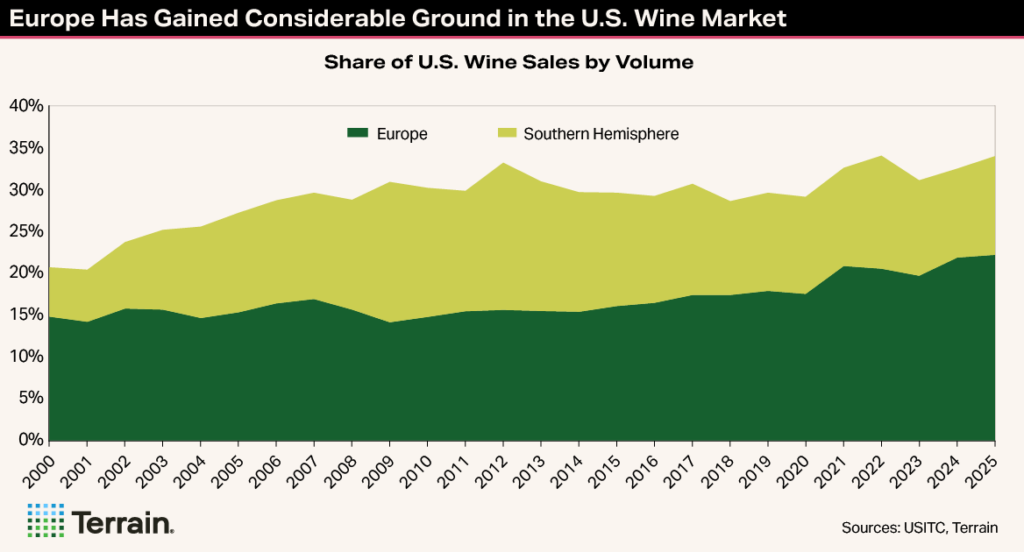
Most imported wine comes from Europe, primarily as packaged wine, and European wines have gained substantial ground in the U.S. market over the last 15 years.
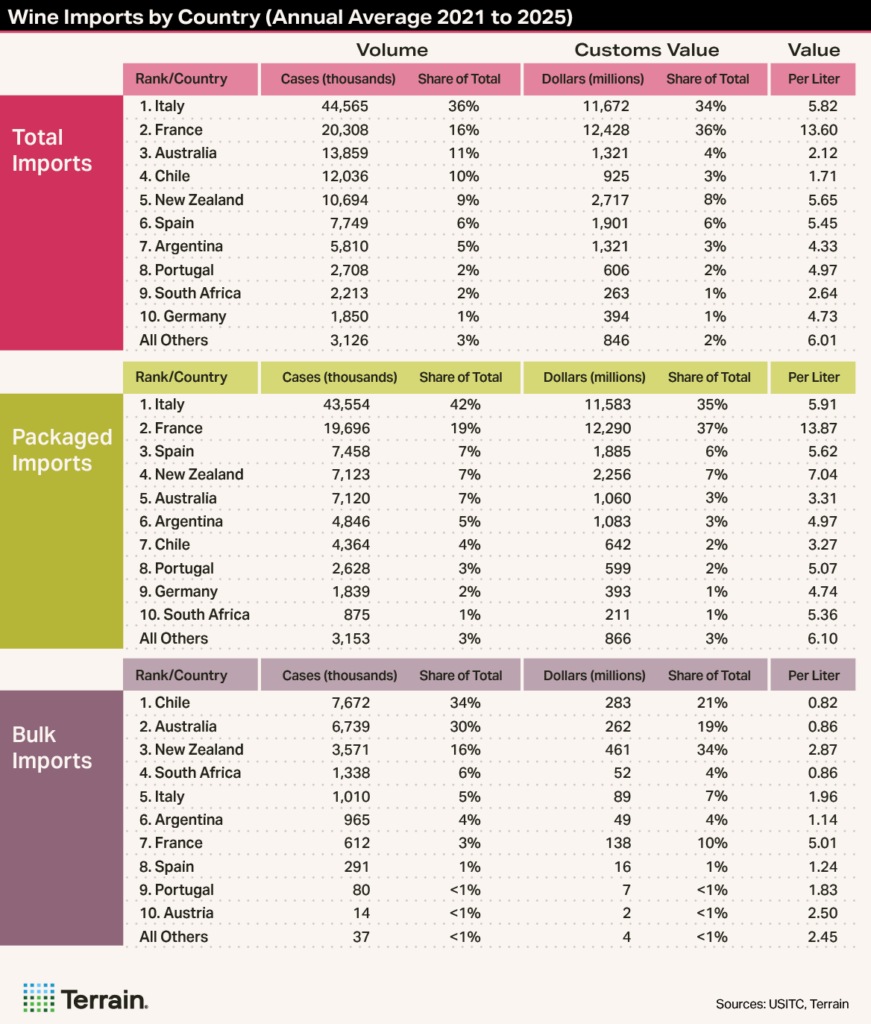
Over the past five years, European wines composed about 80% of total import value and nearly 65% of volume. France and Italy alone accounted for more than 70% of value and 50% of volume. European wines have steadily gained market share since 2009 and now constitute 22% of U.S. wine consumption by volume.
European imports arrive primarily in packaged form, tend to be of higher value, and are destined primarily for the popular-premium and higher price tiers of the market. The five-year average customs value (price paid for the product alone) of imported French wine was $13.60 per liter, and Italian wines came in at $5.82.
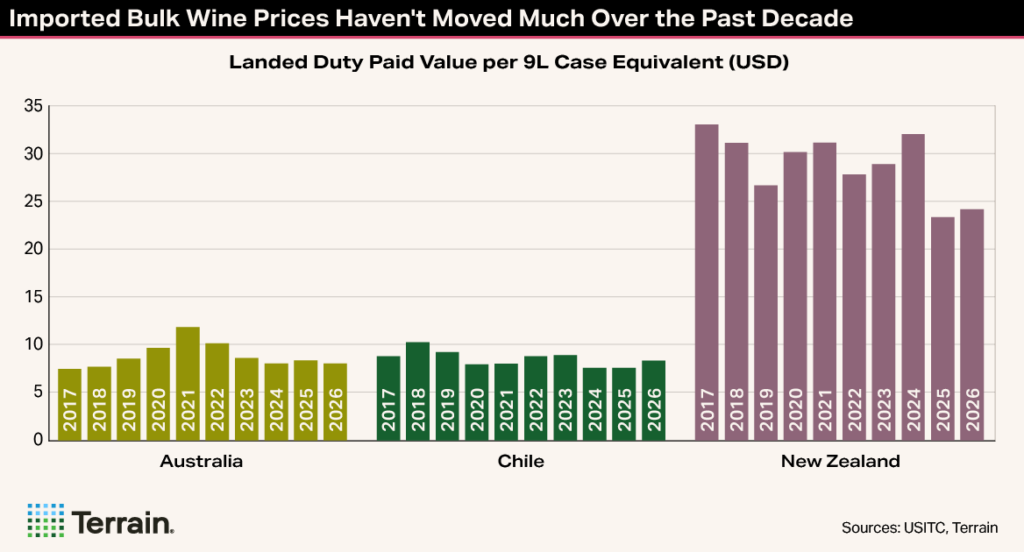
Bulk wines are sourced almost exclusively from nations in the Southern Hemisphere, which account for more than 90% of the total imported bulk by volume. Chile, Australia and New Zealand are the three most important originating nations. They’ve accounted for more than 80% of all bulk wine imported into the U.S. over the past five years.
Australian and Chilean bulk is cheap, with an average value of around 85 cents per liter, and destined primarily for entry-level bottles in the U.S. New Zealand bulk is more expensive, averaging close to $3 per liter over the past five years.
Imported Wines Excel in a Few Key Categories
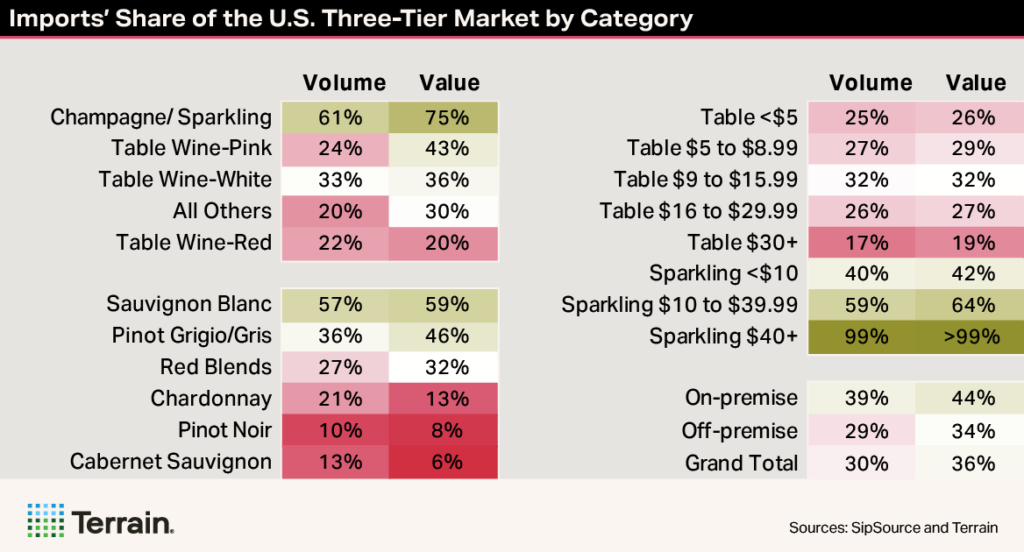
SipSource depletions data provide a window into where imported wines achieve the greatest penetration in the three-tier market. Overall, wines with a foreign appellation on the label represented 30% of depletions by volume and 36% by value in 2025. They captured a larger share of the on-premise market, at 39% of volume and 44% of value, versus the off-premise channel, at 29% of volume and 34% of value.
Imports excel in two key categories: crisp whites and sparkling wines.
Note that these figures don’t account for imported bulk wine that is blended with American wine and sold with an American appellation on the label, which permits up to 25% foreign content. So, they understate imports’ true market penetration.
Imports excel in two key categories: crisp whites and sparkling wines. Indeed, sparkling wine, Sauvignon Blanc and Pinot Grigio alone accounted for nearly half of all imported wine depletions by volume and 57% by value in 2025.
Led by Italian Prosecco and French Champagne, imports command a 75% share of U.S. sparkling wine sales by value and more than 60% by volume. They constitute nearly 60% of Sauvignon Blanc sales, due largely to the success of New Zealand in this category. The concentration has favored imports in recent years as consumer preferences have shifted toward these categories.
Conversely, imports capture a lower share of the red wine market. They make up approximately 10% of Cabernet Sauvignon, Pinot Noir and Merlot depletions.
Import Competition Isn’t Just Intense in the Value Segment
While bulk imports destined for the value tier of the U.S. market have garnered most of the attention, imports also achieve a high level of penetration in the premium and popular-premium segments of the market.
SipSource data indicate that wines with a foreign appellation captured 26% of sales in the under-$9 table wine price tier in 2025. However, given that a good portion of imported bulk wine is blended into wines sold under the American appellation, imports’ true market share in the value segment is substantially higher.
However, imports also capture a sizable share of sales in the middle market. They took 32% of table wine sales by volume in the $9 to $15.99 price tier and 26% in the $16 to $29.99 tier.
Domestic producers of super-premium and luxury table wines are relatively sheltered from imports, which captured just 17% of sales in the $30-and-over segment in the three-tier channel. Moreover, a substantial portion of domestic wine in this price range is sold through the direct-to-consumer channel and isn’t directly exposed to import competition.
On the other hand, imports command a larger share of premium and luxury sparkling wine sales than they do at the entry level. They account for the lion's share of sparkling wine depletions in the $10 to $39.99 price segment and virtually all sparkling wine sales priced at $40 and above.
The Import Substitution Opportunity
Regaining market share from imports represents an opportunity for the U.S. wine industry in a time of slumping wine sales. Indeed, imports command a higher share of the U.S. market than they do in other affluent wine-producing nations, including France where imports capture just 24%, Australia (17%) and Italy (11%), according to data from the International Organisation of Vine and Wine.
There is potentially a lot to gain.
Assuming constant total U.S. wine sales, a 5-percentage point higher domestic market share (where it stood in 2020) would have resulted in an additional 16.6 million cases of domestic wine sales in 2025. This in turn would have required an additional 250,000 tons of domestic grapes. A 10-percentage point gain (to approximately France’s domestic market share) doubles these figures to 32.3 million cases and 500,000 tons of grapes.
If imported wines disappeared from store shelves, overall wine sales would surely decline.
However, the reality is more complicated. Wine is a highly differentiated product, and American wines aren’t perfect substitutes for foreign wines, particularly in the premium and luxury segments of the market. And while the U.S. has a diverse range of terroirs that enable it to produce a wide range of grape varieties and wine styles, geographic diversity is part of the appeal to many wine consumers. Thus, if imported wines disappeared from store shelves, overall wine sales would surely decline.
In addition, many large U.S. wineries directly benefit from the sale of imported wine, and imported bulk wine plays an important role in helping to smooth out fluctuations in domestic grape and bulk wine supply. Thus, any efforts to disincentivize bulk imports would impose costs on some segments of the industry. This complicates matters further.
Nonetheless, import substitution represents an enticing opportunity to stimulate domestic wine and grape sales in today’s challenging market environment.
The Economics Are Daunting
The increase in imported wine’s market share has multiple drivers. For example, technological improvements in bulk wine shipping drove the early advance. The slump in global wine consumption, which began in the late 2010s, also drew an influx of foreign competitors seeking opportunities for growth to the U.S., the world’s fastest-growing wine market at the time. More recently, consumer preferences have shifted toward categories where imports over-index.
But the heart of the matter boils down to economics. Domestic wines have lost cost competitiveness compared with imports over the past decade, particularly in the value segment of the market. Wine production costs have nearly doubled in California over the past decade, but the cost to import bulk wine from the three most important originating nations (Chile, Australia and New Zealand) is about the same today as it was in 2017.
I’ll illustrate the cost advantage of imported bulk wine using entry-level Chardonnay as an example. This represents a ballpark estimate based on conversations I’ve had with several market participants and is intended to be illustrative, not definitive.
The cost to import Australian bulk wine — including duties, insurance and freight — has hovered around 92 cents per liter in recent years. Assume that entry-level Chardonnay comes in at this price, which equates to $8.30 per case. I also assume it costs an additional 40 cents per case to bring the wine from the port into the importing winery’s tanks. The fully loaded cost to bring in imported bulk Chardonnay is $8.75 per case.
Next, I assume it costs $300 per ton for a California winery to process grapes into entry-level bulk wine, or $4.40 per case at a yield of 68 cases per ton. A producer making wine from California grapes could only afford to pay $4.35 per case ($8.75 - $4.40) for the grapes to match the economics of the Australian bulk. This equates to $295 per ton.
It isn’t feasible to produce grapes in the Central Valley of California at this price. Farming costs alone are in the range of $3,750 per acre, so it costs about $375 per ton to produce Chardonnay grapes, at a yield of 10 tons per acre. This figure doesn’t consider the costs of the land or replanting, or a return to the grower.
California wine simply can’t match the cost structure of imported bulk. Thus, the production of entry-level wine doesn’t pencil unless consumers are willing to pay a premium, which doesn’t appear to be the case today.
The duty drawback provision sweetens the deal for bulk importers, though it can be argued that it stimulates exports, which generate demand for California grapes, too. The provision refunds nearly all duties and excise taxes paid by wineries that can offset the imported wine with qualifying exports. Even so, as the illustration above demonstrates, the cost advantage is compelling even before duty drawback comes into play.
The economics of domestic wine production become more favorable at higher price points, as most imported wines in these segments come from higher-cost countries.
What Can Be Done to Improve Cost Competitiveness?
Stagnant imported bulk wine prices are partly attributable to cyclical factors, including a systemic oversupply of bulk wine and grapes. Prices will eventually rise as supply-side adjustments bring these markets back into balance. The U.S. dollar has also been relatively strong over the past decade, and a weaker dollar would help to narrow the cost differential.
But the loss in cost competitiveness is also due to factors that are more structural in nature. These include skyrocketing domestic production costs, particularly in California, subsidies that many competing nations provide to their wine industries, and U.S. regulations that may be incentivizing imports.
Efforts to improve domestic production’s cost competitiveness should focus on three key areas:
- Reducing domestic production costs
- Addressing unfair foreign trade practices
- Thoughtfully evaluating U.S. federal laws that may be incentivizing imports
The growing regulatory burden is perhaps the most important contributor to rising production costs in California.
Reducing Domestic Production Costs
The cost differential for entry-level wines is largely attributable to higher production costs in the U.S. compared with those in competing nations like Chile, where labor and regulatory costs are lower. The cost differential has widened over time as domestic wine and grape production costs have skyrocketed, particularly in California.
Thus, anything that can be done to reduce domestic production costs will help. The growing regulatory burden is perhaps the most important contributor to rising production costs in California. So, reevaluating and streamlining onerous regulations is an obvious first step.
The application of technology to enhance operational efficiency is also part of the solution. This is an area where the U.S. has an advantage over most foreign competitors.
Addressing Unfair Foreign Trade Practices
Many competing foreign nations, particularly those in Europe, directly subsidize their wine industries. This includes crisis distillation programs, marketing support, vineyard removal subsidies and vineyard planting subsidies (yes, they subsidize both removals and replanting). Lodi Wine Growers suggests these subsidies amount to more than $2 billion annually. Australia, too, provides considerable support to its domestic wine industry.
Tariffs represent a potential means of leveling the playing field. As an economist, I don’t support the use of tariffs unless there is a clear violation of international trade policy. Nonetheless, they can be an appropriate and effective tool to combat unfair trade practices, so long as they are implemented in a thoughtful and targeted manner.
Thoughtfully Evaluating U.S. Laws That May Be Incentivizing Imports
The duty drawback provision has received a great deal of attention from the grower community in recent years. I don’t believe it’s the main problem, as the economics of imported bulk are compelling even before the provision comes into play.
It makes sense to reevaluate the provision, however, to ensure it’s being administered in a manner in line with its intended objectives. Any changes would need to be carefully considered to minimize unintended consequences. For example, restrictions to duty drawback could potentially harm some domestic producers and disincentivize wine exports, which also create demand for domestic grapes.
Similarly, reevaluating federal appellation-labeling regulations that permit up to 25% foreign wine content in bottles labeled with the “American” appellation is worth pursuing. This, too, needs to be done with careful consideration to mitigate harm to producers who use the label and ensure it doesn’t result in lower domestic grape content in entry-level wines, as would be the case if it compels producers to switch brands entirely to foreign appellations.
I don’t see a scenario where the cost gap can be eliminated entirely for entry-level wines.
Cost Cutting Can Improve Competitiveness, but Quality Is Key
While these measures could help to improve cost competitiveness, I don’t see a scenario where the cost gap can be eliminated entirely for entry-level wines. It simply costs less to produce wine in nations like Chile or South Africa, where labor and regulatory costs are far lower. The U.S. will never be the low-cost supplier. Thus, I don’t see a great deal of potential to regain lost market share in the entry-level market segment.
I don’t mean to imply that we should or will cede this segment to imports entirely, because there are still advantages to producing in the U.S. even if costs are higher. For example, domestic production affords greater control over the product and reduces risk of supply shortfalls stemming from supply chain disruptions and trade disputes.
Wineries should focus on creating more compelling brands in key categories.
But I do believe that our best bet to regain market share lies in the popular-premium and premium segments. The U.S. is better positioned to compete on quality and imports in these segments, which generally come from nations where production cost structures are higher.
Realizing this opportunity will require more than just enhancing cost competitiveness. Improving grape quality will be just as important as cutting costs for growers to position their grapes for use in higher-quality bottles and justify higher grape prices.
The California wine industry also needs to focus on enhancing its brand and convincing consumers that California wine is deserving of a premium. Wineries should focus on creating more compelling brands in key categories such as crisp white table wines and sparkling wines, where imports dominate the market.



Terrain content is an exclusive offering of AgCountry Farm Credit Services, American AgCredit,
Capital Farm Credit, Farm Credit Services of America and Frontier Farm Credit.