Quarterly Outlook • October 8, 2026
Margin Math Demands Closer Attention

Report Snapshot
Situation
The ability of supply chains to deal with robust U.S. milk production is crucial in determining the path ahead for prices.
Finding
Exports have recently been, and will continue to be, a major part of the answer.
Outlook
Strength in protein demand from consumers should continue to provide support to whey and nonfat dry milk prices, but the overarching theme of plentiful supply will likely continue to weigh on milk prices through the end of 2026 and into 2027.
Milk production in the U.S. continues its march higher, and the wild shifts in consumer priorities for high-protein products have sparked the volatility in markets that I anticipated in previous quarterlies. As we round the final turn in 2026 and look ahead to 2027, a few key factors are developing that I expect will shape dairy markets:
- Milk supply growth will weigh on prices
- Exports will be increasingly necessary and drive domestic prices
- Minor pressure from multiple angles will pressure producer margins
Milk Supply Growth
Robust milk production growth is becoming a recurring theme in the industry, and the ability of supply chains to deal with the additional milk is crucial in determining the path ahead for prices.
Investment in new cheese manufacturing capacity has enabled much of this expansion in milk supply. In most regions, the concern is less about whether the processing sector can handle additional milk, and more about what to do with the additional cheese and butter the plants are making. Exports have recently been, and will continue to be, a major part of the answer.
Fortunately, there is growing demand for products like cheese and butter in global markets.
Export Opportunity
Fortunately, there is growing demand for products like cheese and butter in global markets. In a previous report, Milking the Middle Years, I found that aging populations combined with rising incomes in export destinations like Southeast Asia would likely shift demand toward higher-value finished products like cheese and butter. This shift should be ongoing and will continue to provide more opportunities for export growth. The U.S. has, so far, been capitalizing on this opportunity and growing its total share of exports of both cheese and butter.
Among major exporters of cheese, total export volumes of cheese are projected by the USDA Foreign Agricultural Service to hit 6.7 billion pounds in 2026, an increase of over 15% from two years earlier. Meanwhile, the EU share of that cheese export volume is projected to shrink from 53% to 48% over that period while the U.S. share increases from 19% to 25%.
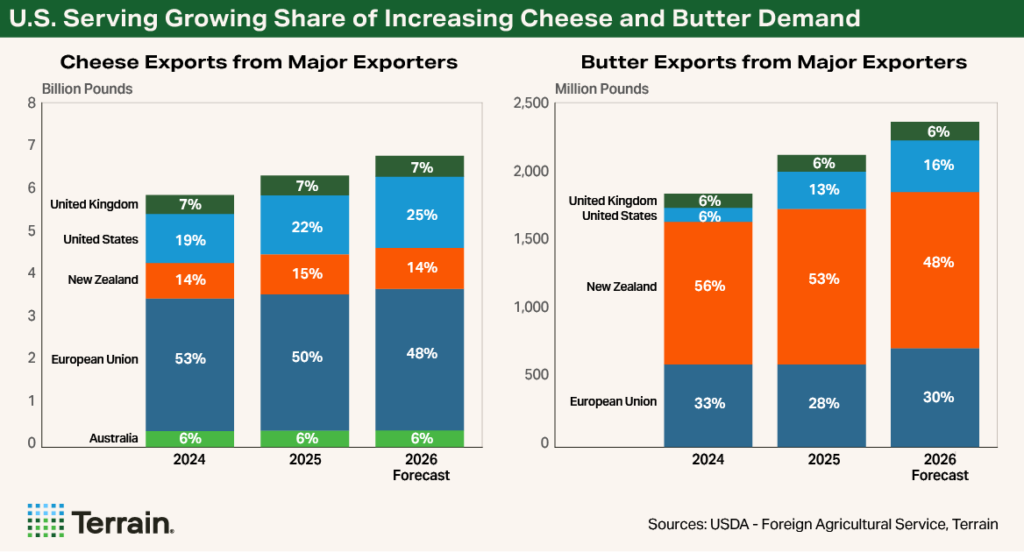
Similar trends in global demand and export share are playing out in butter markets.
As we become more reliant on the ability to export cheese and butter, U.S. prices are increasingly driven by price competition in global markets. And global prices have been depressed amid plentiful supply.
The overarching theme of plentiful supply will likely continue to weigh on milk prices through the end of 2026 and into 2027.
There is potential for a lift in cheese and butter prices if global supplies are disrupted at all. But for the near term, the U.S. is making plenty of cheese and butter and relies on remaining price-competitive with the EU and New Zealand to continue to clear the market. Without an improvement in global prices, U.S. cheese and butter prices will be limited to the upside.
Strength in protein demand from consumers should continue to provide support to whey and nonfat dry milk prices, but the overarching theme of plentiful supply will likely continue to weigh on milk prices through the end of 2026 and into 2027.
Multifaceted Margin Pressure
Lower milk prices aren’t the only headwind producers will have to contend with. Several other factors are moving unfavorably, including lower beef-cross calf prices, higher feed costs, higher fuel prices, and higher interest rates.
We’re getting closer to the point where it becomes important to revisit the math.
None of these factors are devastating individually, but combined they will demand greater attention from producers in 2027 than when feed costs were low, milk prices were high, and beef revenues were unprecedented. This mild but multifaceted margin pressure will require more active risk management and a closer assessment of culling and beef breeding strategies.
Beef calf prices remain elevated relative to their historical norms, but producers will be well served to individually assess the value of breeding for beef calves, culling decisions, and the associated feed and interest expense that comes along with a given strategy.
I don’t believe that we are near the point of any widespread shift away from the beef-on-dairy phenomenon, but we’re getting closer to the point where it becomes important to revisit the math.



Terrain content is an exclusive offering of AgCountry Farm Credit Services, American AgCredit,
Capital Farm Credit, Farm Credit Services of America and Frontier Farm Credit.