Quarterly Outlook • October 8, 2026
Wine Export Update: All Eyes on Canada


Report Snapshot
Situation
Exports of U.S. wine fell 22% in volume and 37% in value in the 12-month period ending January 2026 — a $460 million loss in revenue to U.S. producers. The slump was mainly attributable to a collapse in exports to Canada, the most important buyer of American wine.
Outlook
With no end in sight to U.S.-imposed tariffs, and trade tensions with Canada escalating, exports to Canada are likely to remain severely depressed for the foreseeable future. Prospects don’t look much brighter for our other major wine export markets either.
Impact
Wineries and grape growers shouldn’t count on a rebound in exports to boost sales or grape demand soon.
Trade Tensions Have Severely Damaged U.S. Wine Exports
Exports are an important sales channel to many U.S. wineries. They’ve declined gradually over the past decade due to structural factors, but trade tensions and other nations’ retaliatory measures have exacerbated the slump since the Trump administration instituted sweeping tariffs in February 2025. According to the U.S. International Trade Commission, wine exports fell 22% in volume and 37% in value in the 12-month period ending January 2026 — a $460 million loss in revenue to U.S. producers.
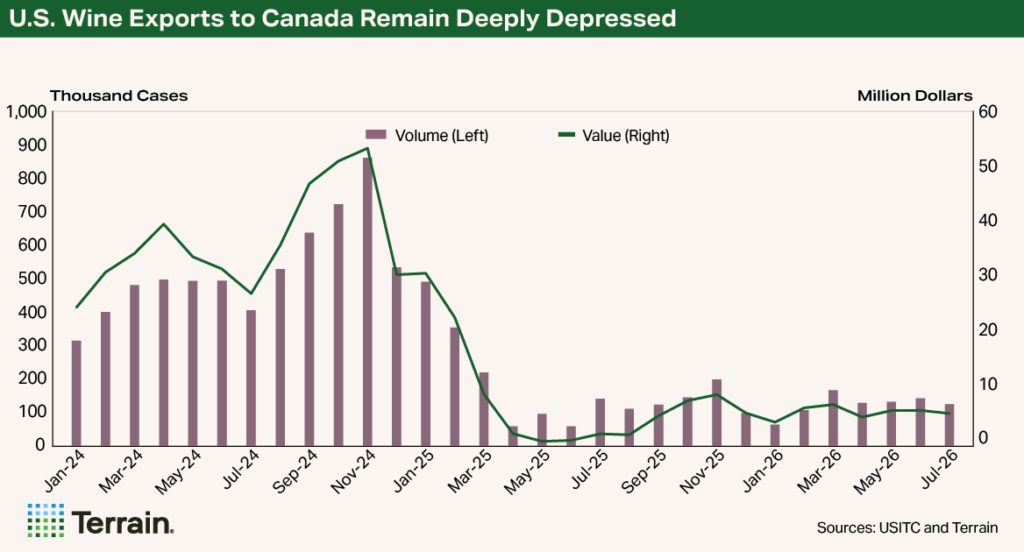
The slump was mainly attributable to a collapse in exports to Canada (down 84% in value and 75% in volume), the most important buyer of American wine. Canadian provinces banned American alcohol in February 2025 in response to U.S. tariffs and sovereignty threats. Wine exports to China, our third-largest market by value in 2024 and another key target of U.S. tariffs, also declined precipitously (down 73% in value and 58% in volume).
While exports are still shrinking, the rate of decline has moderated over the past six months.
Excluding Canada and China, wine exports held up reasonably well during the first year of the trade war. They were down just 2% year on year (YOY) in both value and volume in the 12 months ending in January, due partly to growth in Japan and South Korea. These countries were the fourth- and fifth-largest foreign markets for American wine by value prior to the trade war.
While exports are still shrinking, the rate of decline has moderated over the past six months. They fell just 10% in value and 12% in volume YOY in the six-month period ending in July 2026 and were down just 2% in value and 10% in volume YOY over the final three months of this period.
The improvement was mostly due to stabilization in Canadian exports, though they remain deeply depressed. In the six months ending in July, exports to Canada fell just 1% in value and 14% in volume YOY, though this comes against an extremely weak comparison in 2025.
Most of the improvement occurred in the final three months of the period as shipments to Canada surged by 377% in value and 36% in volume YOY in the three-month period ending in July. While this is positive news, it’s important to put it in perspective. Canadian exports were still down 80% in value and 71% in volume compared with the same three-month period in 2024.
Wine exports should eventually recover at least some of the lost ground once trade tensions ease.
While Canadian exports are stabilizing, albeit at a very low level, U.S. wine exports to the rest of the world have eroded further in 2026. In the six months ending in July, they dropped 11% in value and 12% in volume versus the same period in 2025. The deterioration is likely due to a combination of political backlash as well as economic pressures stemming from energy supply disruptions associated with the ongoing conflict in Iran.
Exports Are Likely to Remain Depressed in the Near Term
Unfortunately, I’m not expecting further improvement on the export front in the near term. Wine exports should eventually recover at least some of the lost ground once trade tensions ease. However, there is currently no end in sight to U.S.-imposed tariffs, and trade tensions with Canada escalated in September.
The U.S. is instituting new tariffs on a variety of Canadian products effective September 29, 2026. Canada has responded in kind with new tariffs on a variety of American products, though these don’t include wine.
Consequently, Canadian provincial bans on American alcohol aren’t likely to be lifted anytime soon. Full or partial bans remain in place in all provinces except for Alberta and Saskatchewan, which lifted them in June 2025. While Alberta and Saskatchewan have signaled that they won’t reinstitute bans against American alcohol, Saskatchewan imposed a 50% tariff on U.S. wine effective September 8. This won’t help, but it won’t hurt too much either, as the province accounts for only a tiny fraction of Canadian wine sales.
Thus, Canadian exports are likely to remain severely depressed for the foreseeable future. Prospects don’t look much brighter for our other major wine export markets either.
While the global economy has been reasonably resilient in the face of both tariffs and energy disruptions to this point, inflationary pressures are likely to persist for some time, and economic growth is likely to remain muted. Thus, global wine sales and demand for American wine is not likely to improve.
For these reasons, I expect exports to continue to decline at a moderate pace in the near term. Thus, wineries and grape growers shouldn’t count on a rebound in exports to boost sales or grape demand soon. I expect a modest rebound in U.S. wine exports once trade tensions subside, though the timing of this is impossible to predict.


Terrain content is an exclusive offering of AgCountry Farm Credit Services, American AgCredit,
Capital Farm Credit, Farm Credit Services of America and Frontier Farm Credit.