Quarterly Outlook • October 1, 2026
The California Olive Oil Revolution


Report Snapshot
Situation
Growing demand, California’s favorable climate, and innovations in production have helped California olive oil become a successful crop.
Finding
The biggest challenge for U.S. producers is competition from imports. Success in California’s industry will depend on its ability to continue differentiating itself through quality, freshness, traceability, and proximity to a growing customer base.
Outlook
Heat waves in Europe could put downward pressure on global olive oil production and, in turn, increase prices once again. For California producers, this could mean higher prices for most products.
Of the hundreds of crops grown in California, olives are particularly unique. Unlike many crops that are concentrated in a specific region, olives are cultivated across multiple production areas throughout the state and have one of the longest histories of any California crop. The industry traces its roots to Spanish missionaries who introduced olive trees in the late 1700s.
According to the USDA, olive oil represented about 80% of processed olive volume in 2022, with table olives representing 20%.
For much of the 20th century, California’s olive industry was dominated by table olives, which are used in pizzas, pastas and salads, among other uses. Advances in canning technology and higher returns made table olives the industry’s primary focus.
The recent growth of California olive oil reflects rising demand among U.S. consumers and attractive production characteristics.
In recent decades, however, this has reversed. While table olives still represented most processed volume as recently as 2013, olive oil has since taken the lead. According to the USDA, olive oil represented about 80% of processed olive volume in 2022, with table olives representing 20%. Today, California has an estimated 12,000 acres of table olives and 27,000 acres of oil olives, per UC Davis. The top counties by olive acreage are Glenn, Yolo and Tulare.
The recent growth of California olive oil reflects rising demand among U.S. consumers and attractive production characteristics.
On the demand side, olive oil consumption has expanded as consumers have embraced its health benefits, culinary versatility and flavor. The U.S. consumed 200,000 metric tons in 2000 and now consumes over twice that, according to the USDA. As of 2023, the U.S. now consumes more olive oil than Spain and some observers expect it to overtake Italy soon as the largest consumer of olive oil globally. Market participants also report growing interest in premium extra-virgin olive oils, although quantifying that trend remains difficult.
On the production side, olive oil fits well within California’s resource constraints. Olives have less pest pressure and require less water than many other crops. Whereas many crops in the Central Valley require around 3 to 4 acre-feet, olives require only an acre-foot and a half. The same goes for pesticide and fertilizer applications.
Another advancement has come from innovative production systems. While Europe still does hand harvesting, modern olive orchards for oil production in the U.S. are increasingly planted in high-density (250-300 trees/ac.) or super-high-density (650-900 trees/ac.) hedgerow systems that allow for relatively cheap mechanical harvesting. This production system is vastly different than the approximately 180 trees/ac. that was once standard.
To put this cost in perspective, olive oil harvest cost was only $7 more expensive per acre than almond harvest costs per acre in the most recent year where a UC Davis Cost Study was available for each crop.
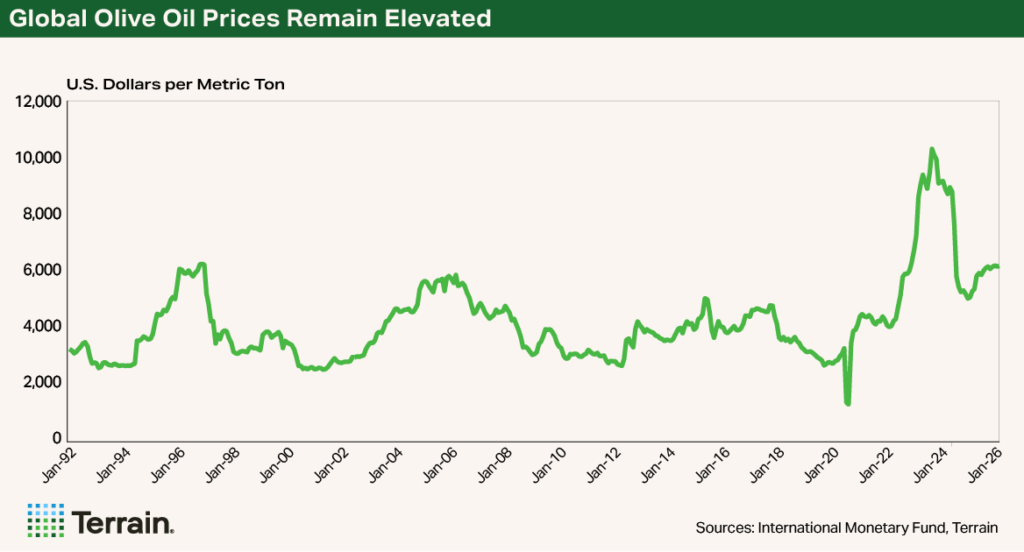
Price discovery in the California olive oil market can be challenging because prices vary considerably across grades, varieties and marketing channels.
While the global price of olive oil has come down since its peak when drought hit Europe’s production, it remains elevated.
Nevertheless, the olive oil market is a global one where international prices can serve as a benchmark. From mid-2022 to early 2024, the global price of olive oil experienced one of the most dramatic increases on record as severe drought conditions reduced production across Europe. While the global price of olive oil has come down since its peak when drought hit Europe’s production, it remains elevated.
Outlook
Looking ahead, the heat waves that Europe has experienced this spring and summer could put downward pressure on global olive oil production and, in turn, increase prices once again. For California producers, this could mean higher prices for most products.
The biggest challenge for U.S. producers is competition from imports. California’s olive oil industry is unlikely to entirely displace imports. The U.S. sources about 95%-98% of its olive oil from overseas suppliers. Spain and Italy are the largest exporters to the U.S. market, while Tunisia and Greece have expanded their presence. California producers face large, established producing regions with scale, infrastructure, relationships and, often, government support.
Instead, success in the California industry will depend on its ability to continue differentiating itself through quality, freshness, traceability, and proximity to a growing customer base. So far, it seems to be working.



Terrain content is an exclusive offering of AgCountry Farm Credit Services, American AgCredit,
Capital Farm Credit, Farm Credit Services of America and Frontier Farm Credit.