Quarterly Outlook • October 1, 2026
Headlines, Drought and Doubt: A Bumpy Q4 for Cattle

Report Snapshot
Situation
Cattle markets are facing heightened volatility with beef plant changes, border reopenings, and federal action to promote beef imports.
Outlook
My price forecasts are substantially below previous expectations and close to year-ago levels. Without long futures commodity hedge fund support, retesting early-summer live and feeder cattle futures highs will be a long, slow process fraught with challenges and risk tied to every news headline.
After losing their footing this summer, cattle markets face a bumpy quarter ahead. Drought continues to impede heifer retention, and news developments are introducing more volatility in futures prices.
An Abnormally Dry Year
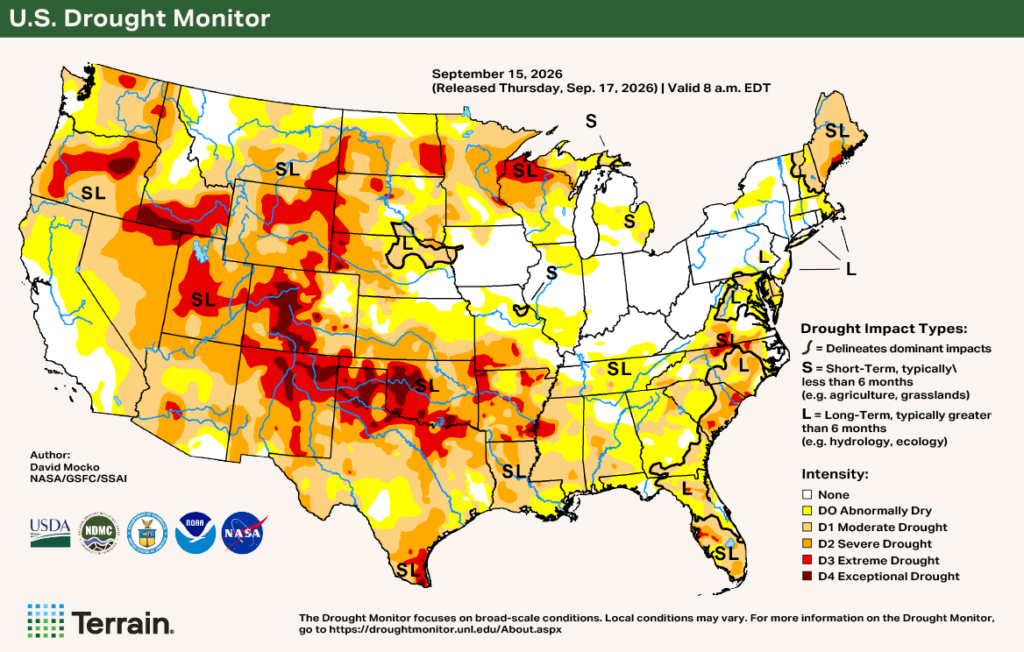
2026 has been a remarkably dry year for much of the Central Plains and West. By the end of summer, more than 80% of the U.S. cattle inventory was in an area with abnormally dry or worse drought conditions. Ongoing super El Niño conditions have yet to bring much relief. Hay prices in the Central and Northern Plains have increased by $150-$200/ton in the past 60 days or so, significantly adding to ranch-level carrying costs. Add to this the replay of political intervention in the beef market via imports, and cow-calf producers are even less incentivized to rebuild cow herd numbers.
Cow-calf producers are even less incentivized to rebuild cow herd numbers.
With beef plants announcing more changes lately, I expect cattle feeders to hold more of the bargaining power as Q4 begins.
Beef News Heats Up
Plant Changes
With beef plants announcing more changes lately, I expect cattle feeders to hold more of the bargaining power as Q4 begins. In mid-August, Tyson closed its plant in Joslin, Illinois; added back the second shift at its Amarillo, Texas, plant; and announced that it was seeking a buyer for the plant in Pasco, Washington. In mid-September, Cargill ratified a contract with its labor and restarted the Fort Morgan, Colorado, plant.
Terrain’s calculation of net fed slaughter capacity is now about 4,000 head per day larger than it was at its lowest point over the summer, but it’s still down 7,800 head per day versus this time last year. The addition of this slaughter capacity will spread existing fed cattle supplies across more plants and erode packers’ bargaining position.
Border Reopenings
The reopening of the Douglas, Arizona, border crossing to imports of feeder cattle and calves from the Mexican state of Sonora was more of a media event than a market mover. Solid imports of 2,450 head during the first week of the open border dwindled to just 104 head during the second week due to equipment issues before jumping to 3,922 head during the third open week. The renewed trade arrangement is expected to allow imports of about 4,000 head per week into Arizona (near the 2024 weekly average before Mexico’s New World screwworm infestation).
The September 24 opening of the Santa Teresa, New Mexico, Livestock Port of Entry is expected to allow 3,750 head per week to move into the U.S. and work toward 7,500-8,000 head per week. Santa Teresa has historically handled about 43% of Mexican cattle imports on an annual basis.
Beef Imports
President Trump’s August executive order to eliminate tariffs on over-quota beef imports for 90 days, which largely benefits Brazil, will add to U.S. ground beef supplies. The order suspends 26.4% duties on 300,000 metric tons of beef trimmings and grinding raw material (100,000 metric tons per month, spread over three months).
The impact on beef availability and consumer prices will be considerably less than the headlines suggest.
Not all the beef imported under the plan will be “new” volume, as there will likely be a shortage of available beef and the flow of product and shipping containers will bump up against logistical constraints. Industry participants expect the flow of product to total about 150,000 metric tons, or one-half of the allowed volume. Approximately 100,000 metric tons of that volume was already destined for the U.S.
The impact on beef availability and consumer prices will be considerably less than the headlines suggest. I expect this will lead to a 2% to 3% increase in domestic availability of ground beef; this is about 0.1 to 0.15 pound per capita per month. This is roughly one McDonald’s Hamburger per person per month (versus two Quarter Pounders that the maximum volume would have added).
That kind of shift in supplies suggests a $15-$20/cwt decline in the boxed beef cutout price and a $9-$12/cwt drop in fed cattle prices for late Q3 and Q4 relative to a year ago.
Price Update and Forecasts
The U.S. administration’s actions to reduce tariffs on lean beef trimmings and promote imports, along with changes to slaughter plant capacity, sowed doubt among futures market participants.
Without long futures commodity hedge fund support, retesting early-summer live and feeder cattle futures highs will be a long, slow process.
The collapse of live and feeder cattle futures contracts expiring in late Q3 and Q4 began during the third week of June. Crude oil futures had begun to rally as U.S.-Iran tensions flared again, and speculators turned their long trade bets (and risk capital) from cattle to a more volatile and lucrative market.
Without long futures commodity hedge fund support, retesting early-summer live and feeder cattle futures highs will be a long, slow process fraught with challenges and risk tied to every news headline. Cash cattle prices can likely return to near year-ago levels.
Recent boxed beef cutout price weakness has been driven by softness in pricing for chuck and round cuts, presumably due to less grinding demand for these cuts in the face of growing supplies of imported 90% lean trim. Conversely, ribeyes and strip loins have been trading at record levels since early August, while tenderloins were near year-earlier levels.
After several volatile weeks in August, choice boxed beef cutout values appear to have found a footing in the $375-$380/cwt area. I expect Q3 2026 5-Area live cattle prices to have found their lows near $220/cwt and could rally into the $235-$240/cwt range by early October.
I expect 5-Area live steers to average $230-$235/cwt (about $30/cwt below the previous forecast) in Q3 2026 and close to the same for Q4. This will likely lead to $200-$250/head unhedged losses for cattle marketed during Q3 and slight losses to near break-even unhedged returns during Q4 2026.
Feeder cattle prices are expected to trade sideways for the balance of Q3 and into Q4, averaging $340-$350/cwt for Q3 and $350-$370/cwt for Q4 2026. I expect Oklahoma City 450-lb. steer calves to have a wide range from $540/cwt (early) to $420/cwt (late) for Q3 due to bearish price pressure from much lower feeder and fed cattle futures. I expect prices averaging $465-$480/cwt during Q3 and Q4 2026.
All these forecasts are substantially lower from our earlier expectations and close to year-ago levels.
Terrain content is an exclusive offering of AgCountry Farm Credit Services, American AgCredit,
Capital Farm Credit, Farm Credit Services of America and Frontier Farm Credit.