Quarterly Outlook • October 1, 2026
On the Side of Cautious Optimism for Almond Prices

Report Snapshot
Situation
The almond market is on much firmer footing than it was just a few years ago.
Outlook
Though there are still challenges facing the almond industry, market fundamentals support a cautiously optimistic outlook as we finish up 2026.
The industry is in a far stronger position today than it was just a few years ago.
The State of the Market
After years of low returns for almond farmers, prices have been moving in the right direction. While almond prices have not returned to levels that characterized the profitability of the 2010s, the industry is in a far stronger position today than it was just a few years ago. Gross grower returns that averaged $1.40/lb. in 2022 — the recent low point — are likely to be somewhere in the $2.50-$2.70/lb. range for the 2025 crop.
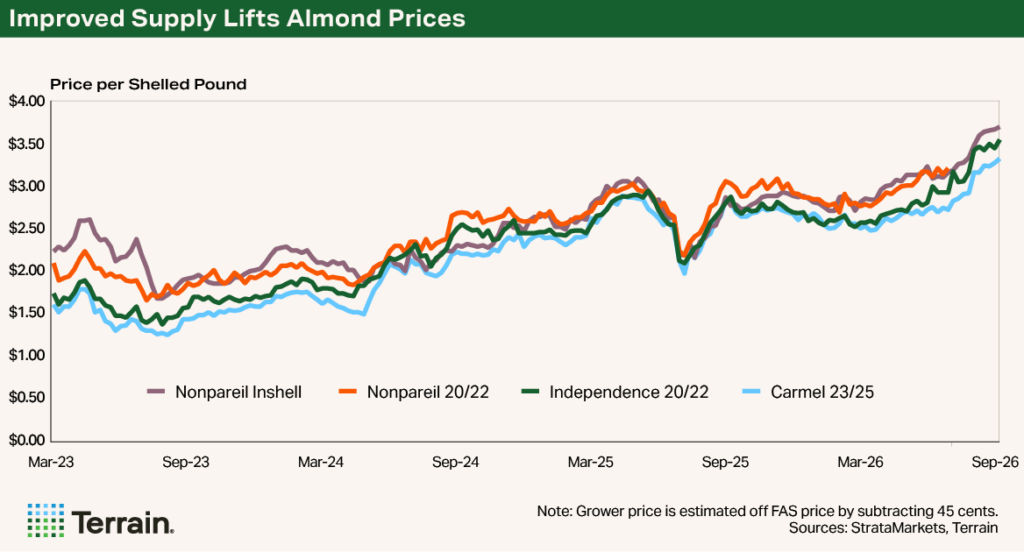
Much of this improvement can be traced to a dramatically different supply situation. The Almond Board of California’s official carry-in for the 2026/27 crop year stands at 471 million pounds, a manageable inventory level and a substantial improvement from the carry-ins exceeding 800 million pounds that weighed on the market not long ago.
The longer-term supply outlook is also evolving. For the first time since 1995, bearing acreage is in decline. How much acreage shrinks due to the Sustainable Groundwater Management Act (SGMA) remains uncertain. What is clear, however, is that California almond production is approaching a more defined ceiling than it’s ever faced before because acres are likely not going back up.
Demand has been relatively stable, with total shipments down just 1% year over year (YOY), per the Almond Board. Exports grew 3% YOY, though concerns persist in certain markets. Trade policy, exchange rates and global events always have the potential to disrupt the almond market given how reliant we are on exports.
Domestic shipments remain less than encouraging, with monthly shipment volumes close to levels last seen in 2013. There are a handful of possible explanations. One is that the current bout of inflation has pushed consumers away from a high-priced, discretionary item like almonds. At the same time, while almonds appear well-positioned to fit the preferences of GLP-1 users, demand could be facing pressure in specific channels like confectionary.
Outlook
Reasonable observers can look at the facts above and reach different conclusions. The almond pessimists focus on demand. They point to domestic shipments and uncertainty in export markets. Combining this with an unexpected bumper crop sometime in 2027 or 2028, they argue that we could see excess carry-ins and renewed downward pressure on prices.
There are two reasons to be optimistic about what holds for the rest of 2026.
The almond optimists focus on supply. They point to a lower-than-expected carry-in and declining bearing acreage. In their view, these factors should keep supplies tight and support current prices or even put upward pressure on them.
Both perspectives have validity. But given stable overall demand and the growth potential in new export destinations, I side with the optimists for the long term. Furthermore, there are two reasons to be optimistic about what holds for the rest of 2026.
First, the 2026 crop will be smaller than initially expected. Whereas most early estimates put the crop around 2.7 billion pounds, this continues to be revised downward with some estimates as low as 2.55 billion pounds. In addition to lower yields, high temperatures just after bloom have resulted in small kernel sizes for many growers. Together, these developments imply less available supply for the 2026/27 crop year, particularly for certain sizes.
Supply-demand fundamentals will be supportive of current prices or possibly some price gains in the final quarter of 2026.
Second, many buyers need to rebuild inventories. In recent years, price volatility and uncertainty encouraged a hand-to-mouth purchasing strategy. Though there has and will continue to be pushback as prices rise, buyers also will need to meet demand in their local markets. Purchasing activity tied to replenishing inventories could provide additional support to prices.
Taken together, these factors suggest that the supply-demand fundamentals will be supportive of current prices or possibly some price gains in the final quarter of 2026. Demand-side challenges should not be ignored for the long term, but at least in the near term, supply considerations will outweigh them. As a result, cautious optimism remains the most reasonable outlook for the almond market.
Terrain content is an exclusive offering of AgCountry Farm Credit Services, American AgCredit,
Capital Farm Credit, Farm Credit Services of America and Frontier Farm Credit.